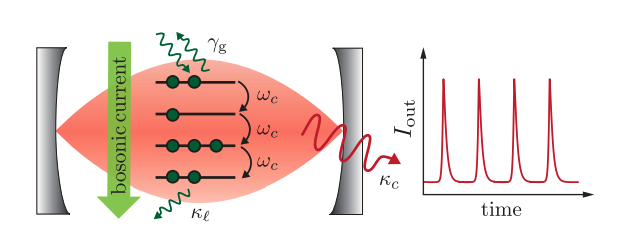
The behaviour of light and matter at the quantum level often defies intuition, and new research explores how to create systems that respond to even the faintest signals. Louis Garbe and Peter Rabl, both from Technical University of Munich, investigate a novel type of laser that relies on a current of quantum particles to amplify light, exhibiting characteristics remarkably similar to excitable biological systems. Their work demonstrates that this ‘bosonic avalanche laser’ can convert random noise into distinct, separated pulses of light, even when operating with very few photons. This surprising resilience to quantum fluctuations suggests potential applications in highly sensitive detectors and could pave the way for building autonomous machines that respond reliably to weak stimuli.
Scientists are investigating a lasing system powered by a current of particles, exploring a regime where the gain medium itself exhibits excitable behaviour. This means the system responds to stimuli with a burst of activity, unlike conventional lasers that rely on a steady-state population. This research aims to understand how such excitable systems generate coherent radiation and what distinguishes them from traditional lasers, potentially leading to new quantum light sources. The team specifically examines conditions under which a ‘bosonic avalanche’ can initiate and sustain lasing, creating a novel type of laser operation.
Monte Carlo Simulation of Bosonic Laser Dynamics
Researchers investigate the dynamics of this lasing system, driven by a current of particles through a three-mode mixing process, employing a sophisticated Monte Carlo simulation. This computational approach extends semi-classical analysis into a regime dominated by substantial particle number fluctuations. The simulation explores how coherence resonance, a phenomenon where random input signals convert into separated, quasi-periodic pulses, survives even with low average particle numbers, revealing the system’s potential as a model for excitable many-body systems. The simulation meticulously tracks the evolution of numerous stochastic trajectories, approximating expectation values of operator functions through ensemble averaging.
To model the system’s dynamics, the team developed a Gillespie algorithm, a standard technique for simulating chemical kinetics, adapted to track the probabilistic changes in particle numbers within the lasing system. The algorithm calculates the probabilities of various events, such as particle gain and loss, with rates defined by parameters like gain, hopping, and loss, as well as the current particle numbers. By simulating a large number of these stochastic events over time, scientists reconstruct the system’s evolution and characterise its key properties, including the emergence of coherent pulses. Researchers validated the robustness of their findings by incorporating realistic loss mechanisms, specifically particle loss within the coupled cavities.
The resulting simulations demonstrate that the system’s three distinct phases remain clearly distinguishable even with significant losses, indicating a high degree of resilience. Specifically, the simulations show that even with high loss rates, the key features of the system’s behaviour are preserved, suggesting that practical implementations using superconducting circuits will not critically affect the observed findings. This detailed analysis confirms the potential of the system for applications such as number-resolved avalanche detectors for microwave photons.
Superconducting Circuits Mimic Laser Behaviour
This research details a theoretical model and potential implementation of a laser-like system using superconducting circuits. This isn’t a traditional laser with atomic transitions, but a system where coherent light is generated through the collective behaviour of coupled microwave cavities and a nonlinear element. The core of the system is a chain of coupled microwave cavities, representing the gain medium. A crucial element is the nonlinear interaction within the cavities, which allows for the amplification of coherent radiation. Researchers use Monte Carlo simulations to study the system’s behaviour.
The simulations reveal three distinct phases of operation: a transparent phase where little amplification occurs, a pulsing phase exhibiting self-sustained oscillations, and a continuous wave phase with a steady output of coherent radiation. The pulsing phase is characterized by a periodic exchange of energy between the gain medium and the output cavity. The authors demonstrate that the behaviour of the system can be described by a few rescaled parameters, which simplifies the analysis and reveals universal features. The simulations also show that the phase diagram is relatively insensitive to moderate levels of loss within the gain medium.
The authors propose implementing the system using superconducting circuits, specifically microwave cavities and Josephson junctions. They emphasize the importance of using high-quality cavities to minimize losses. The work presents a detailed theoretical model, numerical simulations, and a clear explanation of the three phases of operation. The research has the potential to inspire new research in the field of microwave photonics and quantum information processing.
Coherence Resonance Amplifies Signals with Quantum Noise
This research investigates a lasing system driven by a current of particles, demonstrating a unique effect where random input signals are converted into separated, quasi-periodic pulses at the output. The team shows that this ‘coherence resonance’ survives even with significant quantum fluctuations, a surprising result given the inherent noise in such systems. This suggests the possibility of harnessing quantum fluctuations to create amplified signals, rather than being hindered by them. The findings demonstrate that this system functions as an excitable many-body system, with potential applications in quantum sensing and, specifically, as a number-resolved detector for microwave photons. The researchers highlight that the underlying mechanisms could also be relevant to the development of autonomous quantum engines and clocks.
👉 More information
🗞 Excitable quantum systems: the bosonic avalanche laser
🧠 ArXiv: https://arxiv.org/abs/2509.05290