

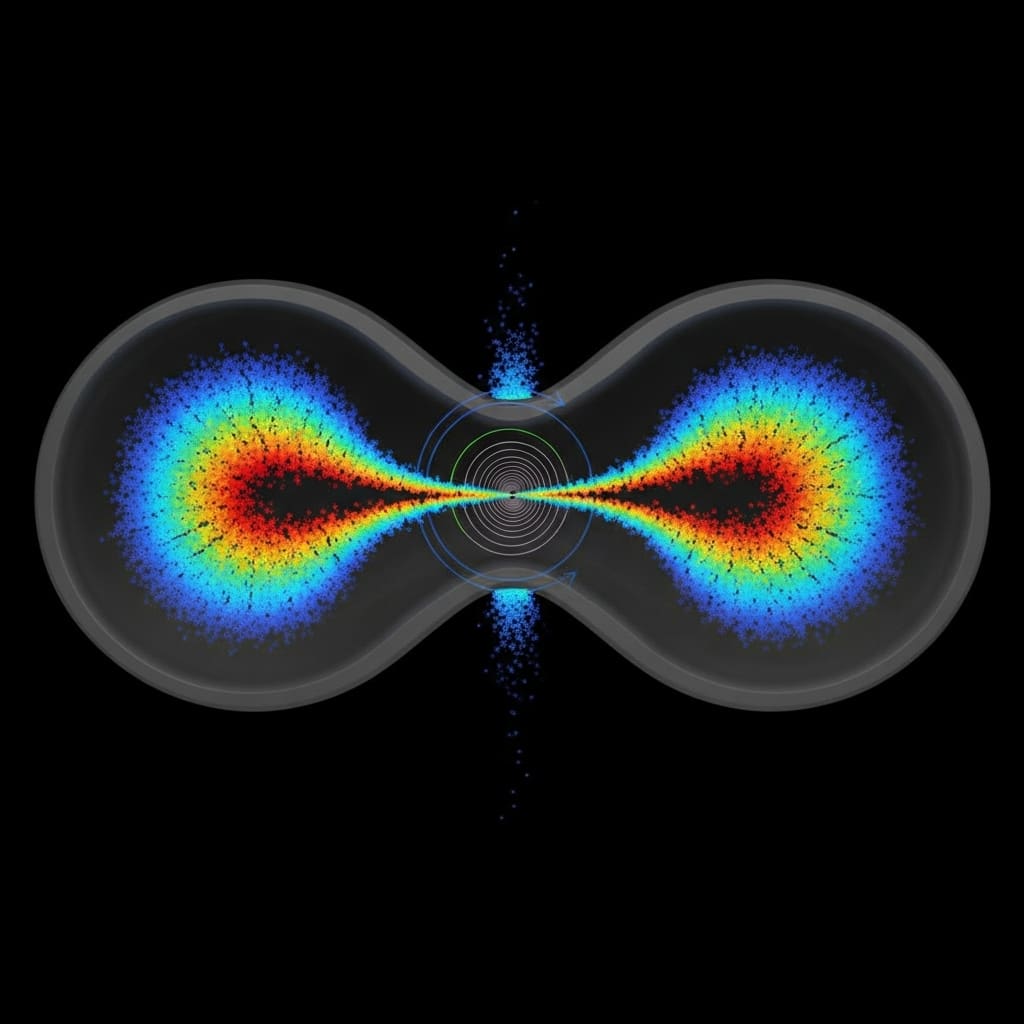
Scientists are increasingly seeking novel methods to precisely measure rotation, and new research published demonstrates a surprising link between rotation and the behaviour of ultracold atoms! Rhombik Roy and Ofir E. Alon, both from the Department of Physics at the University of Haifa, alongside their colleagues, reveal how a bosonic Josephson junction , a system of ultracold atoms in a double-well potential , can be used to infer rotation frequency, displacement and orientation! Their theoretical work establishes that by carefully observing the tunneling dynamics within this system, researchers can not only determine how fast something is rotating, but also where and how it is positioned relative to the axis of rotation , a significant step towards developing new, highly sensitive rotation sensors.
Rotation sensing via ultracold boson tunnelling
Scientists have demonstrated a novel method for inferring rotation frequency, radial displacement, and orientation using the tunneling dynamics of ultracold bosons within a bosonic Josephson junction. This theoretical work explores how rotation modifies quantum tunneling in a two-dimensional double-well potential, revealing a pathway to assess rotation frequency from changes in tunneling behaviour! Researchers employed both mean-field and many-body analyses to show that rotation dramatically alters the tunneling time period, momentum, and angular momentum dynamics of ultracold bosons. When the rotation axis passes through the centre of the double well, distinct dynamical responses emerge with increasing rotation frequency, allowing for precise assessment of the rotational speed from observable changes in tunneling.
Specifically, the study reveals that the tunneling period and time-averaged angular momentum increase exponentially with rotation, while the amplitude of transverse momentum increases linearly! This sensitivity provides a direct link between rotation and measurable quantities within the system. Furthermore, when the double-well potential is displaced from the rotation axis, rotation induces asymmetric tunneling and partial self-trapping, enabling the inference of both rotation frequency and the extent of displacement. Self-trapping increases exponentially with both displacement and rotation frequency, while the time-averaged angular momentum exhibits a linear relationship with rotation frequency and a quadratic relationship with displacement, offering a dual-parameter measurement capability.
The research further establishes that an off-centred double well exhibits a pronounced orientation dependence in its tunneling dynamics, allowing for the determination of the double well’s orientation from observed dynamics. Both self-trapping and time-averaged angular momentum display a Gaussian dependence on orientation, providing a clear signature for orientation measurement. Expanding on this, many-body analysis demonstrates that rotation strongly influences depletion dynamics, offering an additional tool for assessing rotation frequency, with depletion exhibiting exponential dependence on both rotation frequency and potential orientation. Finally, scientists investigated time-dependent rotation, gradually setting the double well into motion and identifying distinct dynamical signatures sensitive to the switching time. Together, these findings establish a comprehensive framework for inferring rotation frequency, radial displacement, and orientation directly from the tunneling dynamics, potentially leading to compact and accurate rotation sensors with quantum-enhanced sensitivity! This work opens exciting avenues for applications in inertial navigation, structural monitoring, and advanced quantum technologies, surpassing the limitations of current ring-laser and MEMS gyroscopes.
Rotation-induced Tunneling Dynamics for Frequency Measurement
Scientists investigated the interplay between rotation and tunneling in ultracold bosonic systems using a sophisticated theoretical approach! The research team explored how rotation within a non-inertial frame modifies tunneling dynamics in a bosonic Josephson junction, demonstrating that these dynamics provide a novel method for determining rotation frequency! Employing both mean-field and many-body analyses, they revealed that rotation significantly alters the tunneling time period, momentum, and angular momentum, observable changes that enable precise assessment of the rotation frequency. When.
Researchers solved the many-body Schrödinger equation, i∂Ψ/∂t = HΨ, to model the tunneling dynamics of interacting bosons within a rotating two-dimensional double-well potential! The Hamiltonian, H, incorporates single-particle terms, interparticle interactions modeled by finite-range Gaussian potentials with a strength of λ0 = 0.2 and σ = 0.25, and a rotation term −ΩLz, where Ω represents the angular frequency and Lz is the angular momentum operator! The double-well potential, defined piecewise, creates a symmetric configuration with two wells separated by a finite barrier, as depicted in Figure 0.1(a). To0.37 × 10−3s! This innovative approach establishes a comprehensive framework for inferring rotation frequency, radial displacement, and orientation directly from the tunneling dynamics, offering a powerful new tool for quantum control and metrology!
Rotation modifies bosonic tunneling in double wells significantly
Scientists have demonstrated that rotation significantly modifies the tunneling dynamics of ultracold bosons within a two-dimensional double-well potential! The research establishes a novel pathway for inferring rotation frequency directly from observed tunneling behaviour, offering potential advancements in rotation sensing technologies. Experiments, conducted theoretically, reveal that the tunneling time period is strongly altered by rotation, with measurable changes in both momentum and angular momentum dynamics. Specifically, the team measured distinct dynamical responses with increasing rotation frequency when the rotation axis passed through the double well’s centre, enabling assessment of the rotation rate from these changes.
Data shows that when the double-well potential is displaced from the rotation axis, rotation induces asymmetric tunneling and partial self-trapping! This asymmetry allows for the inference of both the rotation frequency and the radial displacement of the potential, providing a more comprehensive understanding of the system’s dynamics. Measurements confirm a pronounced orientation dependence in the tunneling dynamics for off-centered double wells, meaning the orientation of the well itself can be determined from the observed dynamics, a crucial step towards precise spatial awareness. The – analysis further indicates that depletion dynamics are strongly influenced by rotation, offering an additional, independent method for assessing the rotation frequency.
Results demonstrate an exponential dependence of depletion on both rotation frequency and the orientation of the potential! The study also investigated time-dependent rotation, gradually setting the double well into motion and identifying distinct dynamical signatures sensitive to the switching time. These signatures provide a unique temporal fingerprint of the rotation process, enhancing the precision of rotation measurements. The breakthrough delivers a comprehensive framework for inferring rotation frequency, radial displacement, and orientation directly from the tunneling dynamics of ultracold atoms.
Tests prove that the amplitude of transverse-momentum oscillations and the angular momentum each exhibit a characteristic dependence on the rotation frequency! The team’s work highlights the potential for developing compact and accurate rotation sensors based on bosonic Josephson junctions, potentially surpassing the limitations of current ring-laser and MEMS gyroscope technologies. This research establishes a foundation for future investigations into quantum-enhanced rotation sensing and inertial navigation systems, with implications for geophysics, structural monitoring, and advanced quantum technologies.
Rotation reveals double-well potential geometry
Scientists have demonstrated that rotation significantly alters the tunneling dynamics of ultracold bosons within a two-dimensional double-well potential! Through both mean-field and many-body analyses, researchers revealed that these modifications offer a novel method for determining rotation frequency. The study establishes a clear link between changes in tunneling dynamics, including tunneling time, momentum, and angular momentum, and the rate of rotation! This work provides a comprehensive framework for inferring not only rotation frequency, but also the radial displacement and orientation of the double-well potential directly from observed tunneling behaviour.
Specifically, the team found that an off-centered double well exhibits asymmetric tunneling and partial self-trapping, allowing for the simultaneous determination of rotation frequency and displacement. Furthermore, the depletion dynamics in the many-body regime were shown to be sensitive to rotation, offering an independent means of assessing rotation frequency in slow rotation scenarios! The authors acknowledge that their analysis primarily focuses on rotation around the z-axis and suggest future research could explore more complex rotational scenarios. They also note that the ability to accurately infer parameters relies on the switching time being sufficiently slow during time-dependent rotation experiments, representing a limitation to consider in practical applications.
👉 More information
🗞 Inferring rotations using a bosonic Josephson junction
🧠 ArXiv: https://arxiv.org/abs/2601.13344


