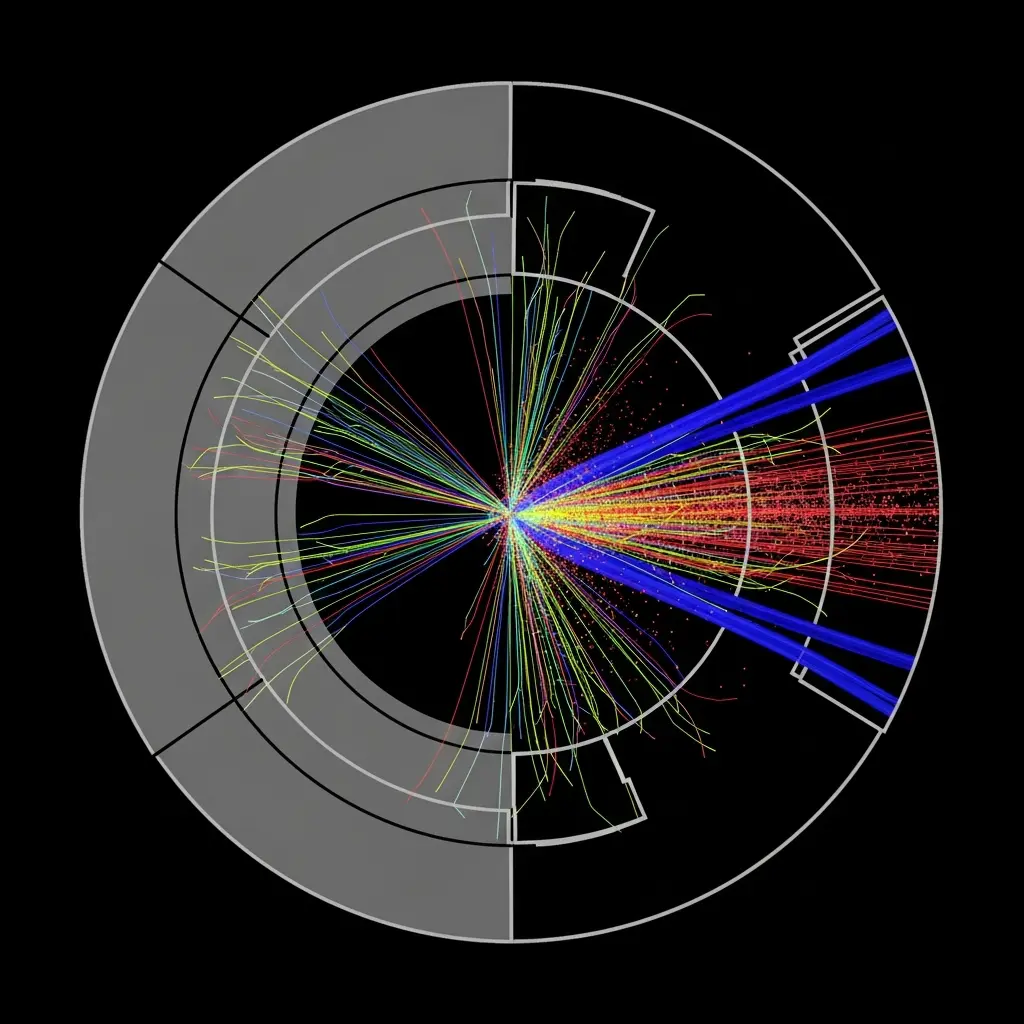
Scientists have precisely measured the production of Z bosons and rigorously searched for deviations from the Standard Model’s predictions regarding how these particles interact. The CMS Collaboration from the European Organisation for Nuclear Research (CERN), alongside colleagues from the CMS Collaboration and the Journal of High Energy Physics, analysed 138 fb⁻¹ of proton-proton collision data collected at 13 TeV to achieve this. Their findings confirm the Standard Model prediction for Z boson production , measuring a fiducial cross section of 23.3 fb , but crucially, also place the strictest limits yet on anomalous triple gauge couplings, potentially revealing new physics beyond our current understanding of the universe. These constraints on parameters like κZ and κγ, determined at the 95% confidence level, represent a significant step forward in probing the fundamental forces governing particle interaction.
Correspondingly, for CP-conserving couplings hZ3 and hZ4, the intervals were found to be (−2.2, 2.2)×10−4 and (−4.1, 4.2)×10−7. These values represent the strictest limits to date on these parameters, significantly refining our knowledge of potential anomalous interactions. The study unveils a powerful method for probing the electroweak sector of the Standard Model and searching for subtle deviations that could hint at new particles or forces.
The neutral decay of the Z boson into neutrinos was strategically chosen for this analysis due to its clean final state signature and a branching fraction of 20%, offering a favourable signal-to-background ratio. The CMS detector, with its silicon tracker, electromagnetic and hadron calorimeters, played a crucial role in accurately reconstructing the particles involved and identifying potential signals of new physics. The work opens avenues for future investigations at higher energies and luminosities, potentially revealing even more subtle effects and furthering our understanding of the fundamental laws governing the universe.
Z Boson and Jet Production at 13 TeV
The team engineered a sophisticated methodology to reconstruct particle trajectories and energies, employing a nearly hermetic detector system designed for optimal particle identification. Central to the experimental setup is a 6m diameter superconducting solenoid generating a 3.8 T magnetic field, crucial for bending charged particle paths and enabling accurate momentum measurements. Within this solenoid, a silicon pixel and strip tracker precisely determines particle trajectories, while a lead tungstate crystal electromagnetic calorimeter (ECAL) measures the energy of photons and electrons. Complementing this, a brass and scintillator hadron calorimeter (HCAL) detects hadronic energy deposits, creating a comprehensive picture of each event.
Avalanche photodiodes and vacuum photo-triodes are utilized for readout of the ECAL barrel and endcaps, respectively, maximizing light collection efficiency and signal resolution. Experiments employ a two-tier trigger system to efficiently select events of interest. The first level, utilizing custom hardware, rapidly filters events at approximately 100kHz with a latency of 4μs, while the high-level trigger, a processor farm running optimized reconstruction software, further reduces the rate to around 1kHz before data storage. The study pioneered a ‘particle-flow’ event reconstruction technique, combining information from all subdetectors to identify and reconstruct individual particles, photons, electrons, muons, charged and neutral hadrons, optimizing the determination of their direction and energy. Hadronic jets are clustered using the anti-kT algorithm with a distance parameter of 0.4, allowing for precise jet momentum determination, found to be within 5 to 10% of the true momentum across the measured spectrum. To address the impact of pileup, additional proton-proton interactions, tracks originating from these extra interactions are discarded, and a correction is applied to residual contributions, ensuring accurate jet energy measurements.
Zγ Production Cross Section Measured at LHC Confirms
Correspondingly, for hZ3 and hZ4, the intervals were found to be (−2.2, 2.2) × 10−4 and (−4.1, 4.2) × 10−7. These measurements represent the strictest limits established to date on hγ3, hZ3, and hZ4, signifying a substantial advancement in precision measurements within particle physics. Data shows that the study leveraged the neutral decay of the Z boson (Z → νν), chosen for its clean final state signature with a 20% branching fraction, offering a distinct advantage over charged lepton or hadronic decay channels. Scientists recorded the total production cross section, which depends on the strength of these couplings, and found no significant evidence for physics beyond the Standard Model within the explored parameter space. The authors acknowledge that the precision of their measurements is limited by both statistical and systematic uncertainties inherent in the experiment and theoretical modelling.
👉 More information
🗞 Measurement of the Z production cross section and search for anomalous neutral triple gauge couplings in pp collisions at = 13 TeV
🧠 ArXiv: https://arxiv.org/abs/2601.14102