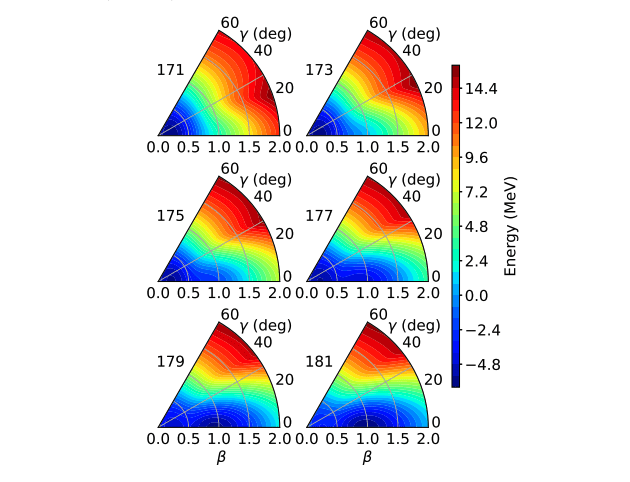
Nuclear structure physics endeavours to elucidate the forces governing the arrangement of protons and neutrons within the atomic nucleus, a task complicated by the behaviour of nuclei possessing an odd number of either protons or neutrons. Even-even nuclei, those with even numbers of both protons and neutrons, exhibit simpler characteristics, allowing for more straightforward modelling. The Interacting Boson Model (IBM) successfully describes the collective behaviour of these even-even nuclei by focusing on collective degrees of freedom, represented mathematically by bosonic operators – particles that describe collective excitations. Extending the IBM’s applicability to odd-mass nuclei necessitates incorporating the influence of individual nucleons, which are fermions – particles obeying different quantum mechanical rules.
The Interacting Boson-Fermion Model (IBFM) achieves this integration by combining the bosonic description of collective motion with the fermionic description of single-particle behaviour. This allows physicists to investigate how these two aspects interact to determine the nucleus’s overall shape and energy levels, and importantly, to account for shape coexistence, where multiple distinct shapes exist simultaneously within the same nucleus. Configuration mixing, specifically the inclusion of both ‘normal’ and ‘intruder’ configurations, provides a means to describe these complex scenarios within both the IBM and IBFM frameworks. Normal configurations arise from filling the lowest-energy orbitals, while intruder configurations involve excitations across energy gaps, leading to more deformed and less stable shapes.
The IBFM’s strength lies in its ability to bridge the gap between traditional shell models, which focus solely on individual nucleon behaviour, and the understanding of heavier nuclei exhibiting collective phenomena. In these heavier nuclei, nucleons interact in concert, resulting in deformations and distinct shapes. An intrinsic-state formalism provides a powerful tool for exploring the potential energy surfaces and identifying stable shapes within these models. This formalism simplifies the mathematical treatment and provides a more intuitive understanding of nuclear shapes, allowing for the investigation of both axially symmetric – elongated or spherical – and triaxial nuclear shapes, providing a comprehensive picture of nuclear structure.
Recent research utilising the IBFM concentrates on understanding how the interplay between these different configurations – regular and intruder – drives quantum phase transitions within nuclei. These transitions are analogous to phase transitions observed in everyday materials, such as water turning to ice, but occur at the quantum level. Calculations reveal that the fermion’s influence depends critically on the interplay between the bosonic and fermionic components of the Hamiltonian, the mathematical operator describing the system’s energy, and the intrinsic state formalism proves crucial in accurately capturing the complex correlations arising from these interactions.
The IBFM demonstrably serves as a robust framework for investigating nuclear structure, particularly in systems exhibiting shape coexistence and undergoing quantum phase transitions. It effectively integrates bosonic and fermionic degrees of freedom, allowing for a nuanced description of collective and single-particle behaviour within the nucleus. Configuration mixing emerges as a central mechanism shaping nuclear properties and driving transitions between different nuclear shapes, and the IBFM’s ability to incorporate both regular and intruder configurations, as detailed in the intrinsic state formalism, provides a comprehensive approach to describing these mixing effects.
Experimental observations consistently validate the predictive power of the IBFM, accurately explaining the existence of shape coexistence, the evolution of nuclear shapes across isotopic chains—variations of an element with differing numbers of neutrons—and the manifestation of critical phenomena in specific nuclei. Future research directions focus on refining the model’s parameters and exploring new phenomena. Investigating the role of geometric interpretations and the influence of single-particle levels promises to yield further insights into nuclear behaviour, and extending the model’s capabilities to describe more exotic nuclei and exploring the connection to other theoretical frameworks remain key priorities.
👉 More information
🗞 An intrinsic-state formalism for the Interacting Boson-Fermion Model with configuration mixing
🧠 DOI: https://doi.org/10.48550/arXiv.2507.05650