

The quest to understand gravity and black holes receives a novel boost from research into the behaviour of fluids, specifically Bose-Einstein condensates. Adrià Delhom, from Universidad Complutense de Madrid and Louisiana State University, and Luca Giacomelli investigate how these ultracold atomic gases mimic the effects of gravity, offering a unique laboratory to explore phenomena like black hole radiation. This work demonstrates that collective excitations within these condensates behave remarkably like fields in curved spacetime, providing an accessible and controllable system to study complex gravitational effects that are otherwise impossible to observe directly. By applying theoretical tools and numerical methods, the researchers advance our understanding of superradiance and Hawking radiation, potentially bridging the gap between analogue systems and the fundamental physics of black holes.
Bose-Einstein Condensates Simulate Gravity Effects
This research explores the connection between condensed matter physics and general relativity, investigating whether gravitational phenomena can be simulated using analogue systems. The central aim is to demonstrate how collective excitations within Bose-Einstein condensates, or BECs, can mimic the behaviour of spacetime, providing a new platform to study gravity in a controlled laboratory environment. The approach establishes a clear correspondence between the equations governing BEC dynamics and those describing gravitational fields, such as how sound waves in the BEC can act as an analogue for light propagation in curved spacetime. The study details how to construct an effective metric for the BEC, allowing calculations analogous to gravitational redshift and Hawking radiation.
The team demonstrates that carefully controlling the BEC’s parameters allows observation of phenomena otherwise inaccessible in astrophysical settings. Furthermore, the research explores the limitations of this analogue gravity approach, highlighting the differences between the BEC system and true gravity. The work also investigates the potential for using these analogue systems to test theoretical predictions about quantum gravity, such as the existence of extra dimensions or modifications to general relativity. This research provides a comprehensive framework for understanding and interpreting analogue gravity experiments with BECs, developing a rigorous mathematical formalism that connects the microscopic properties of the condensate to the macroscopic behaviour of the effective spacetime.
This formalism allows for precise predictions about the analogue gravity system and facilitates comparison between experimental results and theoretical expectations. The study offers new insights into the fundamental nature of spacetime and gravity, suggesting that certain aspects of these phenomena may be understood as emergent properties of underlying quantum systems. Finally, the research paves the way for future experiments that could potentially shed light on some of the most challenging problems in theoretical physics.
Atomic BECs Simulate Curved Spacetime Effects
This work pioneers the use of atomic Bose-Einstein condensates as a platform for analogue gravity, specifically to investigate phenomena like black hole radiance and superradiance, extending beyond the initial focus on the Hawking effect. Researchers established a theoretical framework and employed detailed numerical methods to model and understand these effects within the ultracold atomic gas, providing a novel approach to explore quantum field theory in curved spacetime. The study meticulously constructs a theoretical foundation, drawing from gravitational physics, field theory, and many-body physics, to provide a pedagogical account of the essential concepts and techniques needed for current research in this field. Scientists began by establishing the theoretical basis for modelling BECs, describing them as weakly interacting dilute Bose gases and applying the Bogoliubov approximation to understand their collective excitations.
This allowed them to derive the Gross-Pitaevskii equation, a cornerstone for describing the condensate’s behaviour, and subsequently developed a hydrodynamical approximation using density-phase variables to further simplify the analysis. The team rigorously investigated the low-energy excitations of the condensate, employing both the quantum Hamiltonian and linearization of the Gross-Pitaevskii equation to characterize collective excitations and their dispersion relations. To quantify these excitations, researchers developed the Bogoliubov-de Gennes inner product and a method for calculating the energy of the resulting eigenvectors, ultimately linking these perturbations to an acoustic metric derived from density-phase fluctuations. The quantization of these density-phase perturbations was then performed, utilizing atomic-field variables and addressing the complexities introduced by dynamical instabilities, which were detected through numerical diagonalization of the Bogoliubov problem.
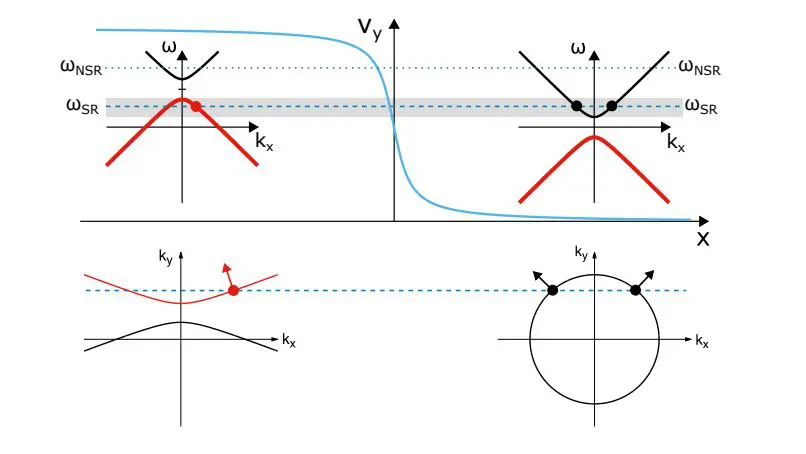
This detailed approach enabled the team to investigate superradiance and the stationary analogue Hawking effect, treating it as a stationary scattering problem and meticulously calculating the mode structure of the transsonic condensate and its scattering matrix. Researchers solved this explicitly for a step interface horizon, drawing direct analogies with the gravitational Hawking effect and highlighting both similarities and differences between the two phenomena. To detect signatures of the analogue Hawking effect, scientists investigated density correlations and even explored the possibility of black hole lasing through numerical time evolution of the Gross-Pitaevskii equation.
Fluid Ergoregions Mimic Black Hole Spacetime
This work demonstrates how sound waves in specific fluids can mimic the behaviour of gravity in curved spacetime, opening new avenues for studying phenomena like black holes in a laboratory setting. Scientists established a theoretical framework describing how collective excitations in Bose-Einstein condensates, fluids at extremely low temperatures, can be used to model gravitational effects. The research centers on the acoustic metric, a mathematical description of how sound propagates in a moving fluid, and its connection to the geometry of spacetime. Experiments reveal that by carefully controlling the flow of a fluid, researchers can create regions where the speed of sound is exceeded by the fluid’s velocity.
This condition defines an ergoregion, a region analogous to the ergosphere surrounding a rotating black hole, where it becomes impossible for objects to remain stationary with respect to the fluid. The boundary of this region, the ergosurface, is defined by the point where the fluid velocity equals the speed of sound. Specifically, the team analyzed a vortex flow, where the fluid rotates around a central point, and derived the acoustic metric in polar coordinates. For a velocity profile defined as v = B r ˆθ, the resulting acoustic metric is ds² vortex = ρ cs² (B² r² − cs²) dt² − 2B dθdt + dr² + r²dθ². This metric accurately describes the propagation of sound waves within the vortex, demonstrating the fluid’s ability to mimic the behaviour of spacetime around a black hole. The research confirms that the derived acoustic metric provides a correct description of sound wave propagation in the fluid, provided the speed of sound remains independent of the wavevector of the perturbations.
Bose-Einstein Condensates Model Curved Spacetime
This work presents a comprehensive exploration of analogue gravity, specifically utilising atomic Bose-Einstein condensates as a platform to model phenomena typically associated with curved spacetime, such as black holes. Researchers demonstrate how collective excitations within these condensates can effectively reproduce behaviours observed in gravitational systems, offering a novel approach to investigate effects like black hole superradiance and Hawking radiation. The study details the theoretical framework and numerical methods employed to analyse these analogue systems, providing insights into quantum field theory in the presence of external classical fields. The findings establish a pathway for experimentally probing regimes of quantum field theory where direct observation is challenging, potentially offering new perspectives on fundamental questions in cosmology, including the quantum origins of cosmic microwave background inhomogeneities. While acknowledging the limitations inherent in any analogue system, the authors highlight the potential of these laboratory simulations to access quantum aspects of phenomena traditionally studied within the framework of general relativity. Future research directions include extending these analogue models to simulate a wider range of relativistic field theory phenomena.
🗞 Analogue gravity with Bose-Einstein condensates
🧠 ArXiv: https://arxiv.org/abs/2512.14209


