

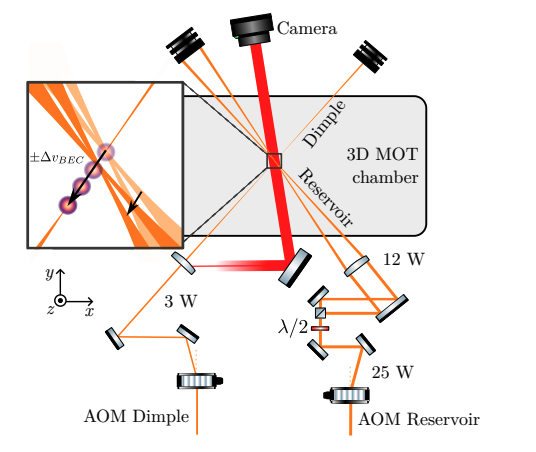
Understanding the precise characteristics of light is fundamental to many areas of physics, and researchers continually seek improved methods for mapping light’s properties, particularly its wave vector, or k-vector. Samuel Gaudout from Laboratoire Kastler Brossel, alongside colleagues, now presents a novel technique for probing the spatial distribution of these k-vectors directly within a laser beam, using a Bose-Einstein condensate as a moving sensor. This innovative approach reconstructs a two-dimensional map of light’s intensity and effective dispersion by measuring the recoil experienced by the condensate as it moves through the beam, revealing subtle distortions in the wavefront. The method not only offers a new way to characterise these distortions with high precision, but also addresses a significant source of error in experiments relying on atom interferometry, potentially improving the accuracy of these sensitive measurements.
BEC Mapping Reveals Laser Momentum Distribution
Researchers have developed a novel technique for mapping the distribution of photon momentum within a laser beam, utilizing a Bose-Einstein condensate (BEC) as a sensitive, moving probe. By carefully measuring the recoil experienced by the condensate as it interacts with the laser light at different points, the team successfully reconstructed a two-dimensional map detailing both the intensity and the effective wave vector dispersion of the beam. This innovative approach allows for precise characterization of distortions in the laser wavefront, offering a valuable tool for understanding and mitigating systematic errors in atom interferometry experiments. The core of this approach lies in leveraging the unique properties of a BEC, a state of matter where atoms behave collectively as a single quantum entity.
By displacing the BEC, researchers can measure minute changes in atomic momentum caused by the recoil from absorbed photons, providing a highly sensitive measure of the light’s momentum distribution. This method offers a significant improvement over traditional techniques, which often rely on external measurements susceptible to environmental effects. Importantly, the team demonstrated the ability to map not only the intensity of the beam, but also subtle distortions in its wavefront, which are often a limiting factor in precision measurements. The results reveal an unexpected phenomenon: an extra recoil effect exceeding the expected value based on the beam’s fundamental properties.
This enhancement, deliberately induced by shaping the laser intensity, demonstrates the technique’s sensitivity to even subtle changes in the light field, and was validated through detailed theoretical modeling with excellent agreement between simulations and experimental data. This method has significant implications for the field of atom interferometry, a powerful technique used for precision measurements of gravity, rotation, and fundamental constants. By accurately characterizing wavefront distortions, researchers can minimize systematic errors that currently limit the sensitivity of these devices. Future improvements, such as utilizing two-dimensional arrays of BECs, promise to further enhance the technique’s speed and precision, potentially unlocking new levels of accuracy in a wide range of scientific applications.
The ability to precisely map light momentum opens avenues for studying complex optical phenomena and developing advanced technologies reliant on precise light-matter interactions. The team also demonstrated the ability to detect subtle effects beyond what would be expected from simple plane-wave decompositions of the laser beam, revealing previously unobserved local recoil phenomena. While the current work focuses on characterizing a beam diffracted by an aperture, the authors acknowledge limitations related to fully reconstructing the wavefront and applying the technique to highly complex beam profiles, suggesting future research could explore application to more intricate optical setups and potentially enhance the precision of atom interferometry-based sensors.
🗞 Probing the spatial distribution of k-vectors in situ with Bose-Einstein condensates
🧠 DOI: https://doi.org/10.48550/arXiv.2507.19157


