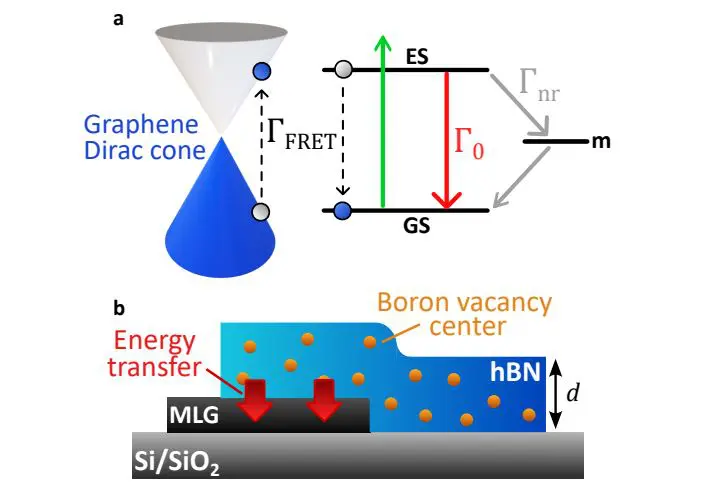
Boron vacancies within hexagonal boron nitride represent a potentially revolutionary platform for developing sensors capable of detecting materials at the atomic scale, but understanding how these sensors interact with the materials they detect has remained a significant challenge. Jules Fraunié, Mikhail M. Glazov, and Sébastien Roux, alongside colleagues at Université de Toulouse and the Ioffe Institute, now demonstrate that energy transfer between these boron vacancies and other two-dimensional materials, such as graphene and semiconductors, occurs through a process called Förster resonance energy transfer. Their research reveals this energy transfer is remarkably efficient only in extremely thin layers of boron nitride, less than three nanometres thick, which opens up exciting possibilities for integrating these defects into ultra-thin sensors within advanced van der Waals heterostructures. Importantly, the team also successfully measures the inherent light-emitting properties of these boron vacancies, providing crucial data for optimising their performance in future sensing applications.
This work investigates the mechanisms responsible for changes in light emission when these sensors are placed near light-absorbing materials, revealing that non-radiative Förster resonance energy transfer (FRET) plays a key role in their sensitivity. Researchers developed a quantitative model that accurately predicts experimental observations, providing insights into the optimal design of hBN-based sensors for enhanced sensitivity and detection range. These findings represent a significant step towards realising the full potential of hBN quantum sensors for applications in materials science, chemistry, and biology.
FRET and Decay in hBN Heterostructures
This research details theoretical calculations and supporting data for understanding how the light emission from boron vacancies (V-B centers) in hexagonal boron nitride (hBN) is affected when placed on graphene or other substrates. The calculations reveal that FRET, the transfer of energy from the V-B center to nearby graphene or substrate, is a major pathway for reducing light emission. The team calculated the radiative and non-radiative decay rates of the V-B center, determining how quickly the defect emits light versus loses energy through other mechanisms. The quantum yield is lower when non-radiative decay dominates, and calculations demonstrate how substrate effects and distance influence light emission. The results show that the substrate significantly affects light intensity, and that quenching of light is strongly dependent on the distance between the V-B center and the substrate. The quenching factor increases as hBN flakes become thinner, becoming significant for thicknesses below three nanometers.
Boron Vacancies Sense Light Absorption at Nanoscale
Scientists have demonstrated that boron vacancies in hexagonal boron nitride (hBN) can function as highly sensitive two-dimensional sensors, operating at the atomic scale. This work investigates how these sensors respond when placed near materials that absorb light, revealing that non-radiative Förster resonance energy transfer (FRET) governs their sensitivity. Experiments focused on FRET between these boron vacancies and either monolayer graphene or two-dimensional semiconductors, uncovering a critical threshold for sensor performance. The team discovered that FRET becomes negligible when the hBN sensing layer exceeds a thickness of three nanometers, highlighting the potential for integrating these boron vacancy centers into ultra-thin sensors within van der Waals heterostructures.
Measurements show that the radiative decay rate is approximately 10⁵ seconds⁻¹, significantly lower than the non-radiative decay rate, which is around 10⁹ seconds⁻¹. This disparity explains the weak light emission typically observed from boron vacancy centers. By thinning the hBN layer to two nanometers, scientists observed a significant reduction in light intensity and a noticeably shorter decay time when placed on graphene, confirming that FRET becomes competitive with non-radiative decay at these reduced thicknesses. Through an electrodynamical model, researchers were able to extract experimental values for the radiative rate, accounting for multiple reflections within the layered structure. These findings establish a clear relationship between hBN layer thickness, FRET, and sensor performance, paving the way for the development of highly sensitive, ultra-thin sensors for a range of applications.
Boron Vacancies Enable Van der Waals Sensing
This research demonstrates that boron vacancies in hexagonal boron nitride can function as effective sensors, even when in close proximity to other two-dimensional materials. The team investigated how the luminescence of these defects is affected when the boron nitride is placed on top of graphene or other semiconductors, revealing that the interaction is negligible for flakes thicker than three nanometers. This finding highlights the potential for creating ultra-thin sensors within van der Waals heterostructures. By carefully measuring the decay rate of light emitted from these defects, the researchers were able to determine the intrinsic radiative rate and confirm that the low quantum yield of boron vacancies explains the weak signal typically observed.
Importantly, they established that the luminescence is largely independent of the underlying material for flakes thicker than three nanometers. Future work could focus on directly imaging the distribution of these defects to refine the understanding of energy transfer mechanisms. This research provides a crucial step towards developing highly sensitive, atomically thin sensors for a range of applications, and establishes a fundamental understanding of how these sensors interact with their environment.
🗞 Non-radiative energy transfer between boron vacancies in hexagonal boron nitride and other 2D materials
🧠 ArXiv: https://arxiv.org/abs/2512.03970