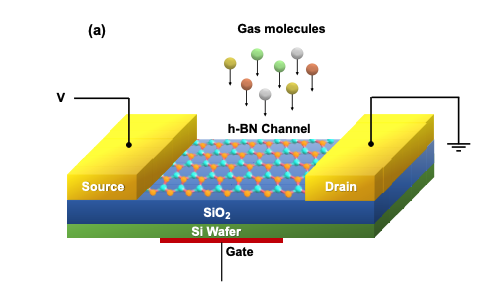
Hexagonal boron nitride holds promise as a highly sensitive material for detecting specific gases, and a new theoretical study explores the electronic properties that underpin its potential. Saumen Acharjee from Dibrugarh University, along with colleagues, investigates how this material responds at the molecular level when exposed to various gases, including nitrogen dioxide, hydrogen sulfide, hydrogen fluoride, and carbon monoxide. The research demonstrates that carbon monoxide and nitrogen dioxide cause the most significant changes in the material’s electronic structure and capacitance, offering a pathway to distinguish between different molecules. By modelling the behaviour of a boron nitride field-effect transistor, the team reveals how manipulating an electric field and controlling temperature can further enhance sensitivity and optimise gas detection performance, offering a comprehensive framework for designing next-generation chemical sensors
Hexagonal Boron Nitride for Gas Detection
This research explores the potential of hexagonal boron nitride (hBN) as a highly sensitive material for detecting harmful gases, a crucial need for environmental monitoring, industrial safety, and healthcare applications. hBN, a two-dimensional material analogous to graphene but with distinct properties, possesses exceptional chemical and thermal stability, alongside tunable electronic properties, making it an attractive candidate for gas sensing. The study investigates how hBN interacts with gases like carbon dioxide, carbon monoxide, hydrogen sulfide, hydrogen fluoride, and nitrogen oxides, aiming to create more effective detection technologies. These gases represent significant environmental and health hazards, necessitating sensitive and reliable detection methods. Researchers employ Density Functional Theory (DFT) calculations to simulate the interaction between gas molecules and the hBN surface, predicting how gases adhere and alter the material’s electronic structure. DFT, a quantum mechanical modelling method, allows for the accurate calculation of electronic structure and bonding characteristics, providing insights into the adsorption process and the resulting changes in hBN’s properties.
This computational approach allows them to assess the sensitivity of hBN to different gases and explore methods for optimizing its performance, such as introducing impurities or applying external fields. Introducing defects or doping hBN with specific elements can create active sites for gas adsorption, enhancing sensitivity. The Non-Equilibrium Green’s Function (NEGF) method further refines this understanding by modelling charge transport through hBN, revealing how gas adsorption affects its conductivity and current-voltage characteristics. NEGF is particularly well-suited for modelling systems far from equilibrium, such as sensors where gas adsorption induces changes in charge carrier density and transport. The research demonstrates that applying an electric field can modify hBN’s electronic properties, potentially enhancing its sensitivity or selectivity to specific gases. This tunability arises from the ability of the electric field to modulate the potential barrier for charge carriers, influencing the material’s response to adsorbed gases. Furthermore, the study utilizes heterostructures, layering hBN with other two-dimensional materials like graphene, to create synergistic effects and improve overall sensor performance. Graphene, with its high electrical conductivity, can serve as an efficient charge collector, amplifying the signal generated by gas adsorption on the hBN layer.
This approach combines the strengths of different materials, leading to more robust and sensitive gas detection systems. The foundational work of Novoselov and colleagues, who isolated graphene in 2004, established the field of two-dimensional materials and van der Waals heterostructures, paving the way for this research. Van der Waals heterostructures are created by stacking different two-dimensional materials, held together by weak van der Waals forces, allowing for the creation of materials with tailored properties. Dean and coworkers highlighted the importance of hBN as an insulating substrate for high-quality graphene electronics, demonstrating its low defect density and suitability for advanced devices. The low defect density of hBN is crucial for minimizing scattering of charge carriers, ensuring efficient charge transport in heterostructures. Britnell and colleagues further advanced the field by fabricating vertical heterostructures using hBN and graphene, opening new avenues for device design. These vertical heterostructures allow for the creation of devices with unique functionalities, such as enhanced gas sensing capabilities. The precise control over layer thickness and stacking order is essential for optimizing device performance.
Recent studies by Rahimi, Kim, Horri, and Raval provide context for this research, demonstrating the growing interest in two-dimensional materials for gas sensing. These studies explore various two-dimensional materials and heterostructures for gas detection, highlighting the potential of this emerging field. Kalwar and colleagues conducted early work on hBN-based gas sensors, demonstrating the feasibility of using hBN for gas detection. Dutta’s textbook provides the theoretical foundation for the NEGF method used in this study, offering a comprehensive overview of non-equilibrium quantum transport. Theoretical advancements by Baym, Kadanoff, and Keldysh laid the groundwork for non-equilibrium statistical mechanics, essential for the NEGF method. Their work provides the mathematical framework for describing systems driven far from equilibrium, such as sensors responding to gas adsorption. Studies by Alaee and Krishnan utilize NEGF to simulate electronic transport in two-dimensional materials, further refining the computational tools used in this research. These studies demonstrate the accuracy and efficiency of NEGF for modelling charge transport in complex materials.
Early work by Sichel explored the thermal properties of hBN, establishing its high thermal conductivity and stability, crucial for sensor operation in harsh environments. Song and colleagues detailed the growth of hBN layers using chemical vapour deposition, providing insights into the fabrication of high-quality hBN films. Phung and colleagues explored hBN heterostructures for gas sensing, demonstrating the synergistic effects of combining hBN with other two-dimensional materials. Le and colleagues demonstrated the tuning of hBN properties with electric fields, highlighting the potential for creating tunable gas sensors. Studies by Ozdemir and Kanrar investigated carbon-based and MoTe2-based sensors, respectively, providing comparative data for this research. These studies offer valuable benchmarks for evaluating the performance of hBN-based sensors. This comprehensive investigation addresses the critical need for sensitive and reliable gas sensors across various applications, including environmental monitoring, industrial safety, and healthcare diagnostics. By leveraging the unique properties of hBN and employing advanced computational methods, the researchers aim to develop a new generation of gas sensors with improved performance and selectivity. The combination of DFT and NEGF methods provides a powerful tool for understanding the underlying mechanisms of gas sensing and optimizing the design of hBN-based sensors. In summary, this is a comprehensive and well-referenced research effort that promises to advance the field of gas sensing using two-dimensional materials, offering a pathway towards more efficient and reliable gas detection technologies.
🗞 Quantum Capacitance and Electronic Properties of a Hexagonal Boron Nitride based FET Gas Sensor
🧠 DOI: https://doi.org/10.48550/arXiv.2507.15011