Researchers are increasingly focused on harnessing bound states in the continuum, a phenomenon offering the potential for ultra-high-quality resonances in nanoscale photonic devices, but current designs are constrained by the limitations of light diffraction. Harsh Gupta, Tatiana Contino, and colleagues from the Istituto Italiano di Tecnologia, along with Mingze He, Andrea Alu from the City University of New York, and Eli Janzen, James Edgar from Kansas State University, now demonstrate a new approach using periodic arrays of isotopically enriched hexagonal boron nitride nanoresonators. Their work reveals topologically protected phonon-polaritonic bound states, where energy loss through radiation is fully suppressed, and the quality of the resonance is limited only by the material itself. This topological protection offers a robust method for controlling light confinement and lifetime, potentially enabling scalable polaritonic devices for applications in mid-infrared optoelectronics and nanophotonics.
HBN Nanoresonators Support Long-Range Polariton Coupling
This research details the investigation of bound states in the continuum (BICs) and their long-range coupling within hexagonal boron nitride (hBN) nanoresonators. The team observed BICs, special resonant states that confine energy without radiating it, within these nanoscale structures, and demonstrated that these BICs can couple with each other over relatively long distances. This coupling arises from the unique properties of polaritons in hBN, quasiparticles formed from the interaction of light and matter, and can be tuned for specific applications. hBN nanoresonators offer a promising platform for manipulating BICs, which provide exceptional light confinement and are highly desirable for applications in optical sensing, lasing, and nonlinear optics.
The observed long-range coupling between BICs is crucial for creating complex photonic networks and functionalities, paving the way for advanced photonic devices with tailored properties. This work builds upon existing research in BICs, previously demonstrated in artificial materials and photonic crystals, and applies these principles to the hBN platform. Leveraging the unique properties of polaritons in hBN, the research demonstrates the potential of hBN nanoresonators as a versatile platform for realizing and manipulating BICs, opening exciting possibilities for advanced photonic technologies.
Boron Nitride Resonators for Bound State Creation
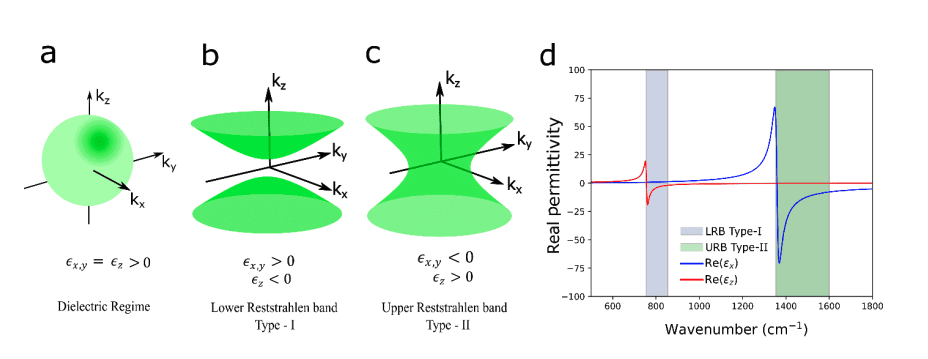
Researchers developed a methodology centered around creating nanoscale cylindrical resonators from isotopically enriched hexagonal boron nitride (hBN) to explore light-matter interactions at the nanoscale. This material was chosen because it exhibits strong vibrational modes, known as phonon polaritons, and possesses inherent anisotropy. The team leveraged these characteristics to create conditions for bound states in the continuum (BICs), which are exceptionally high-quality resonances. The fabrication process involved exfoliating thin layers of hBN onto a silicon substrate, followed by precise shaping into cylindrical nanoresonators using electron beam lithography and reactive ion etching.
This meticulous nanofabrication allowed for precise control over the size and arrangement of the resonators, crucial for tailoring their optical properties. A key innovation was the design of these resonators to exploit the material’s anisotropy and rotational symmetry, enabling the creation of topologically protected BICs that suppress energy loss. Researchers employed infrared spectroscopy, coupled with a microscope, to measure how light transmits through the fabricated structures. By varying the angle of incident light, they introduced asymmetry to the system, transforming the BICs into quasi-BICs with controlled energy leakage and tunability. Comparing simulations with experimental data confirmed the existence of these high-quality resonances and demonstrated a significant enhancement in quality factor, compared to similar structures without topological protection.
Boron Nitride Supports Protected Nanophotonic Resonances
Researchers have demonstrated the existence of topologically protected resonances, known as bound states in the continuum (BICs), within meticulously designed nanostructures composed of hexagonal boron nitride. These BICs represent a significant advancement in nanophotonics, offering the potential for ultra-high quality factor (Q) resonances and minimal energy loss, unlike previous implementations limited by the diffraction limit. The team constructed periodic arrays of cylindrical nanoresonators, exploiting the material’s ability to support specific vibrational modes. They observed that at normal incidence, a true BIC forms with complete decoupling from external radiation, meaning energy is perfectly confined.
However, by intentionally tilting the incoming light, researchers were able to break the symmetry of the system and transform these BICs into “quasi-BICs”, which exhibit controlled radiation leakage and tunable properties. Importantly, the quality of these resonances is exceptionally high, limited only by the inherent properties of the boron nitride material itself. Simulations reveal that the symmetry-protected BIC exhibits minimal energy loss, while the resulting quasi-BICs demonstrate strong field confinement and the ability to manipulate light flow. This research opens exciting possibilities for developing scalable polaritonic platforms for mid-infrared optoelectronics and nanophotonics, promising advancements in sensing, imaging, and energy harvesting.
Tuned Symmetry Reveals Phonon-Polaritonic Bound States
This work demonstrates the emergence of topologically protected phonon-polaritonic bound states in the continuum (BICs) within periodic arrays of cylindrical hexagonal boron nitride (hBN) nanoresonators. The researchers successfully combined theoretical modelling, numerical simulations, and experimental validation to confirm the existence of these BICs, which exhibit theoretically infinite quality factors due to the symmetry of the system and the material properties of hBN. These BICs arise from a mismatch between the symmetry of the nanoresonator modes and free-space radiation, effectively suppressing radiative losses. Importantly, the team showed that these BICs can be tuned into quasi-BICs by intentionally breaking the symmetry of the system through tilting the substrate, allowing for control over the lifetime and confinement of the resulting modes. This tunability, confirmed through angle-dependent measurements, highlights the topological nature of the radiation suppression and provides a pathway for dynamically controlling mid-infrared polaritonic modes. The researchers acknowledge that the quality factor is ultimately limited by the intrinsic phonon damping within the hBN material.
👉 More information
🗞 Topologically Protected Polaritonic Bound State in the Continuum
🧠 ArXiv: https://arxiv.org/abs/2508.14702