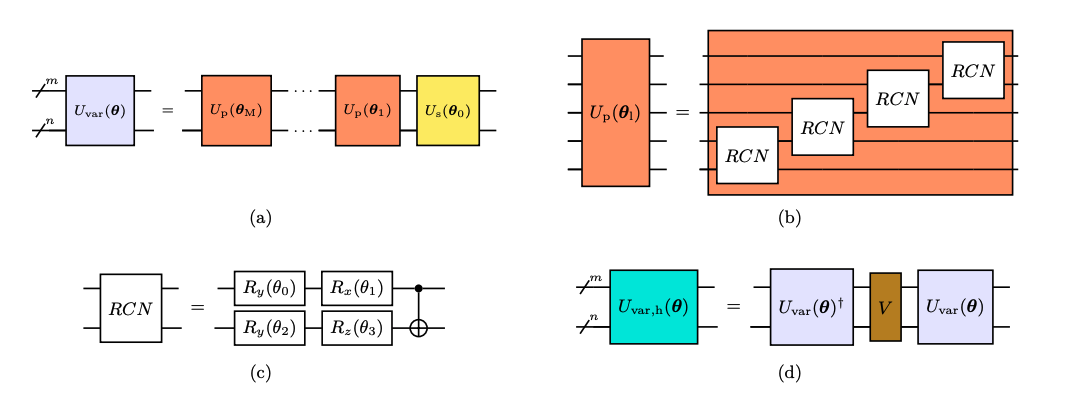
Block-encoding represents a crucial technique in quantum signal processing, yet constructing these encodings often demands significant computational resources. Leon Rullkötter from Fraunhofer IAO and Universität Stuttgart, alongside Sebastian Weber from Universität Stuttgart, and Vamshi Mohan Katukuri et al. from Fraunhofer IAO, now present a resource-efficient method for creating block-encoding operators that dramatically reduces the required computational complexity. The team’s approach compiles these unitaries with near-optimal resource requirements for a wide range of input matrices, achieving a parameter count that closely matches the number of free parameters within those matrices. This advancement not only simplifies the creation of block-encodings, but also enables optimisation for systems with up to eight qubits, and opens the door to building larger, more complex quantum algorithms by combining these efficient operators.
Signal processing relies heavily on the complexity of the quantum circuits used, which largely determines the overall computational cost. Researchers are developing new methods to compile block-encoding unitaries, essential for representing matrices in quantum computations, with significantly reduced resource requirements. These variational methods aim to create circuits where the number of adjustable parameters closely matches the complexity of the input matrix, whether it contains real, complex, or hermitian values. By incorporating symmetries present in the input matrix directly into the circuit design, researchers can further reduce the number of parameters and optimise performance for systems with up to eight qubits. This work focuses on developing variational block-encoding schemes that minimise resource needs and maximise the potential for successful optimisation.
Quantum Circuit Expressibility and Complexity Analysis
This research investigates the expressibility and complexity of quantum circuits used to represent and manipulate matrices, crucial for fields like physics and quantum chemistry. The central question is how to design circuits that are both powerful enough to represent a given matrix and as simple as possible. This is vital for building practical quantum computers, as complex circuits are more prone to errors. Expressibility refers to a circuit’s ability to represent any matrix within a certain space, while complexity relates to the circuit’s depth or number of operations. Hamiltonians, mathematical descriptions of a system’s energy, are key to understanding the behaviour of particles and molecules, and efficiently representing them on a quantum computer is a major challenge.</p
Exploiting symmetries within a Hamiltonian can significantly reduce the complexity of the required quantum circuit. Researchers use mathematical tools like Lie algebra and the Derivative Lie Algebra to analyse the generators and understand their capabilities, determining the range of operations they can achieve. Associative closure helps identify all possible combinations of generators, defining the full set of operations the circuit can perform. The dimension of the basis set, constructed from the generators, measures the circuit’s expressibility. The research takes a multifaceted approach, combining mathematical analysis with algorithm development and circuit optimisation.
Researchers develop algorithms to calculate the basis set and determine circuit expressibility, and explore techniques to reduce complexity while maintaining expressibility by choosing generators that respect symmetries. They also develop methods to verify whether a given circuit can represent a specific matrix or Hamiltonian, and analyse how the complexity of the algorithm and circuit scales with system size. Key findings highlight the importance of symmetry and generator choice, and demonstrate that Lie algebra and the Derivative Lie Algebra are powerful analytical tools. The research also reveals that scaling remains a significant challenge, and provides insights into how to improve expressibility checks.
Two methods are detailed for determining if a circuit can represent a given matrix. The first method calculates the Derivative Lie Algebra of the generators, finds the associative closure, and checks if the target matrix can be expressed as a combination of the resulting operations. The second method decomposes each generator into a sequence of simpler operations, combines these sequences, and checks if the target matrix can be expressed as a combination of the resulting operations. This research has important implications for the development of practical quantum computers, potentially leading to improved circuit design, reduced error rates, and scalable quantum algorithms for fields like chemistry, materials science, and drug discovery.
Variational Block-Encoding with Single Qubit Ancilla
Researchers have developed a new method for creating block-encodings, essential components in quantum signal processing, with significantly reduced resource requirements. This approach, termed Variational Block-Encoding (VBE), leverages the power of adjustable quantum circuits to efficiently encode matrices, promising substantial improvements for quantum computations on limited hardware. The team demonstrates that VBE can achieve exact encoding using only a single ancilla qubit, a remarkable feat considering traditional methods often require more. The core of this advancement lies in designing specialised quantum circuits that adapt to the inherent structure of the input matrix.
By tailoring the circuit to matrices containing only real or hermitian values, the researchers further reduce the number of parameters needed for encoding, streamlining the optimisation process. For problems with known symmetries, the team introduced additional circuit restrictions, achieving even more compact designs and potentially accelerating the optimisation process. This ability to minimise parameters is crucial, as the number directly correlates with the quantum resources, qubits and operations, required for the computation. The VBE circuits developed by the researchers approach theoretical lower bounds on the number of parameters needed to represent a given matrix, demonstrating remarkable efficiency.
The complexity of these symmetry-restricted circuits correlates with the algebraic structure of the circuit generators, providing insights into how to design even more efficient encodings in the future. Compared to existing block-encoding methods, VBE offers a substantial reduction in resource overhead. Traditional approaches often struggle with scaling to dense and unstructured matrices, and can suffer from a loss of amplitude during encoding. The new method overcomes these limitations, paving the way for practical quantum signal processing applications on near-term quantum devices. The researchers highlight that optimisation landscapes in VBE are smooth, allowing for efficient convergence using standard classical optimisation techniques like the BFGS optimiser. This ease of optimisation further enhances the practicality of the approach.
Variational Compilation Reduces Quantum Circuit Complexity
This work demonstrates the potential of variational compilation methods for efficiently constructing block-encoding operators, a crucial component of quantum signal processing algorithms. The researchers have shown that their variational block-encoding (VBE) approach can achieve parameter counts approaching the theoretical minimum required for encoding matrices, using hardware-efficient circuits. Furthermore, tailoring the circuit design to reflect properties of the input matrix, such as hermiticity and symmetry, further reduces the number of parameters needed. However, the significant classical computation required to optimise the variational parameters currently limits the applicability of VBE to systems with up to eight qubits.
The authors suggest a promising near-term application lies in combining VBE with linear combination of unitaries (LCU), using VBE to encode smaller matrix blocks and constructing the full matrix through linear combinations. Future research directions include exploring how additional system-specific properties can further reduce circuit resource requirements and investigating connections to multivariate quantum signal processing, potentially leading to methods for determining circuit parameters without full optimisation. The approach also opens possibilities for improving variational quantum eigensolvers and applications in quantum machine learning.
🗞 Resource-efficient Variational Block-Encoding
🧠 DOI: https://doi.org/10.48550/arXiv.2507.17658