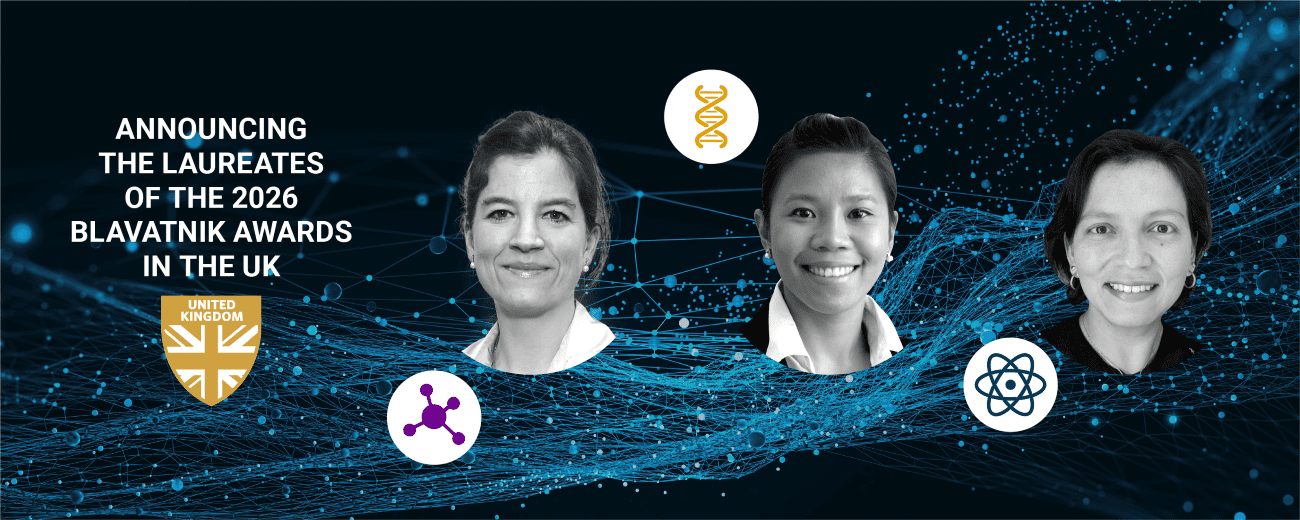
The Blavatnik Family Foundation and The New York Academy of Sciences have announced the recipients of the 2026 Blavatnik Awards for Young Scientists in the United Kingdom, awarding each of three Laureates £100,000—the nation’s largest unrestricted prize for science. Recognizing exceptional early-career achievements across Life Sciences, Chemical Sciences, and Physical Sciences & Engineering, the awards were presented at a gala ceremony at London’s Banqueting House to Thi Hoang Duong (Kelly) Nguyen, Maxie M. Roessler, and Paola Pinilla. This marks only the second time in the United Kingdom that women have claimed all three top prizes. In addition to the Laureates, six Finalists were each awarded £30,000 in recognition of their exceptional scientific contributions. “The exceptional talent celebrated through these Awards reflects the creativity and ambition that continue to place the UK at the forefront of scientific advancement,” said Sir Leonard Blavatnik, Founder of Access Industries and the Blavatnik Family Foundation, highlighting the importance of supporting the next generation of researchers.
£100,000 Prizes Awarded to UK’s Young Scientific Laureates
Beyond the top prizes, an additional £30,000 was awarded to each of the remaining six Finalists, acknowledging their significant scientific contributions. Dirks, President and CEO of The New York Academy of Sciences and Chair of the Awards’ Scientific Advisory Council. Dr. Thi Hoang Duong (Kelly) Nguyen, a molecular biologist at the MRC Laboratory of Molecular Biology, was honored for her pioneering work using cryo-electron microscopy to create the first atomic-level model of telomerase, offering critical insights into ageing and cancer. Prof. Maxie M. Roessler of Imperial College London received recognition for developing innovative electron paramagnetic resonance spectroscopy techniques, revealing intricacies in cellular energy generation and potentially guiding the design of new catalysts. Completing the trio of Laureates is Dr. Paola Pinilla, an astrophysicist from University College London, whose research combines telescope observations and advanced modelling to deepen our understanding of planet formation and the origins of planetary systems. Professor Deborah Prentice, Vice-Chancellor of the University of Cambridge, highlighted the importance of supporting young scientists, stating that such investment provides “grounds for optimism about the future of this country,” especially given the UK’s reliance on science and technology for economic growth.
Nguyen’s Cryo-EM Reveals Telomerase Structure & Function
Recent advances in structural biology are illuminating the intricate mechanisms of telomerase, an enzyme crucial for maintaining the integrity of our chromosomes, thanks to the work of Dr. Thi Hoang Duong (Kelly) Nguyen. Her research, recognized with a £100,000 Blavatnik Award for Young Scientists in the UK, centers on understanding how telomerase functions during DNA replication and its connection to both premature aging and cancer development. This detailed structural understanding is particularly significant because telomerase becomes dysregulated in disease states, and identifying specific regions within the enzyme opens avenues for future therapeutic intervention. The Blavatnik Awards, now in their ninth year in the UK, represent the nation’s largest unrestricted prize for science, with a total of £180,000 awarded to six finalists in addition to the three £100,000 Laureate prizes. Since 2017, the awards have distributed nearly £3.3 million (US$4.5 million) to 73 honourees, supporting “high-risk, high-reward research” across the United Kingdom.
grounds for optimism about the future of this country. Current plans for growth in the UK economy rest heavily on science and technology. And decades of investment mean the UK’s educational infrastructure is incredible – drawing in talent, using it superbly and efficiently.
Professor Deborah Prentice, Vice-Chancellor of the University of Cambridge
Roessler’s EPR Spectroscopy Maps Cellular Energy Transfer
Roessler’s work focuses on the fleeting, highly reactive transfer of electrons crucial to energy generation within cells, a process previously obscured due to its transient nature. She developed powerful electron paramagnetic resonance spectroscopy techniques that have revealed the intricacies of these electron states, effectively mapping previously invisible steps in cellular respiration. This advancement allows scientists to observe how cells generate energy at a fundamental level, opening avenues for manipulating these processes. The significance of Roessler’s research extends beyond basic biological understanding, with potential implications for diverse fields including catalyst design and the creation of novel functional materials. She was recognised for her work in “uncovering the hidden steps in how cells generate energy,” according to the award citation. This detailed mapping of electron transfer could guide the development of more efficient catalysts, mimicking the natural processes observed in cells, and inspire the creation of materials with tailored energy-related properties. Professor Nicholas B.
Notably, this marks the second time in the history of the Blavatnik Awards in the United Kingdom that all three Laureates are women scientists.
Pinilla’s Modeling Uncovers Planet Formation Pressure Structures
Astrophysicist Dr. Paola Pinilla’s innovative modeling is reshaping our understanding of where and how planets originate within the vastness of space, offering crucial insights into the potential for life beyond Earth. These structures act as critical “traps” for dust, the essential building blocks of planets, and reveal the locations where planetary formation is most likely occurring. Her research delves into the earliest stages of planet formation, demonstrating how water and the fundamental components of life can coalesce within these discs, providing a more detailed picture of the conditions necessary for habitability. Pinilla discovered that these pressure structures aren’t random occurrences, but rather consistent features influencing the distribution of materials crucial for planet building. “Combining telescope observations with advanced modelling, she discovered pressure structures in protoplanetary discs that trap dust and enable planet formation,” highlighting the significance of her findings. The implications of Pinilla’s work extend beyond our solar system, offering a framework for interpreting observations of planetary systems light-years away.
The exceptional talent celebrated through these Awards reflects the creativity and ambition that continue to place the UK at the forefront of scientific advancement.