

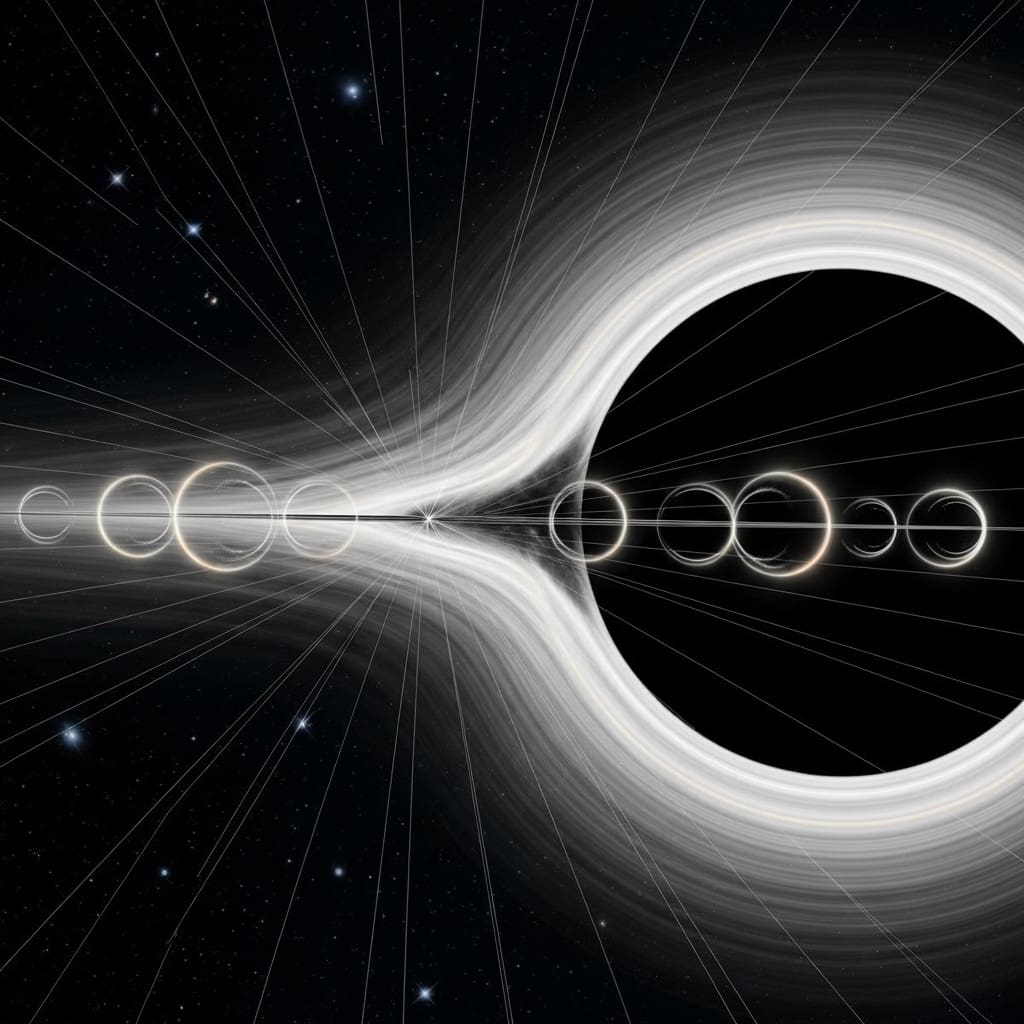
Researchers are increasingly investigating modifications to general relativity to account for phenomena such as dark matter and string theory. Faizuddin Ahmed from The Assam Royal Global University, Ahmad Al-Badawi from Al-Hussein Bin Talal University, and İzzet Sakallı from Eastern Mediterranean University, along with their colleagues, have probed the characteristics of a charged Hayward black hole within environments incorporating both perfect fluid dark matter and a string cloud. Their work is significant because it models a more realistic astrophysical scenario than previous studies, combining multiple theoretical elements to predict observable effects on black hole shadows, particle orbits, and quasinormal modes. By analysing these features, the team demonstrates that the combined influence of dark matter and string clouds could potentially be independently constrained through future gravitational wave and electromagnetic observations, offering a novel avenue for testing extensions to Einstein’s theory.
Detecting dark matter and string clouds via charged black hole shadow enlargement offers a novel observational approach
Scientists are refining techniques to probe the environments surrounding black holes, revealing subtle connections between exotic matter and observable phenomena. Recent work demonstrates that the presence of both perfect fluid dark matter (PFDM) and a cloud of strings (CS) enlarges the shadow of a charged Hayward black hole, offering a potential pathway for detecting these elusive components of the universe.
This research establishes a clear link between theoretical parameters describing dark matter and string clouds and the measurable size of a black hole’s shadow, a crucial step towards validating models of gravity and dark matter. The study constructs a charged Bardeen black hole incorporating PFDM and a cloud of strings, meticulously modelling the spacetime geometry with a metric function that accounts for electric charge, dark matter effects, and the influence of the string cloud.
Researchers analysed the horizon structure, identifying conditions that yield non-extremal black holes, extremal configurations, and even the possibility of naked singularities, thereby mapping the parameter space for stable and observable black hole solutions. Detailed calculations of null geodesics, the sphere radius, and crucially, the shadow radius, reveal that both the cloud of strings and the perfect fluid dark matter contribute to an enlargement of the black hole’s shadow.
For neutral particle dynamics, the specific energy, angular momentum, and the location of the innermost stable circular orbit were derived, providing insights into the behaviour of matter orbiting these modified black holes. Investigations into quasiperiodic oscillations (QPOs) through azimuthal, radial, and vertical epicyclic frequencies showed that the azimuthal frequency remains independent of the cloud of strings parameter, offering a unique observational signature.
Scalar field perturbations, governed by the Klein-Gordon equation, yielded an effective potential whose peak decreases with both parameters, although the transmission and reflection probabilities exhibit opposite responses to variations in the cloud of strings and perfect fluid dark matter. The research establishes that parameters α, representing the cloud of strings, and β, representing the PFDM, modify the shadow radius, suggesting that even small changes in the observed shadow size could indicate the presence of these exotic components.
Semi-analytical methods were employed to obtain greybody factor bounds, further refining the theoretical predictions. These findings demonstrate that the distinct effects of α and β on various observables could allow independent constraints on these parameters through shadow measurements, QPO timing, and gravitational wave ringdown observations, potentially utilising data from future telescopes like the Event Horizon Telescope.
Hayward black hole metrics, horizon analysis and shadow characteristics with dark matter and strings are thoroughly investigated
A charged Hayward black hole surrounded by perfect fluid dark matter and a cloud of strings served as the central object of this study. Researchers constructed a metric function incorporating a magnetic monopole charge from nonlinear electrodynamics, a logarithmic correction from the perfect fluid dark matter, and a parameter representing the cloud of strings, resulting in an asymptotically non-flat spacetime.
The horizon structure was then analysed to identify parameter ranges allowing for non-extremal black holes, extremal configurations, and potential naked singularities. Null geodesics were calculated alongside the sphere radius to determine the shadow cast by the black hole, revealing that both the cloud of strings and the perfect fluid dark matter enlarge this shadow.
To characterise neutral particle dynamics, the specific energy, angular momentum, and location of the innermost stable circular orbit were derived. Quasiperiodic oscillations were examined by computing the azimuthal, radial, and vertical epicyclic frequencies, with a notable finding being the independence of the azimuthal frequency from the cloud of strings parameter.
Scalar field perturbations were then governed by the Klein-Gordon equation, yielding an effective potential whose peak decreased with both the cloud of strings and perfect fluid dark matter parameters. However, the transmission and reflection probabilities exhibited opposing responses to variations in these parameters.
Semi-analytical methods were employed to obtain bounds on the greybody factor, allowing for a detailed investigation of the interplay between these exotic components and observable black hole properties. The resulting data demonstrated that the distinct effects of the cloud of strings and perfect fluid dark matter on various observables could enable independent constraints on these parameters through shadow measurements, QPO timing, and gravitational wave ringdown observations.
The scalar perturbation potential, crucial for understanding the propagation of massless scalar fields, was calculated as a function of dimensionless radial distance, varying the perfect fluid dark matter parameter and the cloud of strings parameter while holding other parameters constant. Observations revealed that increasing either parameter lowered the height of the potential peak, indicating a reduced effective gravitational barrier for scalar waves.
This suggests that scalar waves can propagate more easily in the black hole spacetime with higher values of these parameters, potentially leading to longer-lived quasi-normal modes and slower decay of scalar perturbations. Transmission and reflection probabilities were then investigated using a semi-analytic approach, providing rigorous bounds on the transmission and reflection coefficients for one-dimensional potential scattering problems.
Lower bounds on the transmission probability and upper bounds on the reflection probability were derived using established formulas involving the derivative of a positive function and the effective potential. Analysis of these probabilities showed that increasing the perfect fluid dark matter parameter suppressed transmission, while increasing the cloud of strings parameter enhanced it, further highlighting their distinct influences on black hole dynamics.
Shadow radius modification by perfect fluid dark matter and string clouds offers a novel galactic halo model
Researchers have demonstrated that both perfect fluid dark matter (PFDM) and a cloud of strings (CS) enlarge the shadow of a charged Hayward black hole. This enlargement offers a potential pathway for detecting these phenomena through observations of black hole shadows. The study meticulously analyzes how the parameters α, representing the cloud of strings, and β, denoting PFDM, modify the shadow radius, establishing a crucial link between these parameters and observable quantities.
This connection allows for quantitative analysis using future observational data. The work focuses on the modification of the shadow radius by parameters α and β, revealing that even small changes in the observed shadow size could indicate the presence of these exotic components. Neutral particle dynamics were analyzed through specific energy, angular momentum, and innermost stable circular orbit conditions, providing a detailed understanding of particle behavior around the modified black hole.
Quasiperiodic oscillations were studied using a relativistic precession model, yielding orbital, radial, vertical, and periastron frequencies. Scalar perturbations, governed by the Klein-Gordon equation, were examined, and greybody factors were computed using semi-analytical bounds. Results show that increasing both α and β suppresses the peak of the effective potential for photons and scalar waves, while simultaneously producing opposite effects on the specific energy of orbiting particles.
These findings potentially provide testable predictions for observations from the Event Horizon Telescope and X-ray timing observations, offering a means to constrain the amount of dark matter and string clouds surrounding black holes. The research establishes that the distinct effects of α and β on various observables could allow independent constraints on these parameters. This is achieved through shadow measurements, QPO timing, and gravitational wave ringdown observations, opening new avenues for probing the nature of dark matter and exotic matter in the strong-field regime of black holes.
Detecting dark matter and string clouds via black hole shadow enlargement requires high-resolution observations and precise theoretical modeling
Researchers have demonstrated that combining perfect fluid dark matter and a cloud of strings enlarges the shadow cast by a charged Hayward black hole. This enlargement offers a potential avenue for detecting these phenomena through astronomical observations. The study involved constructing a theoretical model of a black hole incorporating both perfect fluid dark matter, which accounts for the behaviour of dark matter in the universe, and a cloud of strings, representing a theoretical component arising from string theory.
Analysis of this model revealed alterations to the black hole’s spacetime geometry and, crucially, a measurable increase in the size of its shadow. The significance of this work lies in its ability to connect theoretical concepts, dark matter and string clouds, to observable features of black holes. By establishing a relationship between the parameters defining the amount of dark matter and strings present, and the resulting shadow size, future telescopes such as the Event Horizon Telescope may be able to constrain the properties of these exotic components.
Furthermore, the research examined the behaviour of particles and gravitational waves around the modified black hole, revealing how these parameters influence quantities like orbital paths and the frequencies of quasi-normal modes. While the authors acknowledge that the model relies on certain assumptions about the nature of dark matter and string clouds, the findings establish a framework for quantitative analysis using observational data. Future research could focus on refining the model to incorporate more complex dark matter distributions or exploring the implications of these findings for gravitational wave astronomy.
👉 More information
🗞 Probing the Charged Hayward Black Hole in Dark Matter and String Cloud Environments through Shadow, Geodesics, and Quasinormal Spectrum
🧠 ArXiv: https://arxiv.org/abs/2602.02621


