

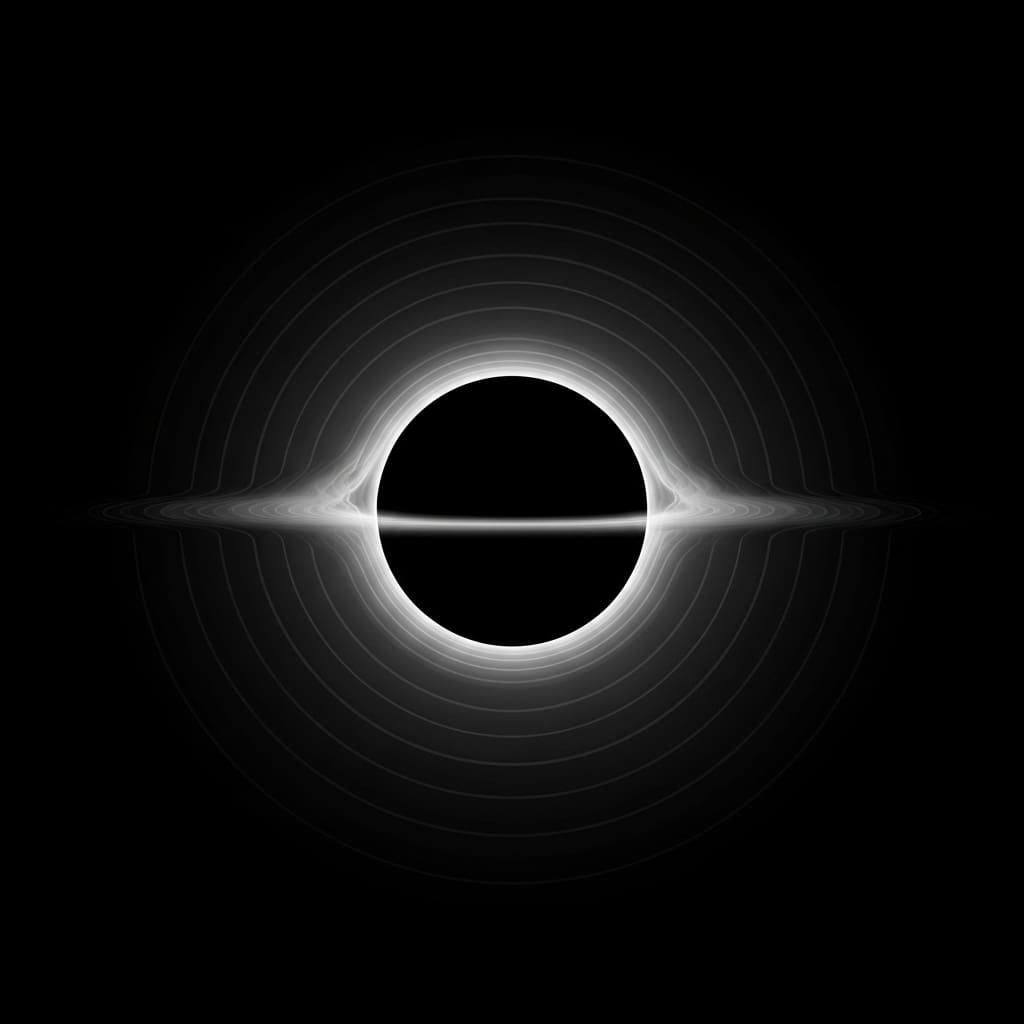
The quest to understand black holes extends beyond their event horizons, now encompassing investigations into their internal structure, and a new study establishes a clear link between a black hole’s inner geometry and its observable shadow. Ming-Xin Li, Jin Pu, and Yi Ling, along with Guo-Ping Li, have classified nonsingular black holes, those without a central singularity, into three distinct types based on their internal curvature, revealing how even subtle differences in core geometry affect the appearance of the black hole’s shadow. The team demonstrates that these variations manifest as measurable changes in shadow size and brightness, with certain types exhibiting greater sensitivity to underlying parameters, offering a promising avenue for testing theoretical models of gravity with future high-resolution observations. This research achieves a significant breakthrough by showing that the internal, unobservable structure of these exotic black holes directly impacts their external, observable features, providing a new tool for probing the nature of spacetime itself.
The team classifies these spacetimes into three fundamental types, Type I, Type II, and Type III, and demonstrates how subtle variations in the core geometry imprint distinguishable features on the BH shadow. Detailed analysis of photon dynamics reveals that the parameters α and n, which control the deviation from Schwarzschild geometry and the radial decay of the regularizing factor, respectively, systematically alter the properties of the photon sphere. These intrinsic geometric differences propagate outward, producing measurable effects on the black hole’s appearance.
Black Hole Shadows Reveal Internal Geometry
Scientists have established a direct link between the internal curvature of nonsingular black holes and their observable optical signatures. They classify these black holes into three distinct types, Type I, Type II, and Type III, based on how their curvature scales with mass, and demonstrate that subtle differences in the core geometry directly impact the appearance of the black hole shadow. Meticulous analysis of photon behavior reveals how parameters governing the deviation from standard black hole geometry systematically alter the photon sphere, the region where light orbits the black hole. The findings demonstrate that each black hole type produces a distinct shadow, with Type III black holes, possessing the most compact photon sphere, creating the smallest and brightest shadows, while Type I black holes generate the largest and dimmest.
These geometric distinctions are observable even when considering realistic scenarios involving infalling matter, suggesting a pathway to test theoretical models of gravity using future high-resolution astronomical observations. Specifically, the team measured that for a fixed set of parameters, the critical impact parameter decreases as α increases for all three types, while the widths of both the photon ring and lensed ring increase. Investigations using spherical accretion models reveal how spacetime parameters influence observable features, with Type III black holes exhibiting the strongest peak intensity and Type I the weakest. As n increases, the observed intensity gradually decreases for all types, but the differences between them become more pronounced at lower values of n, making Type III black holes optimal probes for constraining the underlying spacetime geometry.
Black Hole Shadows Reveal Quantum Effects
This research investigates black hole solutions beyond the classical Schwarzschild metric, driven by the expectation that quantum gravity effects will manifest in the near-horizon region of black holes. Researchers are actively seeking ways black hole shadows can reveal evidence of quantum gravity, and a significant portion of the work focuses on regular black holes, solutions that avoid the central singularity. Examples include Morris-Thorne wormholes, Bardeen black holes, Hayward black holes, Einstein-Gauss-Bonnet (EGB) black holes, and solutions arising from noncommutative geometry. A major thrust is calculating the black hole shadow cast by these modified black hole solutions, as the size and shape of the shadow are sensitive to the black hole’s parameters.
Researchers are developing methods to estimate these parameters from observational data, using Bayesian analysis and other statistical techniques, and studying how light bends around these modified black holes provides another observational probe. Analyzing the stability of these black hole solutions under perturbations is crucial, and exploring the possibility of traversable wormholes offers alternatives to black holes. The research also investigates modified dispersion relations, non-minimal coupling, f(R) gravity, and the thermodynamics of black holes, employing numerical simulations to study black hole behavior, especially during mergers. This work encompasses a range of quantum gravity approaches, including Loop Quantum Gravity and String Theory, and considers solutions involving exotic matter.
This research is fundamentally about testing the limits of Einstein’s theory of general relativity, and any confirmed deviation would be a major breakthrough. Black holes are considered ideal laboratories for probing quantum gravity effects, and regular black holes may offer potential resolutions to the black hole information paradox. The findings could have implications for understanding supermassive black holes and interpreting observations from the Event Horizon Telescope, driving advances in theoretical physics and the development of new mathematical tools. This research represents a vibrant and active area of theoretical physics, and the combination of theoretical modeling, numerical simulations, and observational tests holds the promise of unlocking new insights into the nature of black holes, gravity, and the universe itself.
👉 More information
🗞 Linking interior curvature to observable shadows: A case study of nonsingular black holes
🧠 ArXiv: https://arxiv.org/abs/2512.21178


