
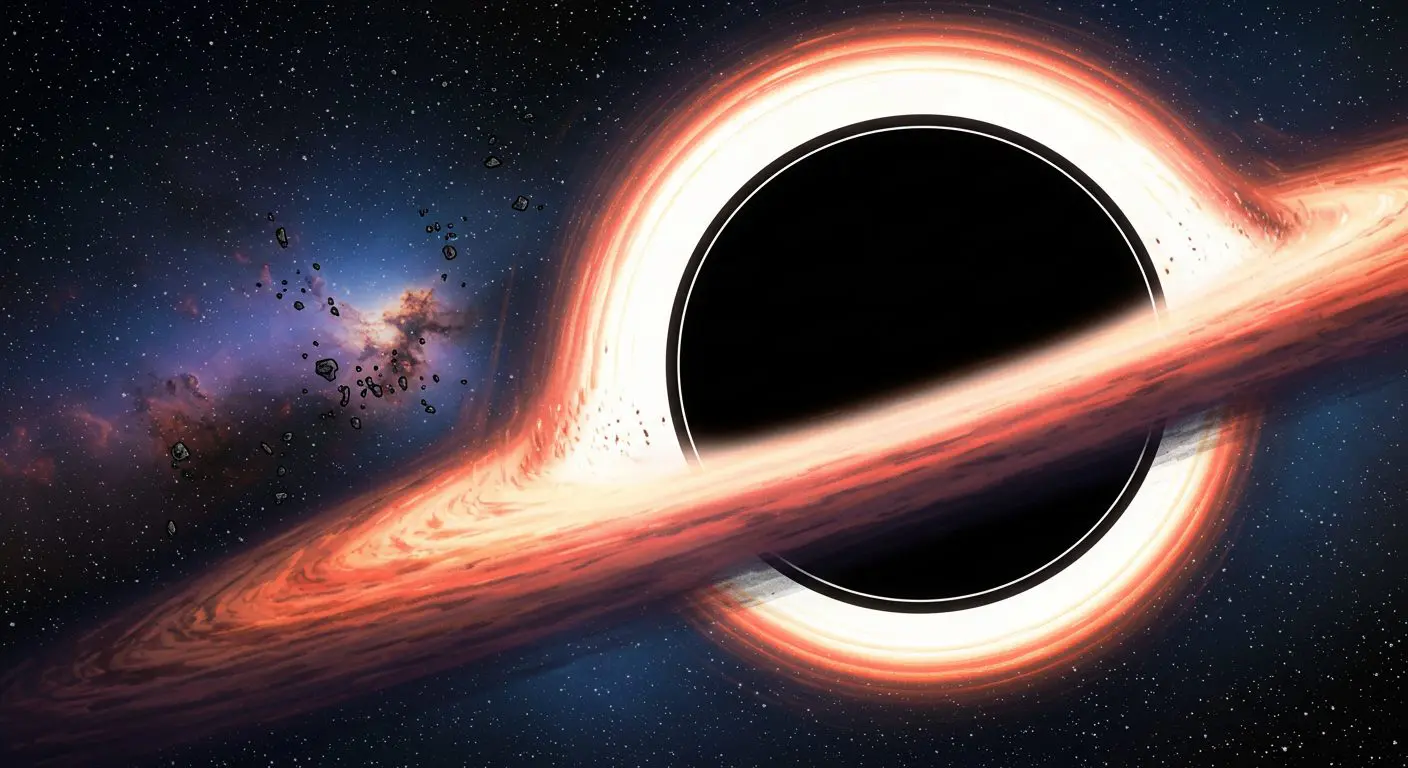
Research demonstrates a freely falling two-level atom near a black hole exhibits acceleration radiation consistent with the Einstein equivalence principle. Open-system analysis reveals horizon-brightened acceleration radiation entropy reproduces the Bekenstein-Hawking law, incorporating logarithmic and inverse-area corrections predicted by the Generalized Uncertainty Principle.
The behaviour of matter in extreme gravitational environments continues to yield insights into the fundamental laws governing the universe. Recent research focuses on the subtle interplay between quantum mechanics and general relativity, specifically examining how atoms respond to the intense gravity near black holes. Ali Övgün of Eastern Mediterranean University and Reggie C. Pantig of Mapúa University, alongside colleagues, investigate this phenomenon in a new study, titled ‘HBAR entropy of Infalling Atoms into a GUP-corrected Schwarzschild Black Hole and equivalence principle’. Their work explores the excitation of atoms falling into a black hole modified by the Generalized Uncertainty Principle (GUP), a theoretical framework suggesting a minimum measurable length scale, and demonstrates a connection to the Einstein equivalence principle, which posits the indistinguishability of gravitational and accelerated frames of reference. Furthermore, the researchers calculate the ‘horizon-brightened acceleration radiation’ (HBAR) entropy, revealing its consistency with the established Bekenstein-Hawking entropy law, with modifications reflecting the influence of GUP effects.
Black hole research consistently demonstrates that thermal radiation processes near event horizons adhere to established entropy laws, as scientists investigate acceleration radiation emitted by a two-level atom falling into a Generalized Uncertainty Principle (GUP)-corrected Schwarzschild black hole. The Schwarzschild metric describes the spacetime geometry around a non-rotating, uncharged black hole. Researchers establish that the excitation probability of the atom, induced by the black hole’s gravity, aligns with that produced by a uniformly accelerating mirror, thereby upholding the Einstein equivalence principle, a cornerstone of modern physics which posits the indistinguishability of gravitational and accelerated frames of reference. This consistency extends beyond the Schwarzschild metric, holding true for any static, spherically symmetric black hole geometry, solidifying the foundations of gravitational theory.
The investigation employs an open quantum system framework to analyse horizon-brightened acceleration radiation (HBAR) entropy for the GUP-corrected spacetime, providing a novel approach to understanding quantum gravity. Open quantum systems are those that interact with their environment, necessitating a different analytical approach than isolated quantum systems. Results indicate this entropy reproduces the established Bekenstein-Hawking entropy law, a cornerstone of black hole thermodynamics which relates a black hole’s entropy to its surface area, confirming the validity of the methodology. Importantly, the calculations reveal universal logarithmic and inverse-area corrections attributable to GUP effects, implying that modifications to spacetime at the Planck scale, the smallest unit of length in physics, directly influence black hole entropy.
The findings underscore the robustness of thermal radiation processes occurring near event horizons, demonstrating a consistent framework for understanding black hole thermodynamics. The research establishes a connection between GUP-induced spacetime modifications and black hole entropy, suggesting a pathway to reconcile quantum mechanics and general relativity, offering a potential solution to long-standing theoretical challenges. Specifically, the observed entropy corrections provide a potential mechanism for resolving singularities, points of infinite density, predicted by classical general relativity, as GUP introduces a minimum length scale that prevents their formation.
Researchers investigate the implications of these findings for our understanding of the universe, exploring the potential for GUP to resolve long-standing problems in cosmology and particle physics. They propose future experiments to test the predictions of GUP, utilising advanced gravitational wave detectors and high-energy particle colliders. The study contributes to the ongoing effort to develop a comprehensive theory of quantum gravity, uniting the principles of general relativity and quantum mechanics.
👉 More information
🗞 HBAR entropy of Infalling Atoms into a GUP-corrected Schwarzschild Black Hole and equivalence principle
🧠 DOI: https://doi.org/10.48550/arXiv.2506.10621