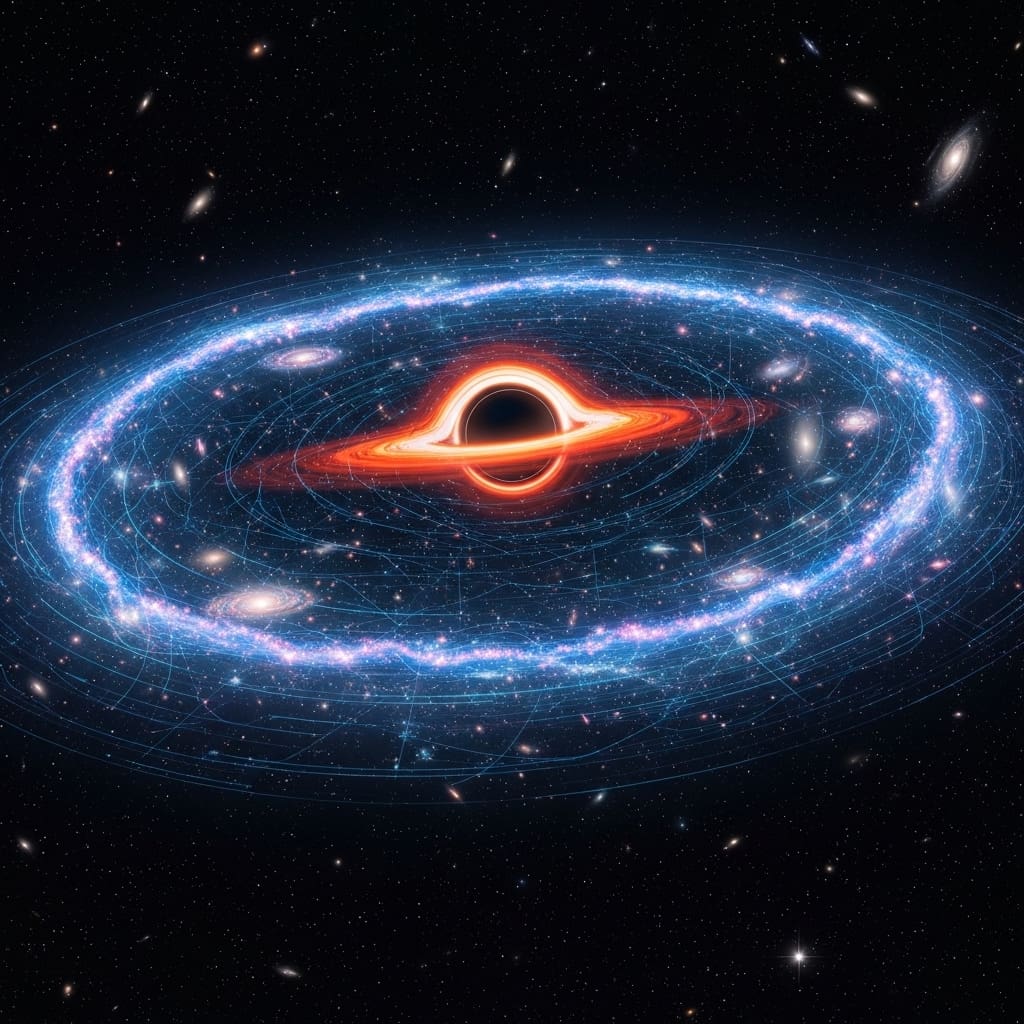
Scientists continue to grapple with the black hole information paradox, a long-standing problem in theoretical physics concerning the fate of information that falls into a black hole. Hao Geng, Andreas Karch, Carlos Perez-Pardavila, Suvrat Raju, Lisa Randall, Marcos Riojas, and et al. present a novel analysis of the Page curve, a theoretical tool used to track the entropy of Hawking radiation, and its connection to the emergence of black hole interiors. Their work challenges the conventional interpretation of the Page curve, demonstrating that in standard gravitational theories, the Hilbert space does not factorise in the way previously assumed. This finding suggests that information is not recovered from a black hole, but is instead already encoded in asymptotic observables, and that the entire interior can be reconstructed from exterior data. By manipulating the observable algebra, the researchers show how Page curves and associated “islands” can be obtained through operational restrictions, representing a redistribution of information rather than its fundamental recovery, with implications for understanding information transfer even when black holes couple to external systems.
Recent work challenges the notion that information genuinely “emerges” from a black hole, proposing instead that it is already encoded within accessible, asymptotic observables.
This research responds to arguments presented in a prior study, demonstrating that in quantum gravity, the algebra of observables at infinity is complete, irrespective of whether the spacetime is Anti-de Sitter (AdS) or asymptotically flat. This completeness fundamentally alters the conventional understanding of the black hole Hilbert space, preventing its factorization along the radial direction and undermining a key assumption within Hawking’s original argument for information loss.
Consequently, the full interior of a black hole can be reconstructed from exterior data, negating the need to solely consider an “island” as the source of recoverable information. Researchers have demonstrated that Page curves and islands can be artificially generated by removing the Hamiltonian from the exterior algebra of observables.
This removal can be conceptually implemented by limiting observation to a specific region of the asymptotic space, akin to a detector with a “blind spot”, or, in flat spacetimes, by formally excluding the Hamiltonian from the observable set despite its physical accessibility. These artificially constructed Page curves, however, represent a mere redistribution of information between measured and unmeasured degrees of freedom, rather than a fundamental recovery of information lost within the black hole.
The study extends to scenarios involving a black hole coupled to a non-gravitational bath, revealing that even in these nonstandard gravity setups, the unique localization of information within gravity provides a concrete mechanism for transferring information from the gravitational system into the bath. This work reinforces the “principle of holography of information”, suggesting that information about the black hole interior is consistently accessible in the exterior, offering an elegant resolution to the long-standing information paradox.
Establishing Observable Completeness and Hamiltonian Reduction for Black Hole Information Retrieval
Investigations into the Page curve and associated paradoxes form the basis of this work, responding to recent analyses concerning information retrieval from black holes. The study begins by establishing the completeness of the algebra of observables at infinity, both in Anti-de Sitter (AdS) and asymptotically flat spaces.
This completeness demonstrates that the bulk Hilbert space in gravity does not factorize radially, challenging a central assumption within Hawking’s argument for information loss and initial derivations of the Page curve. Consequently, information does not “emerge” from a black hole in the manner previously proposed; instead, it is already encoded within asymptotic observables.
Relatedly, the research demonstrates that the entire black hole interior, rather than solely an “island” region, can be reconstructed from exterior data. Page curves and islands are then generated by removing the Hamiltonian from the exterior algebra of observables. This removal is implemented either by restricting observations to a portion of the asymptotic region, effectively creating a detector with a “blind spot”, or, specifically in asymptotically flat spacetimes at null infinity, by formally excluding the Hamiltonian from the observable set despite its physical accessibility.
These resulting Page curves delineate a redistribution of information between measured and unmeasured degrees of freedom, rather than a fundamental recovery of lost information. Further analysis extends to scenarios where a black hole is coupled to a non-gravitational bath, yielding a non-standard theory of gravity.
Even within this complex setup, the unique localization of information in gravity provides a concrete physical mechanism for transferring information from the gravitational system into the bath. The work refines earlier observations regarding the inconsistency of compact entanglement wedges, termed “islands”, in standard gravitational theories, demonstrating that any such wedge must include a portion of the asymptotic boundary to be consistent with observable commutators. This research highlights the principle of holography of information, asserting that information about the black hole interior is consistently accessible in the exterior, offering an elegant resolution to the information paradox.
Completeness of asymptotic observables precludes black hole information emergence
Research demonstrates that in both AdS and asymptotically flat space, the algebra of observables at infinity remains complete. This completeness fundamentally implies that the bulk Hilbert space in gravity does not factorize along the radial direction, directly challenging a central tenet of Hawking’s argument for information loss and initial derivations of the Page curve.
Consequently, information does not emerge from a black hole in the manner previously proposed by the Page curve, but is instead already encoded within asymptotic observables. The full black hole interior, extending beyond just an “island” region, can be reconstructed using data from the exterior. Page curves and islands are obtainable by removing the Hamiltonian from the exterior algebra, a process achievable through restricting access to a portion of the asymptotic region, effectively creating a detector with a “blind spot”.
Alternatively, in asymptotically flat spacetimes at null infinity, the Hamiltonian can be formally discarded from the set of observables. These resulting Page curves represent a redistribution of information between measured and unmeasured degrees of freedom, rather than a fundamental recovery of information.
Furthermore, Page curves and islands also manifest when a black hole interacts with a nongravitational bath, resulting in a nonstandard gravitational scenario. Even within this context, the unique localization of information in gravity provides a concrete physical mechanism for transferring information from the gravitational system into the bath.
The work clarifies that to observe a Page curve in standard gravity, artificial restrictions must be imposed by neglecting accessible degrees of freedom, indicating these curves do not directly address the information paradox. Detailed analysis reveals that compact entanglement wedges, or “islands”, are inconsistent with standard gravitational theories when the global state is pure, due to a non-zero commutator between observables inside the wedge and those outside, including the Hamiltonian.
The “islands” described in recent literature are not truly compact, as they invariably include a portion of the asymptotic boundary. While relational observables can create approximately-local algebras, these are insufficient to define a fine-grained entropy for the black hole exterior that aligns with the Page curve or to establish consistency for islands within standard gravitational frameworks.
Asymptotic completeness resolves the black hole information paradox
Recent analyses of the Page curve and associated paradoxes demonstrate that the algebra of observables at infinity is complete in both Anti-de Sitter and asymptotically flat spacetimes. This completeness fundamentally challenges a key assumption within Hawking’s argument for information loss and early derivations of the Page curve, specifically the factorization of the bulk Hilbert space along the radial direction.
Consequently, information does not emerge from a black hole as typically described by the Page curve, but is instead already encoded within asymptotic observables. Furthermore, the entirety of the black hole interior, rather than solely an “island”, can be reconstructed using data from the exterior. Page curves and islands can be mathematically derived by removing the Hamiltonian from the exterior algebra of observables, a process achievable through operational restrictions such as a detector with a limited field of view or, in asymptotically flat spacetimes, by formally excluding the Hamiltonian from observable quantities.
These resulting Page curves represent a redistribution of information between measured and unmeasured degrees of freedom, rather than a fundamental recovery of lost information. The emergence of Page curves and islands also occurs when a black hole interacts with a non-gravitational bath, resulting in a modified gravitational framework.
Even within this context, the unique localization of information in gravity provides a mechanism for transferring information from the gravitational system into the bath. The Hamiltonian, accessible to an external observer as an integral over a sphere at infinity, allows for the evolution of observables into the past, enabling the probing of the black hole interior.
This is because matter currently within the black hole existed outside it previously, and holographic principles dictate that interior observables can be expressed in terms of those at infinity, preventing Hilbert space factorization. Standard Page curves, unlike those found in typical literature, do not arise from simply surrounding a black hole with a detector, but rather from introducing a non-gravitational bath and measuring information flow across an artificial interface.
Restricting observations to a portion of the asymptotic boundary, effectively creating a detector “blind spot” that cannot measure the full Hamiltonian, can also generate a Page curve. A simple example illustrates this with a static black hole in Anti-de Sitter space, where entanglement entropy follows a Page curve as a function of the boundary region’s angular size, demonstrating a redistribution of information rather than its emergence. Discarding Hamiltonian components from observables at future null infinity in asymptotically flat spacetimes similarly yields a Page curve, highlighting that these curves often describe information redistribution rather than fundamental recovery.
👉 More information
🗞 Seeing Page Curves and Islands with Blinders On
🧠 ArXiv: https://arxiv.org/abs/2602.06543