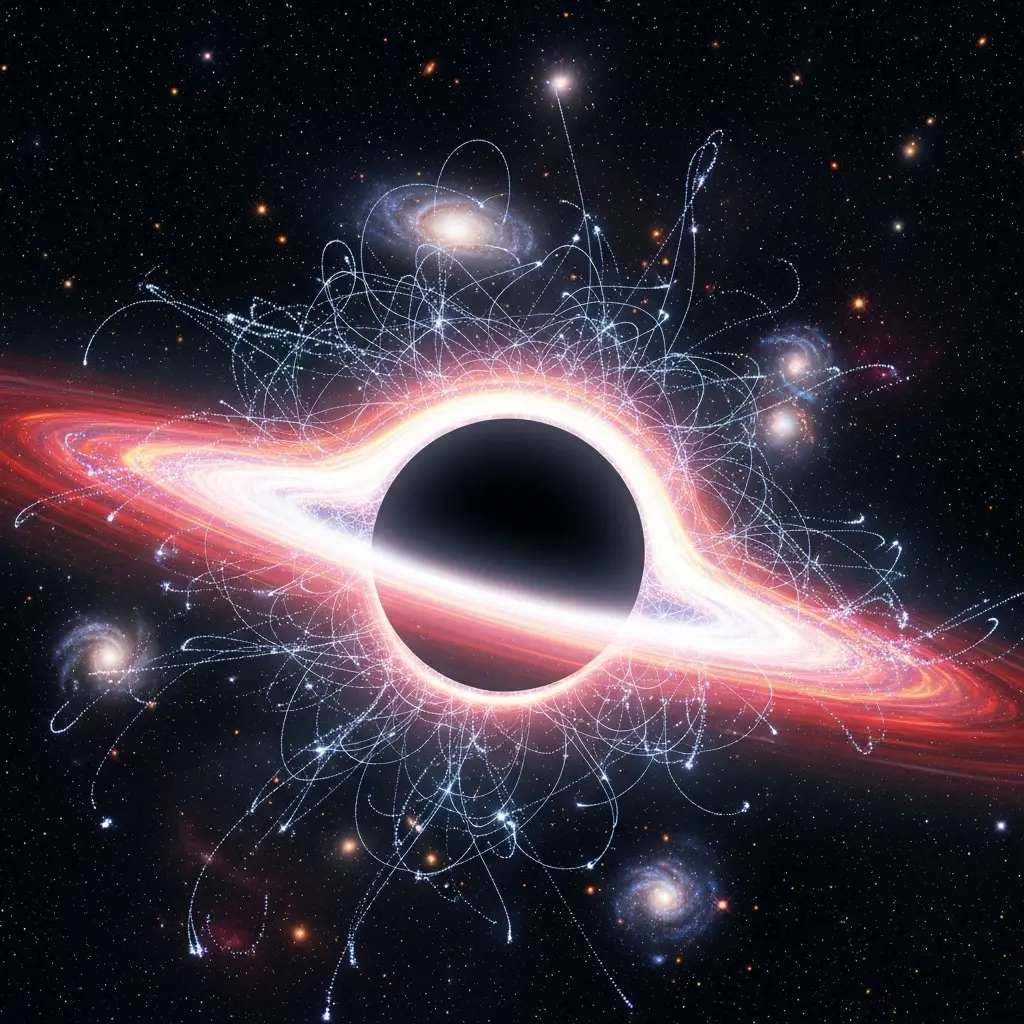
The fate of information swallowed by black holes remains one of physics’ most enduring puzzles, and new research explores what happens as these objects approach their ultimate limit. Samuel E. Gralla from the University of Arizona, along with colleagues, investigates whether black holes can truly evaporate past the point of ‘extremality’, where the usual laws of physics break down. The team’s work reveals two potential outcomes for collapsing matter reaching this critical stage, either forming a conventional singularity or, more surprisingly, re-emerging as an expanding shell of matter carrying information about what fell into the black hole. This offers a novel pathway to address the information paradox, potentially allowing scientists to study the process in conditions where extreme gravity is less of a factor, and even suggests a radical new picture of black hole interiors, where matter doesn’t collapse to a point but instead continues outwards along an outgoing trajectory.
Black Hole Evaporation and Information Loss
This extensive body of work explores black hole evaporation, the information paradox, and related topics in quantum gravity. Research initially focused on establishing the theoretical framework for Hawking radiation and identifying the information paradox, then progressed to investigating instabilities and quantum effects within black holes. Scientists have explored various mechanisms for resolving the paradox, including the firewall paradox, the ER=EPR conjecture, and the use of replica wormholes. Current research refines our understanding of quantum effects near black hole horizons, explores the backreaction of quantum fields on spacetime geometry, and develops more accurate models of black hole evaporation.
The progression of ideas highlights the central role of entanglement and the importance of the inner horizon in understanding the fate of information within black holes. Early investigations, beginning with foundational work on gravitational collapse and the thermal nature of Hawking radiation, laid the groundwork for understanding the paradox. Subsequent research shifted attention to the inner horizon of black holes, exploring potential instabilities and quantum fluxes that might release information. This period saw the emergence of radical proposals, such as the firewall paradox and the ER=EPR conjecture, which attempted to reconcile quantum mechanics and general relativity.
Charged Thin-Shell Collapse Models Black Hole Evaporation
Scientists investigated the final stages of black hole evaporation using a model of spherical collapse within a charged spacetime. They constructed a scenario where matter collapses into a black hole while simultaneously emitting Hawking radiation, represented as negative-energy null dust. By prescribing a decreasing mass function within the spacetime, researchers simulated the energy loss due to Hawking radiation and modeled the resulting evaporation process. Analysis of the collapsing matter shell revealed two possible outcomes, depending on its initial binding energy. Tightly bound shells formed a persistent timelike singularity, while unbound or modestly bound shells transitioned into an expanding null shell. This expanding remnant, bathed in outgoing Hawking quanta during evaporation, is theorized to carry correlations with the emitted radiation, offering a potential pathway to investigate information loss in a low-curvature environment. The team modeled the interaction of incoming radiation with the shell as a classical process, simplifying the complex physics with a stress-free charged shell approximation.
Black Hole Evaporation Avoids Singularity, Re-emits Matter
Recent research demonstrates that black holes, as they evaporate via Hawking radiation, may not necessarily end their existence with a singularity, but instead transition into a remnant of outgoing matter. Using a thin-shell collapse model coupled with charged spacetime, scientists analyzed the fate of collapsing matter during black hole evaporation. Their analysis revealed that tightly bound shells form a timelike singularity, while unbound or modestly bound shells re-emerge as an expanding null shell. This expanding remnant, bathed in outgoing Hawking quanta, carries correlations with those quanta, potentially offering a new avenue for studying the information paradox in a simplified spacetime.
Measurements confirm that even as black holes evaporate down to the Planck size, the collapsing matter settles onto an outgoing null trajectory within the horizon throughout the entire evaporation process. This suggests that realistic black holes may not possess singular interiors, but instead consist of outgoing matter that gradually loses mass, charge, and angular momentum as they evaporate. This work provides a radical new scenario for the interior structure of evaporating black holes and offers a potential pathway to resolving the long-standing information paradox.
Evaporating Black Holes Avoid Singularity Formation
This research presents a novel exploration of black hole evaporation, challenging the traditional expectation of singularity formation. Scientists investigated the fate of matter collapsing into a charged black hole, considering the effects of Hawking radiation as the black hole shrinks. Their models demonstrate that, depending on the initial conditions of the collapsing material, either a timelike singularity forms or the matter re-emerges as an expanding shell of particles. This expanding matter carries correlations with the outgoing Hawking radiation, potentially offering a new avenue for studying the information paradox in a simplified setting. The research suggests that realistic black holes may not possess singular interiors, but instead consist of outgoing matter that gradually loses mass, charge, and angular momentum as they evaporate. While the current models rely on spherical symmetry and simplified conditions, the researchers acknowledge this as a limitation and suggest that the core principles may extend to more complex, realistic black holes.
🗞 Can black holes evaporate past extremality?
🧠 ArXiv: https://arxiv.org/abs/2510.18839