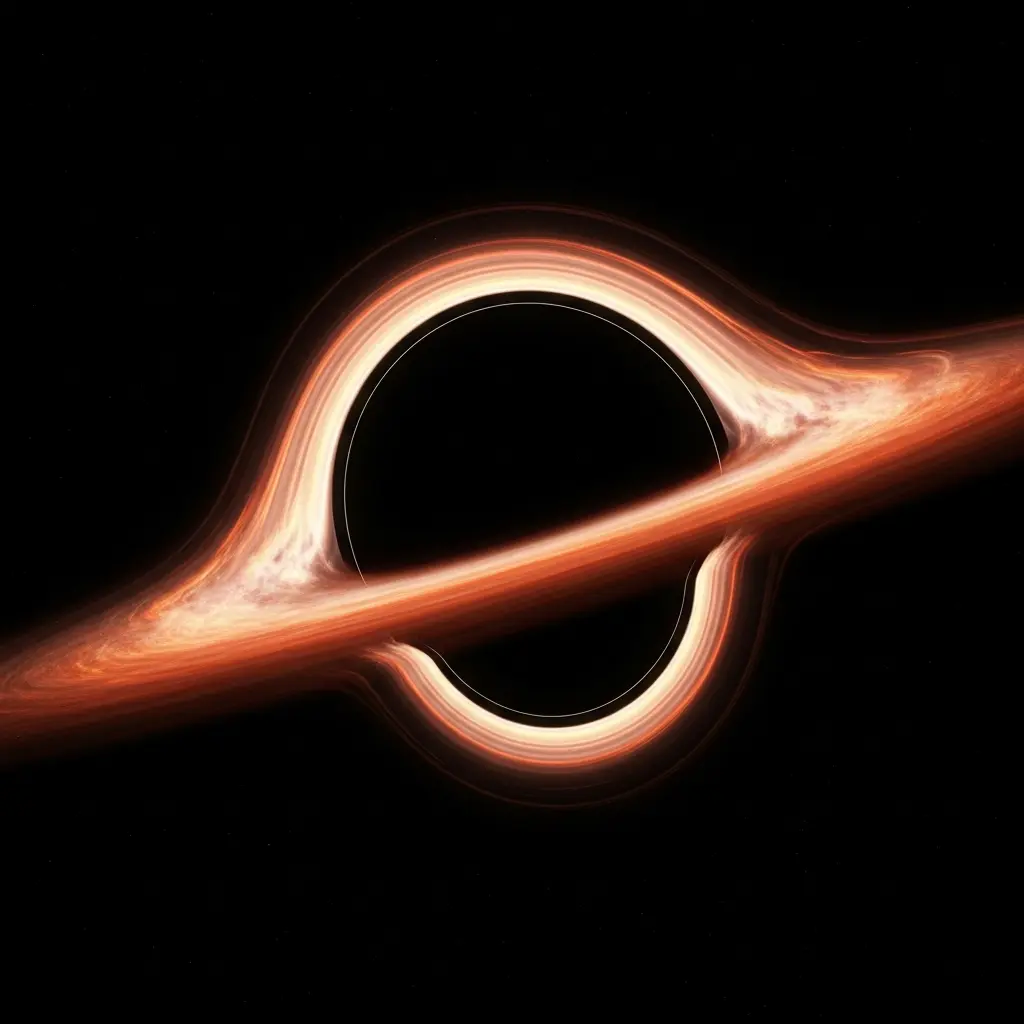
The long-standing black hole information paradox continues to challenge fundamental physics, prompting researchers to explore novel approaches to understanding how information escapes these enigmatic cosmic objects. J-B. Roux of Université d’Aix-Marseille, along with colleagues, demonstrate a surprising duality between point particles and massive scalar propagators within the framework of Liouville theory on a horizon. Their work recovers the entropy of a black hole boundary using effective field theory and proposes a correction to Hawking radiation, resulting in a Page-like curve that suggests information leakage from the horizon. This research represents a significant step towards resolving the paradox by directly encoding information onto the boundary, offering a new perspective on how information might be preserved even as matter falls into a black hole.
Recent work proposes a mechanism where information regarding the interior of a black hole is encoded onto its event horizon, consequently escaping into the bulk universe via Hawking radiation. This research represents a significant step towards resolving the paradox by directly encoding information onto the boundary, offering a new perspective on how information might be preserved even as matter falls into a black hole. The research addresses a fundamental problem in quantum gravity, stemming from the singularity predicted to exist beneath the black hole horizon, suggesting a breakdown in current gravitational physics.
Schwarzschild-Snyder Collapse and Infinite Timescales
The conventional understanding of black holes, rooted in Einstein’s field equations and exemplified by the Schwarzschild metric, describes the exterior of collapsing stars. The Oppenheimer-Snyder model detailed this gravitational collapse, initially criticised for its simplicity but later validated by more complex simulations. This model posits a finite time parameter, though an external observer would perceive this process as taking infinite time, and the state of the universe at the final moment remains uncertain for an infalling observer. A critical consideration is whether astrophysical black holes truly conform to the established Schwarzschild or Kerr solutions, which imply a final state in time.
If these solutions are inaccurate representations of reality, the information paradox , the apparent loss of information as a black hole evaporates , may stem from flawed initial assumptions. Recent research explores an alternative approach to understanding gravity through quantum mechanics, demonstrating that the partition function of General Relativity with a cosmological constant can be reduced to two Liouville models. This methodology involves representing a hypersurface as a point within a ‘super-space’ and applying standard quantum mechanical principles to determine the propagator of a point particle in curved space, defining the partition function with fixed boundary conditions. Specifically, the study proposes that the partition function of Einstein’s gravity is entirely described by a three-dimensional gravity theory existing on an initial hypersurface, itself defined by its boundary.
Information Recovery and Duality in Quantum Gravity
Scientists have established a duality between point particles and massive scalar propagators within a theoretical framework exploring quantum gravity. This work demonstrates that information seemingly lost behind a boundary, such as that of a black hole, is actually encoded on the boundary itself and directly leaks outwards as Hawking radiation. Experiments revealed a precise recovery of the black hole entropy, matching the form predicted by effective field theory approaches, and a corresponding quantum correction to the standard Bekenstein-Hawking entropy. The team calculated the expectation value of point-like sources and scalar propagators, uncovering a fundamental duality between the two, allowing them to describe information enclosed by a boundary using fields rather than particles.
This duality yielded a quantum-corrected entropy for the black hole, which follows a Page-like curve, indicating a potential resolution to the black hole information paradox, although further research is needed to definitively confirm this as a true Page curve. The predictive power of the theory is underscored by its ability to reproduce perturbative quantum gravity corrections with fixed coefficients. Further analysis demonstrates how information escapes the horizon, acting as a source for the scalar field at the cosmological boundary. By independently calculating the evolution of entropy within their model and within standard quantum field theory in curved space, scientists recovered a Page-like curve, supporting the consistency of their findings. The research builds upon previous work showing that the partition function of quantum gravity, with a specific time integration domain, leads to two H+3-WZW models, an instance of AdS3/CFT2 duality.
Black Hole Entropy and Information Recovery via Superspace
This research demonstrates a duality between point particles and massive scalar propagators within a specific quantum gravity approach, successfully recovering the black hole entropy formula consistent with effective field theory calculations. By describing a boundary as a point in a superspace, the authors have shown how information seemingly contained within a black hole can be encoded on its horizon and subsequently emitted via Hawking radiation. This work offers a novel perspective on the information paradox, suggesting that information leakage may be a natural consequence of the theoretical framework employed. The study builds upon a recent finding that the partition function of General Relativity with a cosmological constant can be reduced to Liouville models, allowing for the description of gravity in terms of boundary dynamics.
Through calculations involving point-like sources and scalar propagators, the researchers derived a quantum correction to the Bekenstein-Hawking entropy and observed an entropy curve resembling the Page curve, indicating potential progress towards resolving the information loss problem. The authors acknowledge that the observed Page-like curve requires further investigation to confirm its true nature, and that the initial assumptions regarding black hole formation may not fully reflect physical reality. Future research could focus on exploring the implications of this duality for different boundary conditions and investigating the behaviour of vector propagators. The authors also suggest that further refinement of the theoretical framework may be necessary to fully address the complexities of black hole evaporation and the associated information paradox, while acknowledging the possibility that current models of black holes are mathematical simplifications of more complex physical phenomena.
👉 More information
🗞 Liouville theory on a horizon: point particle/scalar field duality and Page-like curve
🧠 ArXiv: https://arxiv.org/abs/2601.08895