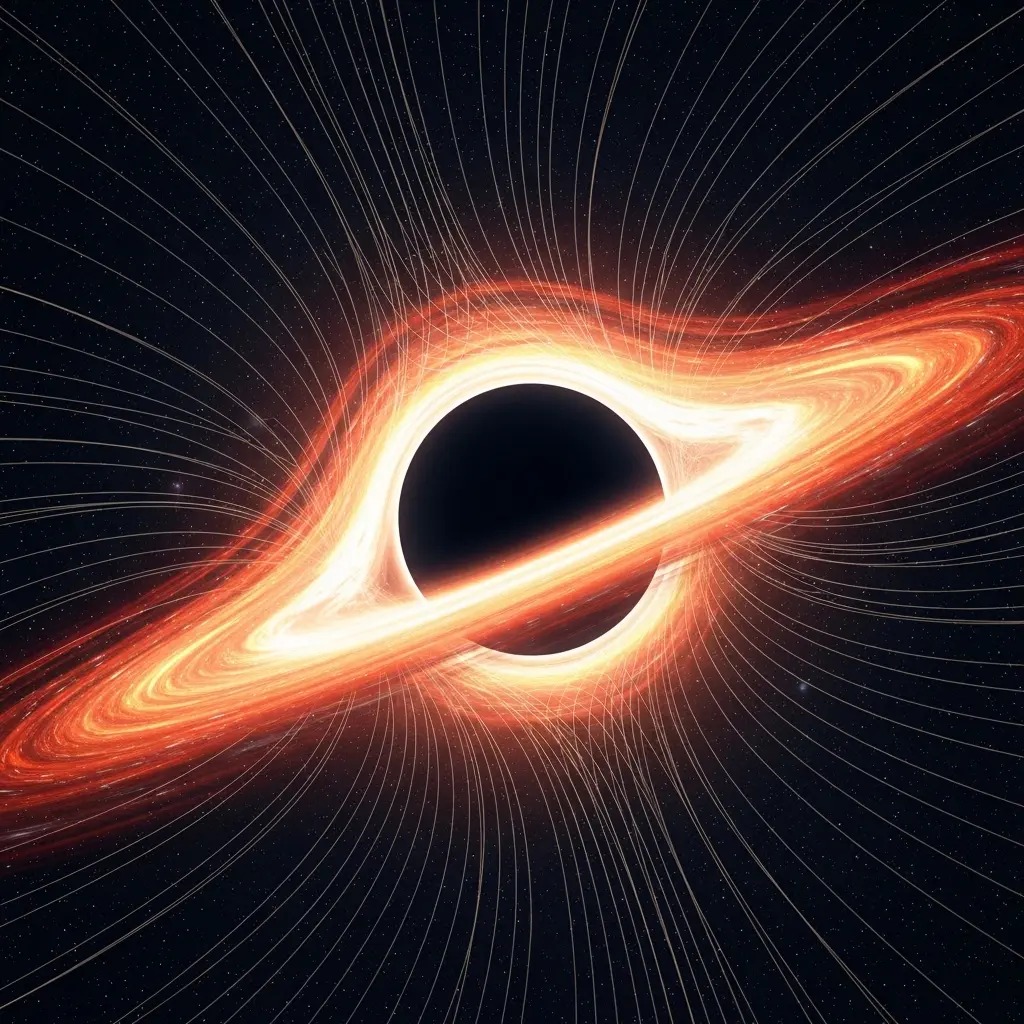
Researchers investigating gravitational-wave echoes following compact binary mergers have long sought evidence of exotic physics near black holes. Now, J.W. Moffat demonstrates that a compelling class of nonlocal gravity theories generically suppress these observable echo signals. This suppression arises from Paley-Wiener bounds inherent in the analytic structure of the nonlocal regulator, effectively damping high-frequency reflections and smoothing potential features within black holes. The findings are significant because they suggest the current lack of observed echoes in gravitational-wave data does not necessarily preclude classical horizons, remaining consistent with well-behaved, ultraviolet-finite theories that enforce unitarity and ghost freedom. This work establishes that echo suppression is a natural consequence of the underlying theory’s analytic structure, rather than relying on stochastic effects or decoherence.
Scientists investigated ultraviolet, finite quantum gravity and modified gravity theories founded on diffeomorphism, invariant, analytic, entire, function nonlocality. These theories generally suppress observable echo signals. The suppression arises from Paley, Wiener bounds linked to the analyticity of the nonlocal regulator, enforcing exponential damping of high, frequency reflection amplitudes and blurring sharp effective potentials within the black, hole interior.
Researchers demonstrated that for regular black holes possessing horizons, the standard ingoing boundary condition negates the cavity necessary for echoes. However, for regular horizon-less compact objects, the nonlocal kernel significantly attenuates both inner and photon, sphere reflections.
Suppression of ringdown echoes constrains quantum gravity theories
Scientists have demonstrated that repeated reflections during the ringdown phase are exponentially suppressed in frequency space and washed out in the time domain. Our results imply that the absence of echoes in current gravitational, wave data is consistent with covariant nonlocal gravity theories and does not, by itself, favor classical horizons over regular or horizonless ultraviolet completions.
The analyticity and Paley, Wiener bounds that enforce echo suppression are required to ensure unitarity, ghost freedom, and ultraviolet finiteness of the underlying quantum theory. As a result, the classical ringdown phenomenology already encodes quantum, gravity consistency conditions. We emphasize that the absence of echoes in such theories does not rely on quantum decoherence or stochastic effects, but instead reflects the analytic structure imposed by quantum gravity on the classical limit.
Probing Gravity in the Post-Merger Ringdown Phase
The detection of gravitational waves from compact binary mergers has opened a new observational window onto the strong, field regime of gravity. In particular, the post, merger ringdown phase, dominated by quasinormal modes of the remnant compact object, provides a sensitive probe of the near, horizon structure of spacetime.
Conceptual Models for Echoes Beyond Event Horizons
Motivated by this possibility, a number of works have proposed that departures from classical black holes, such as horizonless compact objects, quantum, modified horizons, or reflective surfaces replacing the event horizon, could generate late, time, repeating echoes in the gravitational, wave signal. Echoes arise when gravitational perturbations are repeatedly trapped between an effective potential barrier near the photon sphere and a partially reflective inner boundary.
In classical general relativity, an event horizon enforces purely ingoing boundary conditions, preventing such a cavity from forming. By contrast, many phenomenological echo models assume ad hoc reflective conditions at microscopic distances outside the would, be horizon or at the surface of a compact object.
Status of Theories Constraining Gravitational Echo Detection
The observational status of echoes remains unsettled, with current data providing no statistically compelling evidence for their existence. Ultraviolet, complete or ultraviolet, finite theories of quantum gravity can be constructed using nonlocal operators built from analytic entire functions of the covariant d’Alembertian [1, 2, 3, 4, 5, 6, 7, 8].
These theories preserve diffeomorphism invariance, avoid additional ghostlike degrees of freedom, and render quantum loop corrections finite. The nonlocality is controlled by a fundamental scale and is encoded through form factors whose analyticity implies Paley, Wiener bounds on their Fourier transforms [11, 12].
We show that these same analytic and diffeomorphism, invariant properties have direct and robust consequences for gravitational, wave ringdown phenomenology [13, 14, 15, 16, 17]. In particular, the Paley, Wiener bounds enforce an exponential suppression of high, frequency reflection amplitudes and smear any sharp features in the effective radial potential governing perturbations.
As a result, the two essential ingredients required for observable echoes, strong inner reflection and a sharply defined resonant cavity, are generically absent. We analyze both regular black holes possessing true event horizons and regular horizonless compact objects arising in nonlocal gravity. In the former case, the presence of a horizon enforces ingoing boundary conditions that eliminate inner reflection altogether.
In the latter case, regularity at the center replaces the notion of a hard reflecting surface, while the nonlocal kernel suppresses scattering from interior structure and from the photon, sphere barrier itself. In both situations, any would, be echo train is exponentially damped with increasing frequency and echo number, and is further smeared in the time domain by the intrinsic nonlocal scale.
Our results demonstrate that the absence of gravitational, wave echoes is a prediction of analytic entire, function nonlocal gravity theories. Consequently, non, detection of echoes should not be interpreted as evidence against ultraviolet completions featuring regular black holes or horizonless compact objects, but rather as a consistency check of covariant nonlocal dynamics.
Ringdown observations instead constrain the nonlocal scale and the analytic structure of the gravitational form factor, providing a complementary probe of quantum gravity in the strong, field regime. The suppression of gravitational, wave echoes derived in this work operates entirely at the level of classical wave propagation on a fixed background geometry.
The modified Regge, Wheeler, type equations [18, 19, 20], the smearing of effective potentials, and the exponential damping of reflection coefficients follow from classical integro, differential equations of motion. However, the specific nonlocal structure responsible for these effects, namely, analytic entire functions of the covariant d’Alembertian obeying Paley, Wiener bounds, is not motivated by classical considerations alone.
Such analyticity conditions are imposed to ensure unitarity, ghost freedom, and ultraviolet finiteness of the quantum gravitational theory. In this sense, quantum gravity is already implicitly encoded in the classical dynamics. The same analytic properties required for a consistent quantum theory manifest classically as a frequency, space filter that suppresses sharp reflections and eliminates the resonant cavity necessary for observable echoes.
The resulting ringdown phenomenology reflects quantum, gravity consistency conditions, even in the absence of explicit quantum fluctuations or loop effects. A covariant entire-function form factor F(□/Λ2 G) with F entire and F(0) = 1 can be implemented so that distributional matter sources are replaced by smooth effective profiles.
The effective stress tensor (4) must satisfy ∇μT μν = 0. For the metric (3) this implies: p′ r(r) + f ′(r) 2f(r) ρ(r) + pr(r) + 2 r pr(r) −pt(r) = 0. A minimal consistent condition for smeared static sources is T tt = T rr, pr = −ρ, which ensures regularity and simplifies (18) to a relation determining pt(r).
The detailed microphysical interpretation of pr, pt depends on the underlying nonlocal completion, but the geometric conclusions above follow already from the single input, a smooth, conserved T eff μν generated by the entire-function smearing map. The covariant entire-function regulator replaces distributional matter sources by smooth effective profiles, and for a smeared point mass leads to the closed-form metric (10).
The geometry is asymptotically Schwarzschild, develops a de Sitter core (13), and exhibits a sharp horizon phase diagram controlled by the single parameter μ = GM/l, with the extremal point determined implicitly by (16), (17). This is the sense in which the regulator simultaneously enforces UV finiteness via nonlocal damping and geometrically resolves the classical Schwarzschild singularity in the static, spherically symmetric sector.
We consider the class of covariant nonlocal theories in which the gravitational action is built from curvature invariants and analytic entire functions of the covariant d’Alembertian □≡gμν∇μ∇ν. A representative form is given by S = 1 16πG Z d4x √−g h R + R F1(□) R + Rμν F2(□) Rμν + Cμνρσ F3(□) Cμνρσi, where R, Rμν and Cμνρσ denote the Ricci scalar, Ricci and Weyl curvature tensors, respectively.
Each Fi(z) is analytic entire and chosen so that no additional propagating ghost poles are introduced. In ultraviolet, finite constructions one typically encounters an entire form factor or regulator of exponential type: F(z) = exp h − z/Λ2 G ni, n ∈Z≥1, with nonlocality scale ΛG. We study linearized gravitational perturbations.
Analyticity and nonlocality preclude sustained gravitational-wave echoes
Analytic entire-function nonlocal gravity theories generically suppress observable gravitational-wave echo signals through inherent properties of their construction. Paley-Wiener bounds, associated with the analyticity of the nonlocal regulator, enforce exponential damping of high-frequency reflection amplitudes and smear sharp effective potentials within black-hole interiors.
This work demonstrates that for regular black holes with horizons, the standard ingoing boundary condition eliminates the cavity necessary for echo formation. For regular horizonless compact objects, the nonlocal kernel strongly attenuates both inner and photon-sphere reflections, preventing the sustained reflections required for echoes.
Repeated reflections during the ringdown phase are therefore exponentially suppressed in frequency space and washed out when observed in the time domain. The absence of echoes in current gravitational-wave data is consistent with these covariant nonlocal theories and does not, in itself, favour classical horizons over regular or horizonless ultraviolet completions.
The analyticity and Paley-Wiener bounds that enforce echo suppression are essential for ensuring unitarity, ghost freedom, and ultraviolet finiteness of the underlying quantum theory. Consequently, classical ringdown phenomenology already encodes quantum-gravity consistency conditions. This suppression does not rely on decoherence or stochastic effects, but instead reflects the analytic structure imposed by quantum gravity on the classical limit.
The research highlights that the absence of echoes serves as a consistency check of covariant nonlocal dynamics rather than evidence against horizonless compact objects. This study demonstrates that the nonlocal scale and the analytic structure of the gravitational form factor can be constrained through ringdown observations, providing a complementary probe of quantum gravity in the strong-field regime. The modified Regge-Wheeler-type equations, the smearing of effective potentials, and the exponential damping of reflection coefficients all follow from classical integro-differential equations of motion derived from the nonlocal structure.
Analytic nonlocality diminishes gravitational-wave echo amplitudes from compact objects
Researchers investigated the suppression of late-time gravitational-wave echoes in a specific class of modified gravity theories based on nonlocality. These theories, built upon diffeomorphism invariance and analytic entire functions, generically diminish the amplitude of observable echo signals from compact binary mergers.
This suppression arises from Paley-Wiener bounds linked to the analyticity of the nonlocal regulator, which effectively dampens high-frequency reflection amplitudes and smooths out sharp potential features within black holes. For regular black holes possessing horizons, the standard ingoing boundary condition prevents the formation of the cavity necessary for echoes to develop.
In the case of regular, horizonless compact objects, the nonlocal kernel significantly weakens both inner and photon-sphere reflections, leading to exponential suppression of reflected signals in frequency space and their subsequent washing out in the time domain. Consequently, the lack of detected echoes in existing gravitational-wave data aligns with the predictions of these nonlocal theories and does not inherently favour classical horizons over alternative ultraviolet completions of black hole physics.
The analyticity and Paley-Wiener bounds are crucial for maintaining unitarity, avoiding ghost particles, and ensuring the ultraviolet finiteness of the theoretical framework, meaning that consistency conditions are already embedded within the classical ringdown phase. The authors acknowledge that their analysis relies on specific assumptions regarding the analytic structure of the nonlocal regulator and the conservation of the effective stress tensor.
Future research could explore the implications of different functional forms for the nonlocal kernel and investigate the effects of potential deviations from strict conservation laws. Furthermore, extending this analysis to more complex gravitational wave sources and incorporating additional physical effects, such as rotation and eccentricity, would provide a more comprehensive understanding of echo suppression in covariant nonlocal gravity.
🗞 Suppression of Gravitational-Wave Echoes in Diffeomorphism-Invariant Nonlocal Gravity
🧠 ArXiv: https://arxiv.org/abs/2602.04996