The search for novel states of matter increasingly relies on the principles of topology, a field promising both fundamental advances and potential technological breakthroughs. Jingyuan Zhong, Ming Yang, and Wenxuan Zhao, alongside colleagues at their respective institutions, now demonstrate the coexistence of multiple topological orders within quasi-one-dimensional bismuth halide chains. Their work overcomes a significant challenge in the field, revealing a composite phase where a strong topological state merges with a high-order topological state, achieved through precise control of the material’s composition. By meticulously investigating the system’s electronic structure, the team unveils a series of topological phase transitions, establishing a pathway to engineer a diverse range of topological phases based on the fundamental principle of band inversion, and providing an ideal platform for exploring these exotic states of matter.
Iodine Tuning Reveals Dual Topological Phase
This research details the discovery of a novel topological insulator, Bi₄(Br₁₋ₓIₓ)₄, exhibiting a unique dual topological phase, simultaneously hosting both high-order and strong topological insulator states. Scientists have demonstrated that this material’s electronic properties can be finely tuned by altering its composition, specifically the ratio of bromine and iodine. The material’s structure features chains running along a specific crystal axis, with two distinct types of bismuth atoms playing a crucial role in its topological behaviour. Investigations focused on the material’s surfaces, revealing the presence of unique electronic states characteristic of topological insulators.
The dual topological phase arises from double band inversions, occurring at specific points within the material’s electronic structure, directly linking to the different bismuth atom sites. These band inversions give rise to both two-dimensional surface states and one-dimensional hinge states, characteristic of high-order topological insulators. By carefully controlling the iodine content, researchers can tune the material between different topological phases, effectively switching between high-order and strong topological insulator states. The research team employed a range of experimental techniques to characterize the material, including angle-resolved photoemission spectroscopy to map the electronic band structure, and scanning tunneling microscopy to image the surface topography and probe the local density of electronic states. High-angle annular dark-field scanning transmission electron microscopy provided detailed images of the material’s atomic arrangement, while X-ray diffraction confirmed its crystalline structure. These combined techniques allowed for a comprehensive understanding of the material’s properties and the underlying mechanisms driving its topological behaviour.
Bismuth Halide Crystal Growth and Characterisation
Scientists investigated the topological phases within bismuth halide crystals, employing a multifaceted approach to characterize their electronic structure and properties. Single crystals of Bi₄(Br₁₋ₓIₓ)₄ were grown using both solid-state reaction and chemical vapor transport methods, allowing for precise control over the halide composition and tailoring of the material’s properties. The actual iodine content was carefully verified using energy dispersive spectroscopy, ensuring accurate control over the material’s composition. Structural characterization was performed using X-ray diffraction and high-angle annular dark-field scanning transmission electron microscopy, providing detailed images of the material’s atomic arrangement.
To probe the surface structure, scanning tunneling microscopy was utilized at low temperatures, revealing atomic-resolved topographies of the (001) and (100) crystal surfaces. Measurements of the crystal parameters revealed specific dimensions for the material’s unit cell, confirming its structural characteristics. Differential conductance spectra were acquired to analyze the electronic density of states, providing insights into the material’s electronic properties. Angle-resolved photoemission spectroscopy, performed at multiple facilities, was used to map the electronic band structure with high energy and angular resolution. Electrical transport measurements were conducted on freshly cleaved crystal surfaces to assess the material’s conductivity. First-principles calculations, based on advanced computational methods, were performed to complement the experimental results and provide theoretical insights into the material’s electronic structure and topological properties.
Bismuth Halides Exhibit Dual Topological Insulator States
Scientists have uncovered a novel material, bismuth halide, exhibiting a unique combination of topological states, simultaneously realizing both a strong topological insulator and a high-order topological insulator. This breakthrough stems from investigations into the material’s band structure using scanning tunneling microscopy, angle-resolved photoemission spectroscopy, and theoretical calculations, revealing double band inversions at specific points in its electronic structure. These band inversions, occurring at the M and L points within the material’s three-dimensional electronic structure, lead to the coexistence of these distinct topological phases. Experiments demonstrate that the bismuth halide material, α’-Bi₄Br₄, undergoes multiple topological phase transitions as the halide element ratio is altered.
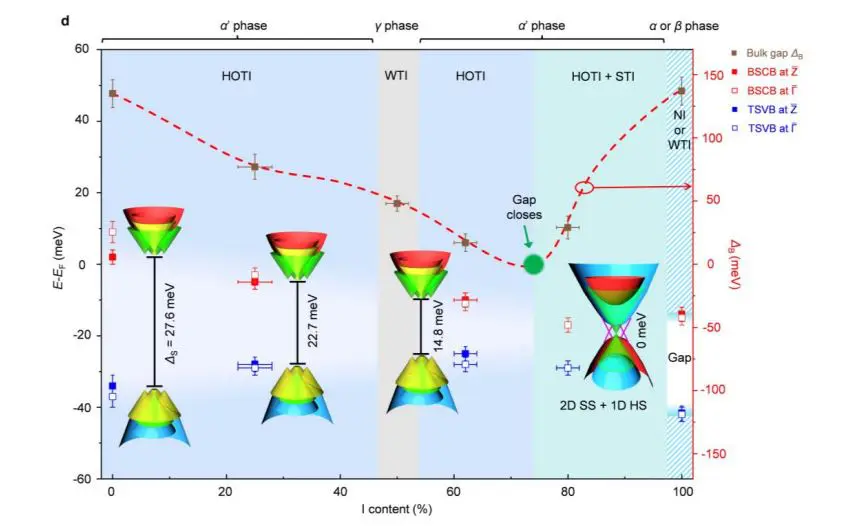
By varying the concentration of iodine atoms introduced into the bismuth bromide structure, researchers observed transitions from a high-order topological state to a weak topological state, then to an unusual dual topology, and finally to a trivial or weak topological state. Detailed analysis using high-angle annular dark-field scanning transmission electron microscopy and focused ion beam techniques confirmed a specific stacking mode within the material’s structure, consistent with previous reports and structural models. Measurements of the material’s crystal structure using X-ray diffraction revealed high crystalline quality, and a change in the lattice parameters with increasing iodine concentration. Energy-dispersive spectroscopy confirmed a monotonic change in iodine concentration corresponding to the intended composition. These findings establish a topological phase diagram for Bi₄(Br₁₋ₓIₓ) as a function of iodine concentration, providing a pathway for precise control over the material’s quantum properties and opening possibilities for advanced quantum devices.
Bismuth Halides Exhibit Multiple Topological Transitions
This research team successfully demonstrated a novel composite topological phase in a quasi-one-dimensional bismuth halide system, revealing the coexistence of strong and high-order topological states. Through careful manipulation of the material’s composition, specifically by varying the ratio of halide elements, the scientists observed multiple topological phase transitions, progressing from high-order to weak topology, then to an unusual dual topology, and finally to trivial or weak topological states. These observations establish bismuth halides as an ideal platform for realizing and studying complex topological phenomena. The significance of this work lies in the realization of a material system exhibiting multiple, sequentially occurring topological phase transitions, a feature not commonly observed.
By linking these transitions to band inversion mechanisms, the researchers provide valuable insight into the fundamental principles governing topological matter and offer a pathway for designing materials with tailored topological properties. This research provides a deeper understanding of the interplay between different topological phases and their potential for future applications. Further investigation is needed to fully understand the interplay between the different topological phases and to explore potential applications of these materials in future devices. Continued research focusing on the surface states and their response to external stimuli will be crucial for advancing this field and unlocking the full potential of these novel topological materials.
🗞 Coalescence of multiple topological orders in quasi-one-dimensional bismuth halide chains
🧠 ArXiv: https://arxiv.org/abs/2512.08239