
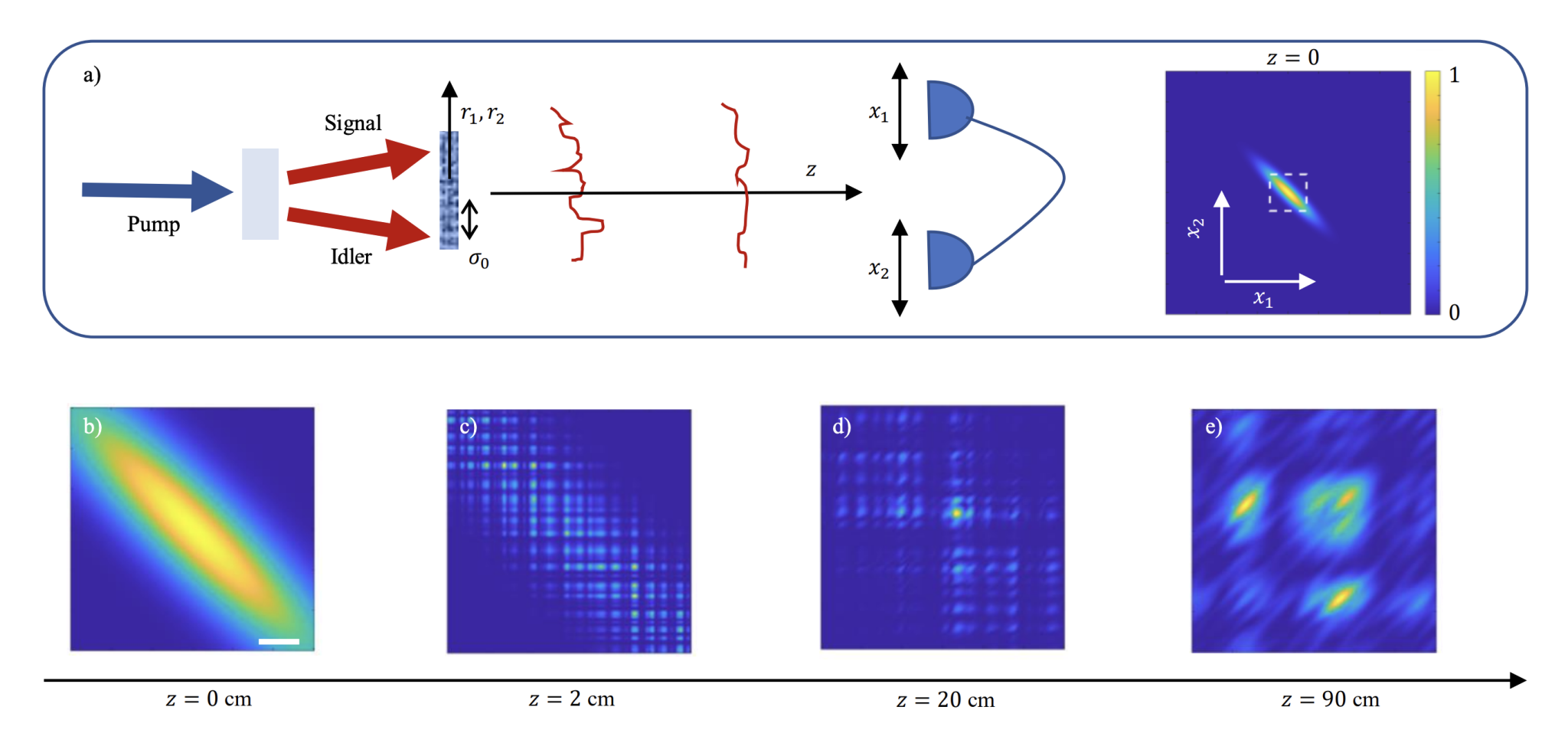
Quantum speckle patterns, the seemingly random interference patterns created with entangled light, exhibit far more complex behaviour than their classical counterparts, and researchers are now revealing previously unseen dynamics in these patterns. Shaurya Aarav, S. A. Wadood, and Jason W. Fleischer, all from Princeton University, investigate how these patterns evolve as entangled photons scatter, focusing on the short distances where previous studies have not looked. Their work demonstrates that the unique properties of entangled photons introduce a new ‘Fresnel regime’ between the traditionally defined near and far fields, creating square-shaped speckles that remain stable during propagation. This discovery merges the principles of quantum coherence with scattering statistics, and opens up exciting possibilities for advanced imaging and correlation-based technologies that exploit these newly understood regimes.
Speckle patterns – seemingly random interference created when light scatters from a rough surface – are increasingly recognised as a valuable resource for advanced imaging and sensing. Researchers have now demonstrated that quantum speckle, created using entangled photons, exhibits surprisingly rich behaviour, revealing new ways light can propagate that are not seen with classical light. This work challenges conventional understanding of speckle formation and opens exciting possibilities for future quantum technologies.
For decades, the study of speckle has focused on how it changes with distance from the scattering surface, typically described by a ‘near field’ and a ‘far field’. However, this framework assumes classical light. The team investigated how entangled photons behave when scattered and discovered an entirely new intermediate regime of speckle propagation, bridging the gap between the near and far fields.
This arises because entangled photons possess an extra degree of freedom – the correlation between their positions – allowing for unique control over speckle shape and size, impossible with classical light. The researchers validated their theoretical predictions through detailed numerical simulations and experimental measurements, carefully analysing the spatial correlations of the entangled photons to confirm the existence of this new propagation regime and characterise its unique properties. In this intermediate zone, the overall size of the speckle pattern can remain constant in one direction while simultaneously expanding in another, and the shape of the speckle itself transforms from a square grid-like pattern to an elliptical shape as the light propagates.
The method used to study this phenomenon involves propagating each photon individually, offering greater accuracy than traditional approximations. To accurately measure speckle size, the researchers removed slowly varying components from the data and employed techniques to enhance image quality and prepare it for analysis. Coincidence imaging – a technique that detects pairs of entangled photons – was used to capture the speckle patterns.
The results demonstrate the merging of quantum coherence with scattering statistics, suggesting new operational regimes for correlation-based quantum sensing and imaging. This integration allows for a more nuanced understanding of light-matter interactions at the quantum level, opening possibilities for developing advanced technologies that exploit quantum correlations for improved measurement capabilities and potentially enhanced sensitivity and resolution. This work investigates the propagation behaviour of biphoton speckles, revealing a distinct intermediate propagation region between the near and far fields, unlike what is observed with classical light.
The characteristics of this intermediate region depend on the correlation length of the scattering surface, alongside the correlation lengths of the biphoton, and the wavelength of the light. Varying these parameters results in differences in speckle shape, statistics, and dynamics. For higher-order photon number states, increased internal degrees of freedom offer further opportunities for separating scales, informing the generation, propagation, and control of high-dimensional entangled states.
👉 More information
🗞 New scattering zones in quantum speckle propagation
🧠 DOI: https://doi.org/10.48550/arXiv.2507.08408