
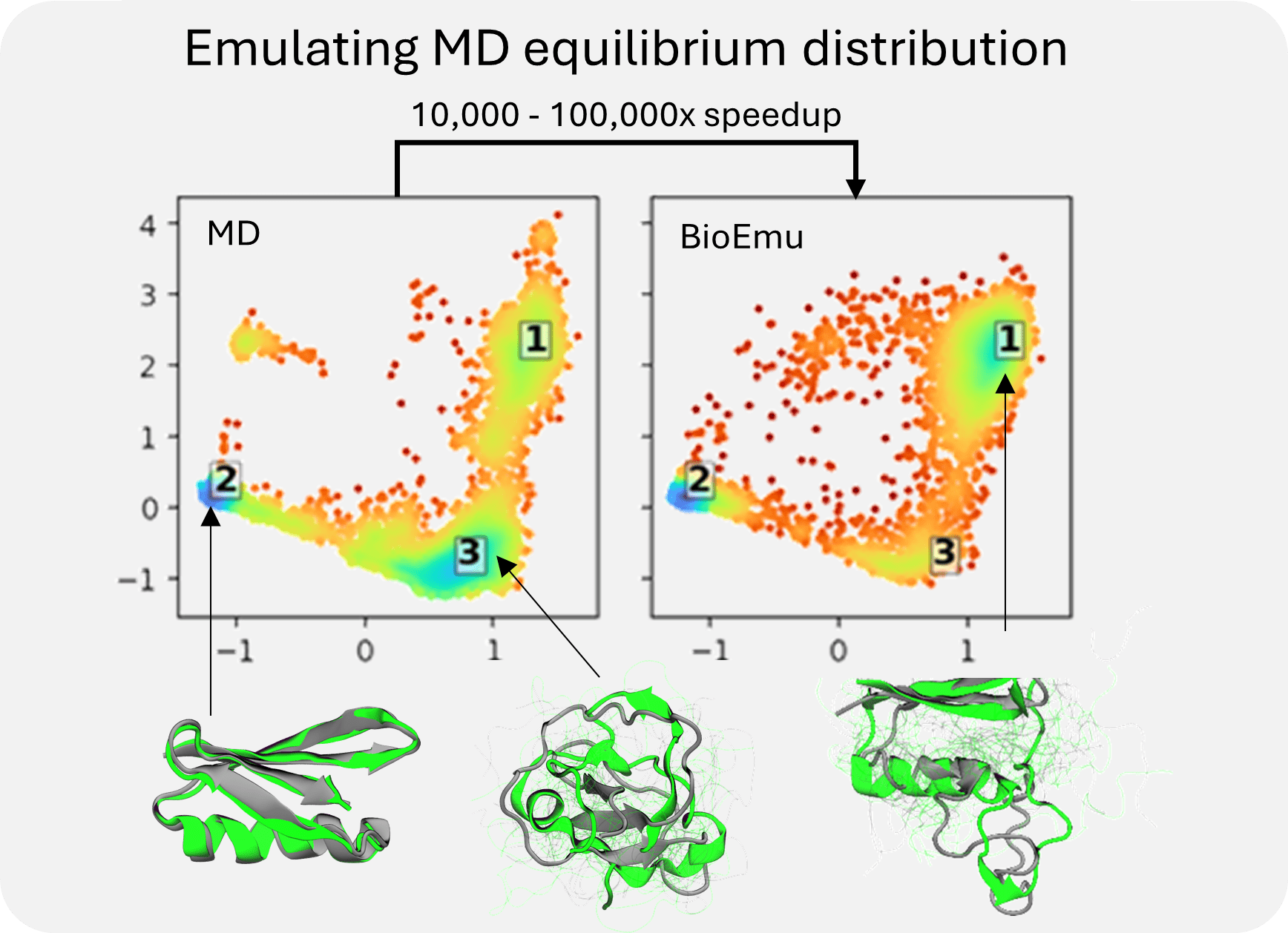
Researchers at DeepMind have developed BioEmu-1, an AI tool that predicts diverse protein structures and dynamics with high accuracy at unprecedented speeds. Using generative deep learning, BioEmu-1 emulates molecular dynamics simulations 10,000 to 100,000 times faster than traditional methods while achieving comparable results. This advancement could accelerate drug development by offering new insights into protein behavior and stability.
BioEmu-1 predicts physically plausible structural changes around protein islands
BioEmu-1 is an innovative tool designed for predicting protein structures with a focus on capturing dynamic changes, such as those involving LapD proteins bound or unbound with c-di-GMP. This capability allows researchers to explore previously unseen intermediate structures, enhancing our understanding of protein function and potentially aiding in drug development.
Compared to traditional Molecular Dynamics (MD) simulations, BioEmu-1 offers a significant computational advantage, being up to 100,000 times faster while maintaining accuracy. It effectively reproduces results from extensive MD studies, such as those on Protein G by DESRES, with minimal computational resources, making it a cost-effective solution for studying protein dynamics.
Another key feature is the tool’s ability to predict protein stability through accurate folding free energy predictions. This is crucial for applications like therapeutic protein design, where stability directly impacts functionality. BioEmu-1’s performance on unseen sequences highlights its broad applicability and reliability beyond its training data.
Recognized by experts like Professor Martin Steinegger, BioEmu-1 stands out for enabling the efficient exploration of free-energy landscapes, a critical aspect of understanding protein dynamics. Despite being in early development stages, its open-source nature encourages collaborative testing and refinement across various proteins, fostering advancements in the field.
BioEmu-1 generalizes to unseen protein sequences
BioEmu-1 demonstrates strong generalization capabilities when predicting protein structures for sequences not encountered during training. The tool achieves this by accurately reproducing the structural distributions observed in extensive Molecular Dynamics (MD) simulations, such as those conducted by D. E. Shaw Research on Protein G, but with a computational efficiency that is 10,000 to 100,000 times higher. This makes it particularly useful for studying protein dynamics without the need for resource-intensive simulations.
The ability of BioEmu-1 to predict folding free energies provides insights into protein stability, which is critical for applications such as therapeutic protein design. By sampling protein structures and quantifying the ratio between folded and unfolded states, BioEmu-1 generates predictions that correlate well with experimental measurements, even on novel sequences. This capability underscores its utility in understanding protein behavior under various conditions.
Expert validation from researchers like Professor Martin Steinegger highlights BioEmu-1’s potential as a tool for efficiently exploring free-energy landscapes, an essential aspect of studying protein dynamics. While still in early development, the open-source nature of BioEmu-1 encourages collaborative testing and refinement across diverse proteins, fostering advancements in the field.
BioEmu-1 emulates equilibrium distribution faster than MD simulation.
BioEmu-1 is an innovative tool designed to predict protein structures with a focus on capturing dynamic changes, such as those involving LapD proteins bound or unbound with c-di-GMP. This capability allows researchers to explore previously unseen intermediate structures, enhancing our understanding of protein function and potentially aiding in drug development.
Compared to traditional Molecular Dynamics (MD) simulations, BioEmu-1 offers a significant computational advantage, being up to 100,000 times faster while maintaining accuracy. It effectively reproduces results from extensive MD studies, such as those on Protein G by DESRES, with minimal computational resources, making it a cost-effective solution for studying protein dynamics.
The tool’s ability to predict folding free energies provides insights into protein stability, which is crucial for applications like therapeutic protein design, where stability directly impacts functionality. BioEmu-1’s performance on unseen sequences highlights its broad applicability and reliability beyond its training data.
Recognized by experts like Professor Martin Steinegger, BioEmu-1 stands out for enabling efficient exploration of free-energy landscapes, a critical aspect of understanding protein dynamics. Despite being in early development stages, its open-source nature encourages collaborative testing and refinement across various proteins, fostering advancements in the field.
In summary, BioEmu-1 represents a leap forward in protein structure prediction by combining speed, accuracy, and dynamic insights, positioning it as a valuable tool for researchers seeking efficient solutions to complex protein studies.
BioEmu-1 accurately reproduces MD distributions with lower computational cost.
- Computational Efficiency
- BioEmu-1 achieves a computational advantage of up to 100,000 times over traditional Molecular Dynamics (MD) simulations while maintaining accuracy. This efficiency is demonstrated by its ability to reproduce results from extensive MD studies, such as those on Protein G conducted by DESRES, using minimal computational resources.
- Structural Prediction and Stability
- The tool accurately predicts protein structures, including dynamic changes like those involving LapD proteins bound or unbound with c-di-GMP. It captures previously unseen intermediate structures, enhancing understanding of protein function. Additionally, BioEmu-1’s prediction of folding free energies provides insights into protein stability, crucial for therapeutic protein design.
- Free-Energy Landscapes
- Recognized by experts like Professor Martin Steinegger, BioEmu-1 efficiently explores free-energy landscapes, a critical aspect of studying protein dynamics. This capability allows researchers to understand protein behavior under various conditions more effectively.
- Open-Source Collaboration
- As an open-source tool, BioEmu-1 encourages collaborative testing and refinement across diverse proteins. This fosters advancements in the field by allowing contributions from various institutions, enhancing its robustness over time.
- Generalization and Applicability
- BioEmu-1 demonstrates strong generalization capabilities, accurately predicting protein structures for unseen sequences. Its performance highlights broad applicability beyond training data, making it a reliable tool for studying protein dynamics without resource-intensive simulations.
More information
External Link: Click Here For More