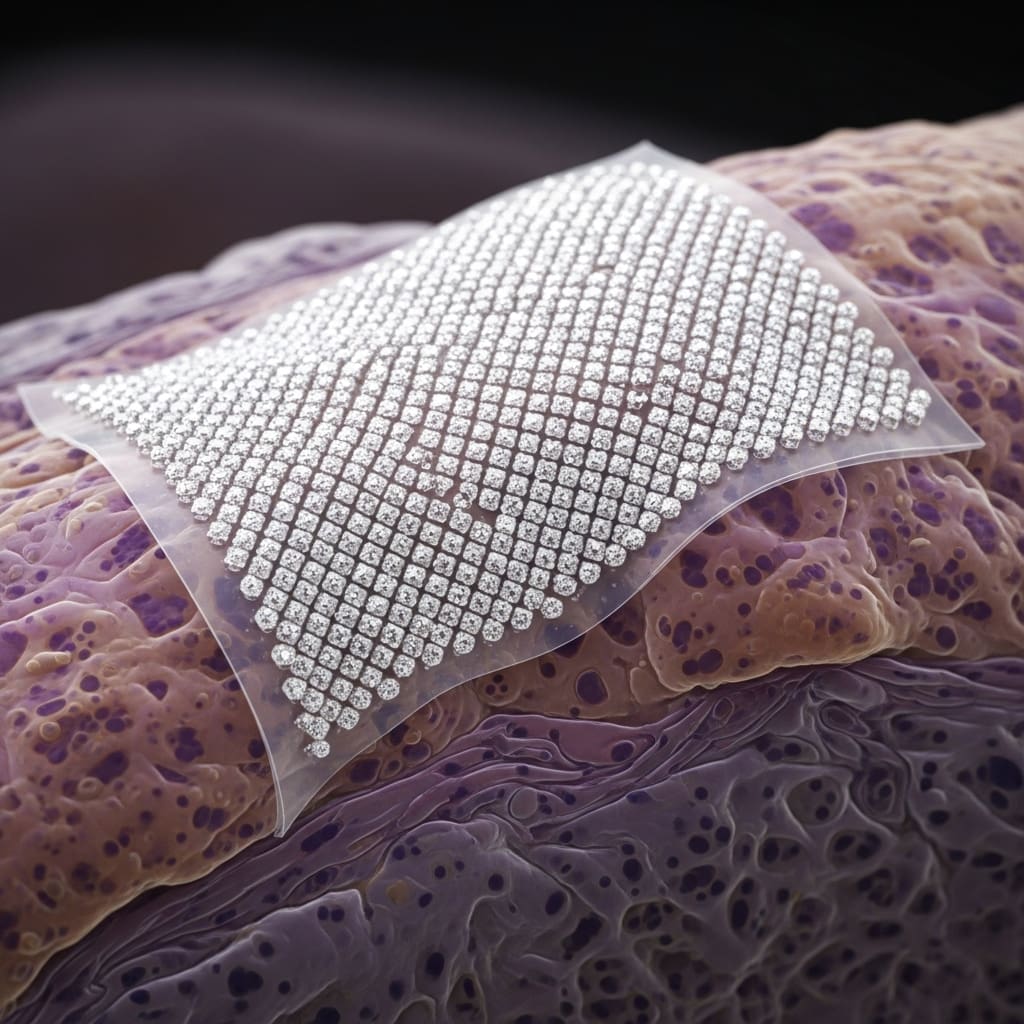
Researchers are tackling the significant hurdle of seamlessly integrating nanodiamond arrays onto delicate biological surfaces for advanced sensing and imaging applications. Luyao Zhang, Lingzhi Wang, and Xinhao Hu, from the Department of Electrical and Electronic Engineering at The University of Hong Kong, alongside colleagues including Yip Tai Nam, Mingzhe Sun and Jixiang Jing, have developed a novel transfer technique using a polyvinyl alcohol (PVA) carrier tape, a method that overcomes the limitations of existing approaches which often rely on harsh conditions or damage sensitive materials. Their work demonstrates a rapid, residue-free process driven by a unique “hydrate-soften-expand-self-peel” mechanism, generating stresses that facilitate transfer within minutes at room temperature. This breakthrough enables conformal patterning on ultra-soft materials and curved surfaces like hair, and even paves the way for sophisticated bio-integrated devices, such as a dual-identity verification system embedded within a hydrogel contact lens, offering a versatile framework for gentle and efficient nanomaterial transfer.
This breakthrough addresses the limitations of conventional transfer methods which often rely on high temperatures, corrosive chemicals, or mechanical peeling, leading to pattern damage and poor biocompatibility. The core of this innovation lies in a unique “hydrate-soften-expand-self-peel” mechanism intrinsic to the PVA-based soluble tape.
The study reveals that upon hydration, non-uniform swelling of the PVA generates transient local normal and shear stresses at the interface between the tape and the substrate. In situ mechanical tracking demonstrates that these stresses facilitate delamination of the tape within just 3 minutes at room temperature, simultaneously promoting strong adhesion of the nanodiamond array to the target surface. This is a significant improvement over conventional water-soluble tapes with composite structures, which undergo passive dissolution and collapse, resulting in residue contamination and reduced transfer efficiency. Experiments show the team successfully achieved conformal patterning on ultra-soft hydrogels, with a stiffness of approximately 0.6 kPa, and highly curved bio-surfaces such as hair, exhibiting a curvature of 100μm−1.
Leveraging this mechanism, the researchers demonstrate a dual-identity verification system integrated onto a hydrogel contact lens, combining data storage with physical unclonable functions. This innovative approach provides a versatile tool for bio-interface engineering and establishes a general framework for the gentle and efficient transfer of functional nanomaterials. The work opens exciting possibilities for in vivo quantum sensing and imaging, enabling the creation of advanced biosensors capable of real-time, spatially resolved measurements at the micro- and nanoscale. This method promises to unlock the full potential of nanodiamond arrays in applications ranging from mapping cellular traction forces to continuous glucose monitoring via skin patches.
Water-soluble tape transfer for nanodiamond patterning offers precise
Scientists developed a novel water-soluble tape transfer printing (WTT) method for conformal patterning of nitrogen-vacancy (NV) center nanodiamond arrays onto biological interfaces. This technique addresses the limitations of conventional transfer methods, which often rely on high temperatures or corrosive chemicals, causing damage to delicate substrates. The research team engineered a polyvinyl alcohol (PVA)-based soluble tape with a unique bilayer architecture to facilitate rapid and residue-free transfer within 3 minutes at room temperature. Experiments employed in situ mechanical tracking to reveal that non-uniform PVA swelling upon hydration generates transient local normal and shear stresses at the interface between the tape and the substrate.
These stresses actively delaminate the tape while simultaneously promoting adhesion of the nanodiamond array to the target material, a mechanism fundamentally different from passive dissolution seen in conventional tapes. The team meticulously characterised the swelling behaviour of the PVA tape, demonstrating its ability to generate compressive and shear forces crucial for efficient transfer. This innovative approach achieves conformal patterning on ultra-soft hydrogels with a stiffness of approximately 0.6 kPa and highly curved bio-surfaces, such as hair with a curvature of 100μm−1. Researchers harnessed the tape’s dynamic response to water, exploiting the “hydrate-soften-expand-self-peel” mechanism to ensure high-fidelity transfer and minimal contamination.
Furthermore, the study pioneered a dual-identity verification system integrated onto a hydrogel contact lens, combining data storage capabilities with physical unclonable functions. The team systematically investigated substrate interfacial properties to optimise transfer efficiency across diverse materials, including microstructured polydimethylsiloxane (PDMS) and biomimetic substrates. This work delivers a versatile tool for bio-interface engineering and establishes a general framework for the gentle, efficient transfer of functional nanomaterials, paving the way for advanced in vivo quantum sensing and imaging applications. The method’s success hinges on the active, force-assisted release mechanism, enabling robust and reliable patterning on challenging biological surfaces.
Hydrate-soften-expand mechanism enables nanodiamond transfer to surfaces
Scientists achieved high-fidelity transfer of nanodiamond (ND) patterns onto diverse biointerfaces using a novel water-soluble tape transfer (WTT) strategy. The research team successfully demonstrated a “hydrate-soften-expand-self-peel” mechanism with a polyvinyl alcohol (PVA) carrier tape, enabling rapid and residue-free patterning. Experiments revealed that the PVA layer quickly hydrates and expands by approximately 500% within the first 30 seconds, concurrently experiencing a reduction in Young’s modulus from 60 kPa to 0.5 kPa. This transformation creates a soft, deformable gel capable of accommodating substrate topography and generating the necessary compressive stress for efficient particle transfer.
Traction force microscopy (TFM) analysis quantified the stress evolution during tape release, showing an ellipsoidal compressive stress field of 500-600 Pa generated by swelling-induced expansion at approximately 20 seconds. Subsequently, at 30 seconds, this force reversed, displaying inward particle recoil as the gel detached, confirming the self-peeling action. In stark contrast, composite water-soluble tapes exhibited only passive dissolution without measurable swelling, resulting in no significant particle displacement as observed by TFM. Measurements confirm that transfer efficiency with the swelling-based PVA tape consistently exceeds 98%, a substantial improvement over the 50, 60% achieved with dissolution-based tapes.
The breakthrough delivers clean, uniform ND arrays with no visible defects or residue, as evidenced by optical and confocal microscopy. Researchers recorded a clear mechanistic divergence between the two tape types, establishing that the bilayer PVA architecture enables an active, swelling-induced stress-assisted transfer. This mechanism simultaneously enhances particle adhesion through compressive stress and ensures clean removal via self-peeling shear forces. Furthermore, the team demonstrated conformal patterning on ultra-soft hydrogels with a stiffness of approximately 0.6 kPa and highly curved bio-surfaces like hair, exhibiting a curvature of 100μm⁻¹.
This work also showcases a dual-identity verification system integrated onto a hydrogel contact lens, combining data storage and physical unclonable functions. Wafer-scale patterning is now achievable, paving the way for high-performance, bio-integrated sensing platforms. Systematic investigation of substrate interfacial properties optimized transfer efficiency across hydrogels, microstructured polydimethylsiloxane (PDMS), hair, and biomimetic substrates, solidifying the versatility of this technique.
Hydrate-soften PVA enables nanodiamond transfer to surfaces
Scientists have developed a novel water-soluble tape transfer (WTT) strategy for seamlessly integrating nanodiamond arrays onto delicate biological surfaces. This technique overcomes limitations of conventional methods, which often rely on harsh conditions damaging sensitive materials or resulting in poor adhesion. The WTT method utilizes a unique polyvinyl alcohol (PVA) carrier tape exhibiting a “hydrate-soften-expand-self-peel” mechanism, enabling rapid and residue-free transfer at room temperature. In situ mechanical tracking demonstrated that hydration induces non-uniform swelling of the PVA, generating stresses that facilitate tape delamination and promote nanodiamond adhesion to the target substrate.
This research successfully demonstrated conformal patterning on ultra-soft hydrogels and highly curved surfaces like hair, showcasing the method’s versatility. Furthermore, researchers integrated data storage and physical unclonable functions onto a hydrogel contact lens, highlighting potential applications in secure biomedical devices. The authors acknowledge limitations related to the specific PVA tape formulations tested and the need for further optimisation for diverse nanomaterials. Future work could focus on automating the WTT process and combining it with 3D printing to create a high-throughput manufacturing platform for bio-integrated sensors and tissue engineering.
The significance of this work lies in decoupling the trade-off between conformability and precision in nanoparticle patterning, offering a gentle yet effective approach to bio-interface engineering. By systematically investigating the influence of substrate properties, the team established a rational framework for deploying this technology across various applications. The successful transfer of polymer microspheres suggests broader applicability beyond nanodiamonds, potentially impacting fields like flexible electronics and multimodal biosensing.
👉 More information
🗞 Swelling-Induced Stress-Assisted Transfer of Nanodiamond Arrays with a PVA Carrier Tape for Conformal Bio-Integrated Sensing and Labelling
🧠 ArXiv: https://arxiv.org/abs/2601.15587