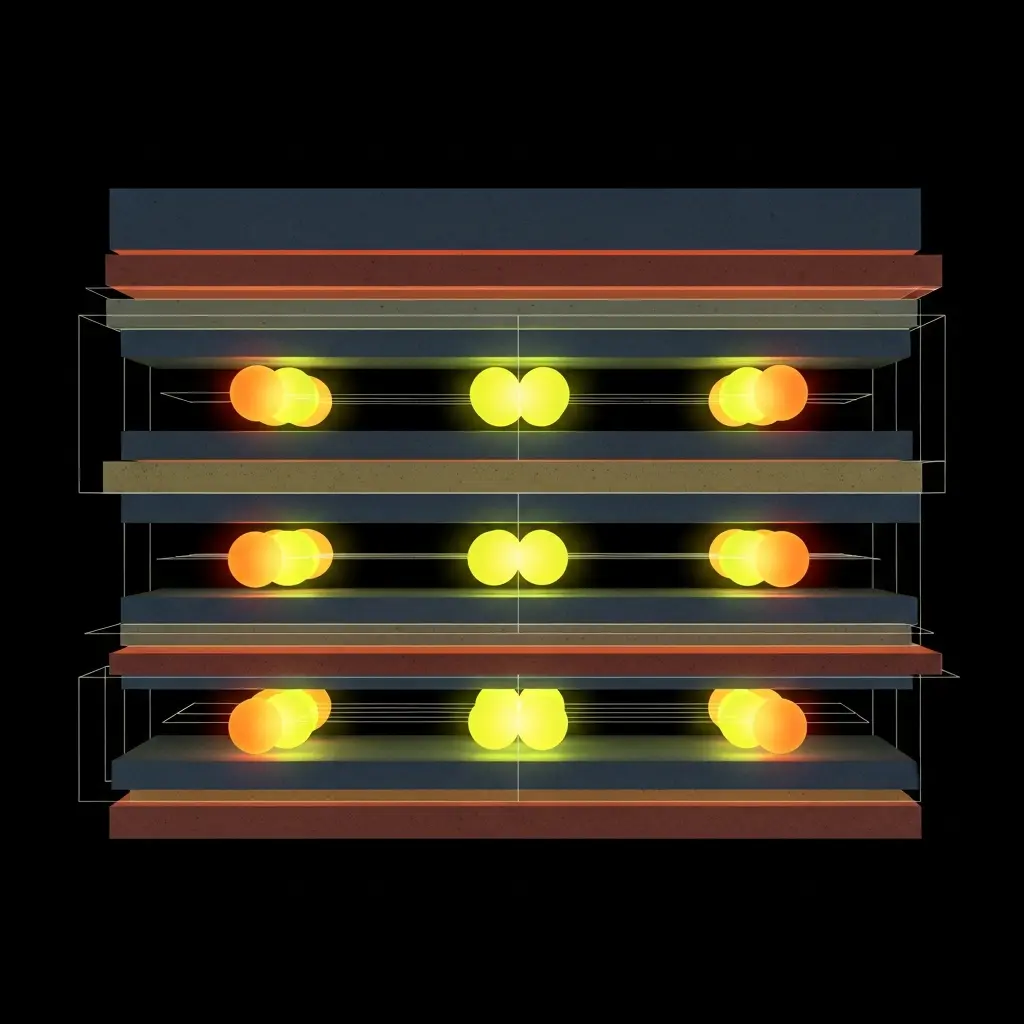
Researchers are increasingly focused on understanding excitons and their interactions within low-dimensional semiconductors, and a new study led by Katherine A. Koch and Ajay Ram Srimath Kandada of Wake Forest University, alongside Carlos Silva-Acuña from the Université de Montréal, details crucial insights into biexcitons within Ruddlesden-Popper metal halides. These bound states of two electrons and two holes are particularly well-defined in these materials due to their strong confinement and high binding energies, offering a unique opportunity to investigate fundamental interactions between excitons. The team employed nonlinear coherent spectroscopy to overcome limitations of traditional methods, providing unambiguous evidence for biexciton formation and a more reliable pathway to disentangle complex many-body effects in these promising metal-halide perovskite derivatives , potentially paving the way for advanced optoelectronic devices.
Biexcitons probe Coulomb interactions in RPMH materials
Scientists have recently demonstrated a groundbreaking approach to understanding multi-exciton phenomena in Ruddlesden-Popper metal halide (RPMH) materials, utilising advanced nonlinear coherent spectroscopy. This research establishes that two-quantum (2Q) multidimensional spectroscopy provides a reliable pathway to disentangle complex many-body interactions within quantum-well derivatives of metal-halide perovskites. Excitons, Coulomb-bound electron-hole pairs, are central to the optical response of semiconductors, enhancing absorption and emission cross-sections and modulating optoelectronic performance. In quantum-confined systems, these excitons exhibit sharp resonances, providing an excellent platform for exploring many-body physics through studies of linear and nonlinear optical responses.
Among these excitonic complexes, biexcitons offer a compelling window into correlated excitation dynamics, exciton-exciton interactions, and the influence of the surrounding environment, their formation, stability, and spectral signatures are highly sensitive to dimensionality, dielectric environment, and quantum confinement. This makes them ideal probes of fundamental condensed-matter physics and material-specific behaviour. The research meticulously investigates the interplay of exciton-exciton annihilation, excitation-induced dephasing, and biexciton formation, processes that are often consequential in excitonic materials. Exciton-exciton annihilation describes the non-radiative recombination of excitons, where energy transfers between them, commonly investigated via fluence-dependent photoluminescence.
Excitation-induced dephasing, conversely, arises from incoherent Coulomb scattering between excitons, leading to faster dephasing dynamics accurately measured using two-dimensional coherent electronic spectroscopy. Biexciton formation, representing the creation of a new quasiparticle bound by Coulomb interaction, competes with annihilation, stabilising excitons into a correlated state. The study highlights that quantifying biexciton binding energy, the energy difference between the biexciton and unbound exciton states, is critical for understanding underlying many-body interactions. While linear spectroscopy offers initial estimates, the team proves that 2Q multidimensional spectroscopy directly accesses multi-exciton coherences, providing the most accurate measurement of this crucial parameter. This breakthrough opens exciting possibilities for advancing quantum optoelectronic technologies, including entangled photon sources, quantum gates, and nonlinear light-harvesting platforms.
2D Coherent Spectroscopy of RPMH Excitons reveals complex
Scientists are employing advanced spectroscopic techniques to unravel the complex photophysics of excitons within confined semiconductors, particularly Ruddlesden-Popper metal halide perovskites (RPMHs)! The study pioneered the use of ultrafast, phase-controlled pulses to create and manipulate quantum coherences within the RPMH material, extending the principles of interference observed in conventional interferometers. Instead of light interfering with itself, this method induces interference between quantum pathways, distinct sequences of light-matter interactions, revealing the material’s nonlinear polarisation. Experiments employed a non-collinear geometry known as the BOXCARS configuration, utilising three temporally short pump pulses each characterised by wavevectors kA, kB, and kC.
These pulses interact with the sample in a controlled time-ordered sequence, inducing a third-order nonlinear polarisation that emits a coherent signal in the phase-matched direction, defined by ksig = −kA + kB + kC. The team carefully selected phase-matching directions, rephasing, non-rephasing, and double quantum pathways, to isolate different components of the nonlinear response, such as ground-state bleaching and excited-state absorption. This approach enables the isolation of biexciton contributions, disentangling them from overlapping excitonic, trionic, or phonon-assisted processes that confound linear methods. Temperature-dependent photoluminescence measurements, exhibiting a reduction of the biexciton resonance and a decreasing energy difference between biexciton and exciton peaks at higher temperatures, were further clarified by the 2D coherent spectroscopy.
Biexciton Energies Revealed via 2D Spectroscopy
The team measured nonlinear polarization generated through multiple field interactions, employing a diagrammatic perturbation theory based on density matrix formalism. This approach visually represents the evolution of quantum coherences and populations under laser pulse interactions, treating each interaction as a perturbation to determine its contribution to the overall signal. Tests prove that emission in 2D spectroscopy arises from the time-varying nonlinear polarization, induced by three time-ordered light-matter interactions, detected in the phase-matched direction. Researchers utilized a BoxCARS beam geometry, focusing three pulse trains (A⋆, B, C) onto the sample with a common lens, alongside a local oscillator (LO) beam co-propagating with the resonant four-wave mixing signal.
Results demonstrate that by altering the time-ordering of the pulse sequence, distinct nonlinear responses, one-quantum (1Q) rephasing and two-quantum (2Q) non-rephasing signals, can be measured. Double-sided Feynman diagrams were employed to track the evolution of quantum states, revealing how the system moves through different quantum states via absorption or emission events. The study confirms that the direction of each arrow in these diagrams determines the sign of the wavevector in the phase-matching condition, linking the spatial direction of the emitted signal to the underlying quantum pathway. Measurements confirm that a time-ordered sequence with pulse A arriving first, followed by B and then C, selects rephasing diagrams, partially cancelling inhomogeneous broadening and producing an echo-like 1Q correlation map.
Conversely, a sequence of B, C, then A isolates 2Q pathways, driving the system into a coherence between singly and doubly excited states, mapping the energy and coupling of these states. Analysis of (F−PEA)2PbI4, (F−PEA)2PbI4, and (F−PEA)2PbI4 using 2DES-1Q spectroscopy revealed two distinct resonances, X1 and X2, along the diagonal, obscured in linear spectra.
👉 More information
🗞 Biexcitons in Ruddlesden-Popper Metal Halides Probed by Nonlinear Coherent Spectroscopy
🧠 ArXiv: https://arxiv.org/abs/2601.16101