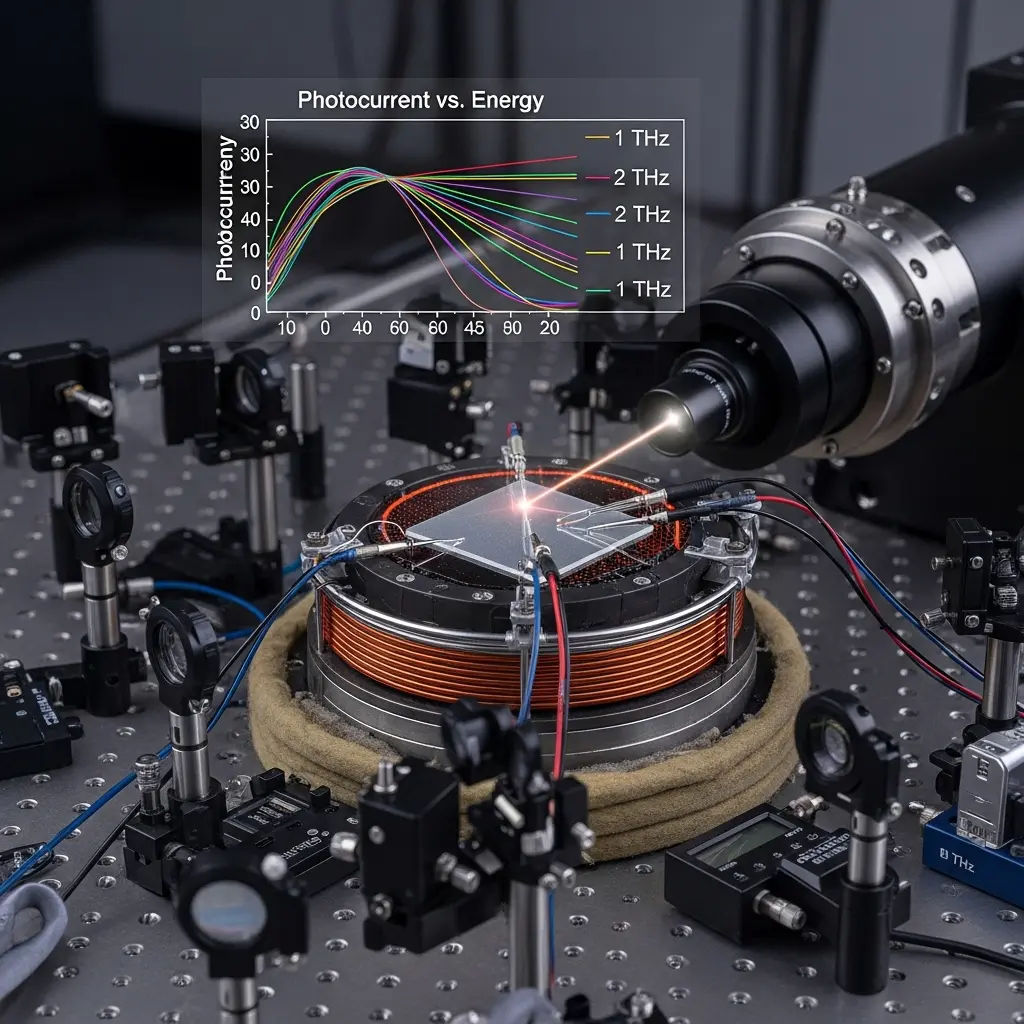
The interplay between magnetism and light absorption holds promise for novel photovoltaic technologies, and recent research explores this connection within the unique structure of graphene. Yuncheng Mao and Claudio Attaccalite, both from CNRS/Aix-Marseille Université, investigate how magnetic fields influence the bulk photovoltaic effect in Bernal bilayer graphene, a material formed by stacking two graphene layers. Their work reveals that applying a magnetic field dramatically alters the way light generates electrical current within the material, activating a previously dormant current mechanism and significantly boosting the overall photovoltaic response. This discovery demonstrates a new level of control over light-matter interactions, potentially paving the way for more efficient and tunable solar cells and light detectors.
Researchers explore how shift current (SC) and magnetic ballistic current (MBC) develop in AB-stacked bilayer graphene when subjected to both in-plane and out-of-plane magnetic fields. The research demonstrates that the shift current responds only mildly to weak magnetic fields, behaving as an almost even function of field strength. In contrast, the magnetic ballistic current activates directly when time-reversal symmetry breaks, growing linearly with weak fields at specific photon energies.
Symmetry-Protected Currents and Bulk Photovoltaic Effects
This research investigates the bulk photovoltaic effect (BPVE), a phenomenon where materials generate voltage when illuminated without a traditional p-n junction, and the underlying mechanisms driving it. The BPVE arises from symmetry-protected currents, notably the shift current, an intrinsic current generated by the asymmetric scattering of photons from electrons originating from the material’s electronic band structure. Researchers are exploring a wide range of materials to enhance the BPVE, including ferroelectric materials, topological insulators, Weyl semimetals, and various two-dimensional materials and heterostructures. Enhancement strategies focus on band structure engineering, symmetry breaking, magnetic proximity effects, and manipulating the Fermi surface.
Theoretical modeling, including density functional theory calculations, predicts the BPVE in different materials, clarifies the underlying mechanisms, and guides experimental efforts. The BPVE offers a potentially revolutionary approach to solar energy conversion, potentially exceeding the efficiency of conventional solar cells by eliminating the limitations of p-n junctions. Beyond solar cells, the BPVE enables highly sensitive photodetectors, imaging devices, and the generation of terahertz radiation for applications in imaging, spectroscopy, and communications. This research also opens possibilities for entirely new optoelectronic devices and provides insights into fundamental aspects of solid-state physics, such as Berry curvature, symmetry protection, and electron transport.
Magnetic Currents in Bilayer Graphene Revealed
This work details a comprehensive investigation into how magnetic fields influence electrical currents within AB-stacked bilayer graphene, specifically focusing on the shift current and the magnetic ballistic current. Researchers developed a computational model to simulate the material’s electronic structure, accurately representing the interlayer interactions and stacking configuration of the bilayer graphene. This model allows for precise calculations of current responses under varying magnetic field conditions. The team discovered that the shift current exhibits a mild response to weak magnetic fields, behaving almost as an even function of field strength.
In contrast, the magnetic ballistic current demonstrates a direct activation upon the breaking of time-reversal symmetry by the magnetic field, growing linearly with increasing field strength at specific photon energies. Further analysis using an AB-bilayer graphene ribbon revealed a striking role for edge states. Under weak magnetic fields, these edge states contribute negligibly to the shift current. However, when subjected to strong magnetic fields, creating Landau levels, the spatial extent of these edge states expands dramatically, transforming them into significant contributors to the current. This demonstrates a field-dependent modulation of edge state behaviour and their impact on current generation. These detailed calculations provide a fundamental understanding of how magnetic fields manipulate charge transport in bilayer graphene, paving the way for potential applications in novel electronic devices and spintronics.
Graphene Symmetry and Magnetic Current Control
Researchers have demonstrated how magnetic fields influence the flow of electrical current in AB-stacked bilayer graphene, a material with unique electronic properties. The work centers on two key mechanisms, the shift current and the magnetic ballistic current, and how these currents respond to applied magnetic fields. The team found that the shift current exhibits only a mild response to weak magnetic fields, while the magnetic ballistic current is directly activated by breaking the material’s symmetry and increases linearly with weak fields at specific energies. Notably, the study reveals a striking contrast in the behaviour of edge states under varying magnetic field strengths.
Under weak fields, these edge states contribute little to the shift current, but when strong vertical fields are applied, creating conditions dominated by Landau levels, these same edge states expand spatially and become significant contributors to the current. This demonstrates a powerful ability to control current flow by manipulating the material’s edge states with magnetic fields. The authors acknowledge that their calculations are based on a specific model of bilayer graphene and that the observed effects may vary with different stacking orders or the presence of defects.
🗞 Magnetic Bulk Photovoltaic Effect in Bernal Bilayer Graphene
🧠 ArXiv: https://arxiv.org/abs/2511.20498