

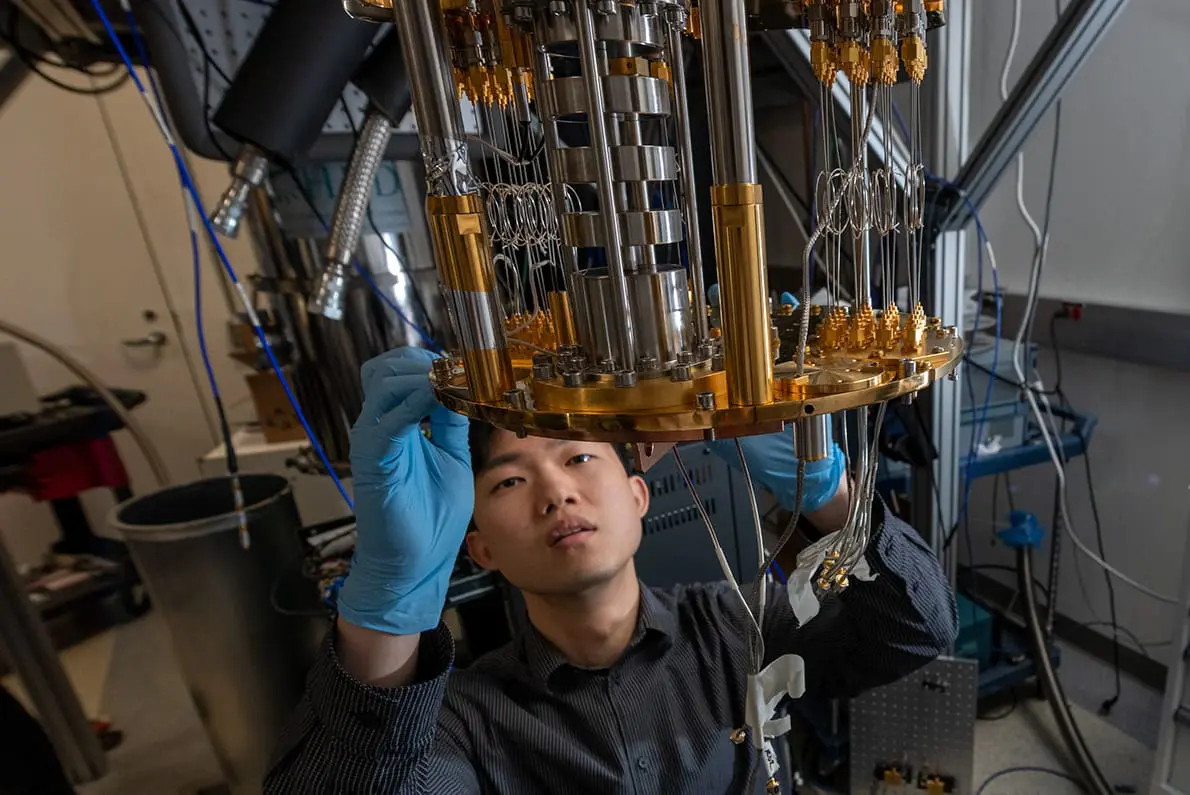
Berkeley Lab is at the forefront of quantum research, advancing innovations across qubits, sensors, computing networks, materials, simulations, and dark matter detection. As leaders in initiatives like QSA and AQT, they have developed groundbreaking techniques for superconducting qubits, created an open-source control system (QubiC), and established a quantum network testbed (QUANT-NET). Collaborating with industry and academia, their work significantly impacts emerging technologies and scientific discovery.
Noise-Free Qubits
Berkeley Lab’s research into noise-free qubits focuses on enhancing the reliability of superconducting qubits by engineering quantum defects in materials through high-throughput computation and atomic-scale fabrication. This approach reduces susceptibility to external noise, a critical challenge in maintaining qubit coherence. The work extends beyond computing applications, leveraging 2D materials with shared electronic pathways for more efficient telecommunications and sensing solutions. Additionally, the lab explores localized excitons in atomically thin materials, opening new possibilities for quantum information science.
Quantum Control Systems
The development of advanced quantum control systems at Berkeley Lab addresses fabrication and quality control challenges by employing femtosecond lasers to program telecom-band optical qubits in silicon. This method leverages existing infrastructure for large-scale manufacturing, enabling the creation of robust and scalable quantum technologies. The lab’s error mitigation strategies enhance computational accuracy, bringing theoretical advancements closer to practical applications.
Subatomic Simulations with Quantum Computers
Berkeley Lab is pioneering subatomic simulations using quantum computers to tackle complex problems in particle physics. By simulating quantum systems at unprecedented scales, researchers gain insights into fundamental interactions and properties of matter. These simulations are complemented by advancements in quantum sensing, which enable precise detection of subatomic particles, contributing to dark matter research and the broader understanding of quantum phenomena.
Dark Matter Detection via Quantum Sensors
The lab’s work on dark matter detection utilizes superconducting transition-edge sensors for precise measurement of subatomic particle interactions. These sensors, developed through advancements in quantum sensing technology, play a crucial role in identifying potential signatures of dark matter. By integrating these sensors with quantum computing systems, researchers at Berkeley Lab are pushing the boundaries of our understanding of the universe’s most elusive particles.
Quantum Materials Engineering
Berkeley Lab’s research in quantum materials engineering focuses on designing and fabricating novel materials with tailored electronic properties for quantum technologies. This includes the development of 2D materials and hybrid systems that can operate at higher temperatures and with greater stability, addressing key limitations in current quantum computing architectures. The lab’s work in this area supports the creation of more robust and scalable quantum systems, with applications ranging from advanced sensing to complex simulations.
Advanced Quantum Sensing
Integrating advanced quantum sensing technologies into dark matter detection efforts represents a significant leap forward in experimental physics. By combining high-resolution sensors with sophisticated data analysis techniques, researchers at Berkeley Lab are able to detect even the faintest signals associated with potential dark matter interactions. This interdisciplinary approach, which draws on expertise in quantum computing, materials science, and particle physics, underscores the lab’s commitment to advancing our understanding of the universe through cutting-edge technology.
Scalable Quantum Systems
Berkeley Lab is at the forefront of developing scalable quantum systems that can be integrated into existing infrastructure. By leveraging advancements in quantum control systems and error mitigation strategies, researchers are working toward the creation of fault-tolerant quantum computers capable of solving problems beyond the reach of classical computing. These efforts are complemented by innovations in quantum materials engineering, which provide the foundation for building more reliable and efficient quantum technologies.
Interdisciplinary Quantum Research
The lab’s interdisciplinary approach to quantum research brings together experts from diverse fields to tackle some of the most pressing challenges in modern science. By fostering collaboration between physicists, engineers, and computer scientists, Berkeley Lab is able to accelerate progress in areas such as quantum sensing, materials engineering, and computational modeling. This collaborative environment not only drives technological innovation but also ensures that advancements in quantum research are translated into practical applications that benefit society.
Quantum Computing Applications
Berkeley Lab is actively exploring the potential of quantum computing to solve real-world problems across various domains. This includes applications in cryptography, optimization, and materials science, where quantum algorithms can offer significant advantages over classical methods. By advancing the state-of-the-art in quantum computing, researchers at the lab are helping to establish a new paradigm for scientific discovery and technological innovation.
Quantum Networking and Communication
Berkeley Lab also focuses on developing quantum networking and communication technologies. By leveraging advancements in quantum control systems and sensing, researchers are working toward the creation of secure and efficient quantum communication networks. These networks have the potential to revolutionize data transmission by enabling ultra-secure communication channels that are resistant to eavesdropping and hacking.
Quantum Simulation and Modeling
Berkeley Lab’s expertise in quantum simulation and modeling is driving advancements in our ability to predict and understand complex quantum systems. By developing sophisticated computational tools and techniques, researchers can simulate scenarios that would be impossible to study experimentally, providing valuable insights into the behavior of quantum materials and devices. This work is essential for designing next-generation quantum technologies and optimizing their performance.
Quantum Error Correction
The lab’s research in quantum error correction is critical for ensuring the reliability and scalability of quantum computing systems. By developing novel error detection and correction protocols, researchers are working to mitigate the effects of noise and decoherence, which are major obstacles to achieving fault-tolerant quantum computation. These efforts are laying the groundwork for a new era of quantum technologies that can operate with high precision and accuracy.
Quantum Materials Discovery
Berkeley Lab’s focus on quantum materials discovery is aimed at identifying and characterizing novel materials with unique electronic properties suitable for quantum applications. By combining experimental techniques with computational modeling, researchers are able to accelerate the discovery process and uncover new materials that could revolutionize the field of quantum technology. This work is essential for building a strong foundation for future advancements in quantum science and engineering.
Quantum Information Science
The lab’s contributions to quantum information science are shaping our understanding of how information can be encoded, processed, and transmitted using quantum systems. By advancing the theoretical underpinnings of quantum information theory, researchers at Berkeley Lab are helping to establish a robust framework for developing practical quantum technologies. This includes work on quantum cryptography, communication protocols, and computational algorithms that leverage the unique properties of quantum systems.
Quantum Engineering Education
Berkeley Lab is also committed to fostering the next generation of quantum engineers through innovative education and training programs. By providing students and researchers with access to state-of-the-art facilities and expertise, the lab is helping to build a skilled workforce capable of addressing the challenges and opportunities in the rapidly evolving field of quantum technology.
Future Directions in Quantum Technology
Looking ahead, Berkeley Lab is exploring new directions in quantum technology that promise to revolutionize fields ranging from medicine to energy production. By continuing to push the boundaries of what is possible with quantum systems, researchers at the lab aim to unlock new capabilities and applications that could transform our world. From developing more efficient quantum algorithms to creating novel materials for quantum devices, the lab’s work is paving the way for a future where quantum technologies play a central role in addressing global challenges.
More information
External Link: Click Here For More


