Lawrence Berkeley National Laboratory has launched SYNAPS-I, a groundbreaking initiative poised to revolutionize scientific discovery by harnessing the power of artificial intelligence. This multi-lab effort, part of the Department of Energy’s new Genesis Mission, will transform petabytes of data from advanced light and neutron scattering facilities into actionable knowledge across fields like energy, semiconductors, and medicine. “Our national lab facilities are already world leaders in scientific discovery. SYNAPS-I will radically accelerate the path from experiment to insight by embedding AI directly into the analysis workflow,” said Alex Hexemer, a senior scientist at Berkeley Lab’s Advanced Light Source (ALS) and SYNAPS-I lead. By uniting seven DOE facilities and integrating large machine learning models, SYNAPS-I promises a new era of accelerated insight, particularly with upgrades like the ALS-U project increasing data outputs.
SYNAPS-I Initiative Accelerates Scientific Discovery with AI
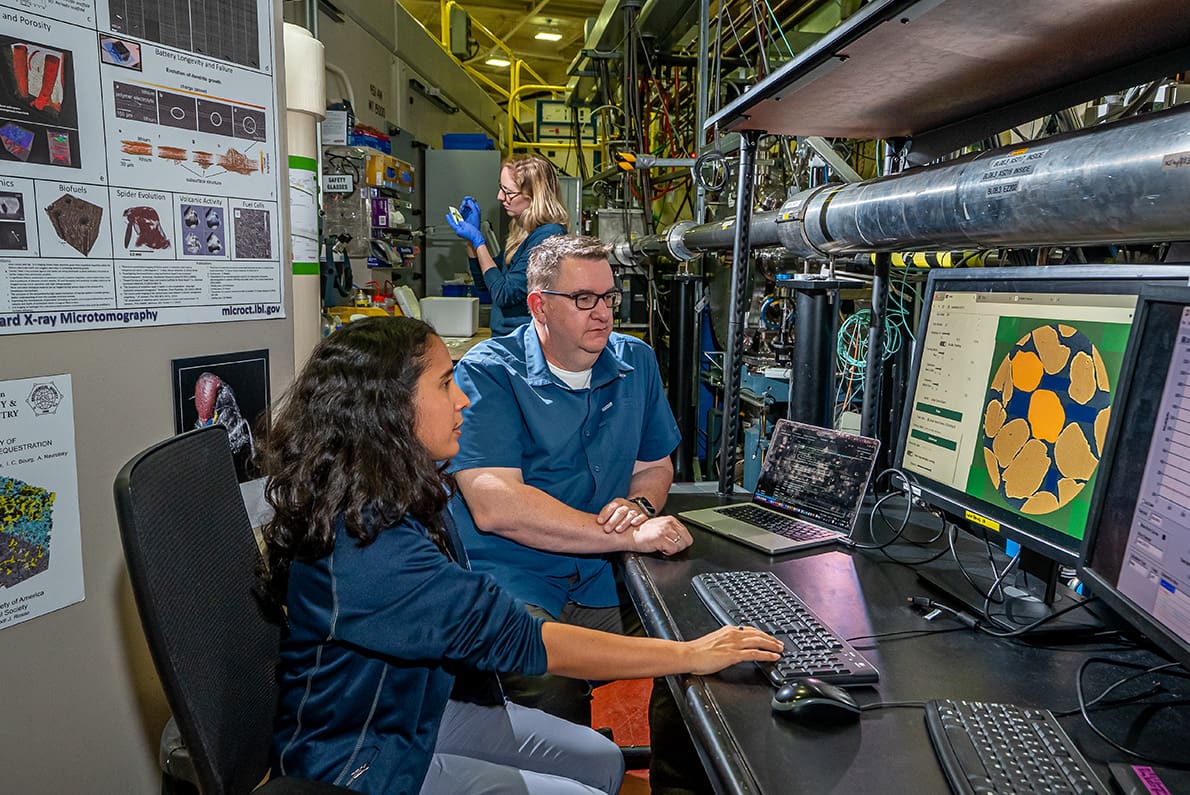
The SYNAPS-I (SYnergistic Neutron and Photon Science – Intelligence) initiative is poised to revolutionize scientific analysis by integrating artificial intelligence directly into the workflows of major U.S. light and neutron scattering facilities. SYNAPS-I is one of three AI model teams led or co-led by Berkeley Lab, leveraging existing expertise in high-performance computing and large dataset management. A central focus is building a machine learning pipeline to dramatically speed up the analysis of data generated by techniques like X-ray microscopy and neutron scattering, which reveal crucial details about material composition and structure. Currently, tasks like image segmentation – identifying individual grains within a material – are often painstakingly performed manually. “There are segmentation AI models available today for images of everyday objects, but they don’t work well for scientific data. We’re building SYNAPS-I to fill that gap.”
The initiative will unify analysis across seven DOE Basic Energy Sciences user facilities, including the ALS, which is undergoing an upgrade (ALS-U) promising even greater data output. By pooling resources and expertise with partners like Argonne, Brookhaven, and SLAC, SYNAPS-I aims to create AI capabilities exceeding what any single facility could achieve independently. “By pooling expertise and data across facilities, we can build AI capabilities that benefit all users and accelerate scientific discovery in ways that no single facility could achieve alone,” Hexemer added.
Ptychography and Image Segmentation in X-ray/Neutron Science
Advancements in X-ray microscopy and neutron scattering are yielding increasingly complex datasets, demanding new approaches to data analysis and interpretation; SYNAPS-I aims to bridge this gap. Scientists utilize these techniques to meticulously study phase changes and molecular structures within active materials, crucial for developing improved batteries and other advanced technologies. A key method, ptychography, employs lensless computational X-ray microscopy to analyze samples at the atomic level—researchers at the Advanced Light Source (ALS) previously achieved imaging of 5-nanometer structures in lithium iron phosphate using this technique over a decade ago. This breakthrough revealed insights into defect formation during chemical transformations.
The SYNAPS-I team intends to significantly accelerate knowledge extraction from both X-ray microscopy and neutron scattering by constructing a machine-learning pipeline. This pipeline will augment existing algorithms for automated ptychography and, critically, image segmentation – the process of identifying features within complex X-ray and neutron data. Dimitrios Argyriou stated, “SYNAPS-I marks the first step into an exciting new era for science at modern facilities.”
ALS-U Upgrade Enables High-Resolution Data Collection
The recently completed and ongoing upgrades to national scientific facilities are poised to unlock a new era of materials science, with the Advanced Light Source Upgrade (ALS-U) at Lawrence Berkeley National Laboratory playing a central role. This enhancement, coupled with the SYNAPS-I initiative, promises a dramatic acceleration in the conversion of complex imaging data into actionable scientific insights. SYNAPS-I, a multi-laboratory effort, is part of the Department of Energy’s Genesis Mission, designed to advance artificial intelligence and discovery across multiple fields. A key focus is streamlining processes like ptychography—a lensless X-ray microscopy technique—and image segmentation, traditionally time-consuming tasks.
Researchers previously used ptychography at the ALS to image 5-nanometer structures in lithium iron phosphate, a breakthrough that revealed details about defect formation. Currently, manually identifying individual grains within materials during image segmentation can be painstaking. SYNAPS-I intends to replace this with an automated tool capable of characterizing particles in real-time at X-ray or neutron beamlines. “Automated segmentation in advanced microscopy is still a significant challenge in science. Dimitrios Argyriou, Interim ALS-U Project Director, stated, “With the ALS — especially after the ALS-U upgrade — we’ll gain an unprecedented view into the inner workings of nature and technology.”
By pooling expertise and data across facilities, we can build AI capabilities that benefit all users and accelerate scientific discovery in ways that no single facility could achieve alone.
Alex Hexemer, Berkeley Lab senior scientist and SYNAPS-I lead point of contact
Multi-Lab Collaboration Drives Transformational AI Models
Department of Energy facilities, leveraging artificial intelligence to accelerate scientific breakthroughs in fields ranging from energy to medicine. This multi-laboratory effort, a key component of the broader Genesis Mission, aims to build and deploy self-improving AI models using unique DOE data and facilities. SYNAPS-I unites researchers from Berkeley Lab, Argonne, Brookhaven, SLAC, and Oak Ridge, demonstrating a commitment to shared resources and expertise. Recent upgrades, such as the ALS-U project, are generating unprecedented data volumes, creating a prime opportunity for AI-driven discovery.