

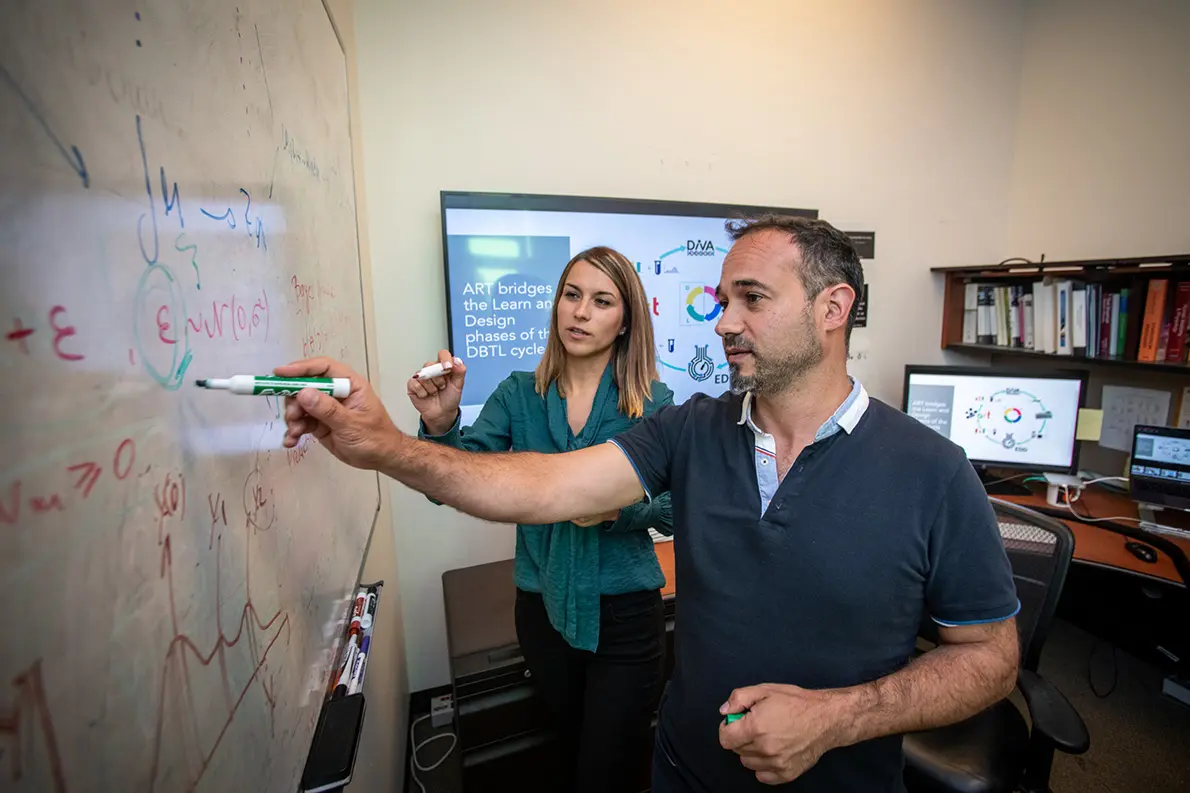
A new DOE initiative led by Lawrence Berkeley National Laboratory is poised to revolutionize biological research with the creation of AI foundation models. The Orchestrated Platform for Autonomous Laboratories to Accelerate AI-Driven BioDesign (OPAL) project will unite AI researchers from four national laboratories and industry to rapidly advance biotechnology – from sustainable fuel production to critical mineral recovery. Researchers aim to overcome a key hurdle in bio-AI development: the limited and inconsistent availability of biological datasets. “AI models are already transforming many fields, but building them for biological research has been slower because there are fewer datasets…to train them on,” explains Paramvir Dehal, OPAL cross-cut task lead. This work, part of the broader Genesis Mission, promises to dramatically accelerate discovery and unlock the potential of biological systems for a range of applications.
OPAL Project: Accelerating BioDesign Through AI and Robotics
This initiative, part of the broader Genesis Mission, aims to overcome limitations in biological datasets—a key obstacle to advancing bio-AI—by assembling the “largest and most precise biological datasets ever assembled” using automated experimentation and supercomputing resources at DOE user facilities. Existing data from decades of national lab and industry research will also be leveraged to build these crucial foundation models. OPAL’s core strategy centers on developing powerful, general-purpose biology AI models that can be adapted for specific tasks and ultimately control investigations autonomously.
These models are expected to enhance biological understanding through prediction, control, and design, impacting areas from environmental resilience to biomanufacturing. “These models advance biological understanding by enabling prediction, model‑informed control, and design, with applications from environmental productivity and resilience to biomanufacturing,” said Dehal. Paul Adams stated, “OPAL is at the forefront of changing how we do biological research, using advanced AI methods to dramatically improve our understanding of biological systems, but to realize that potential we need to collect significantly more data, and AI can help us do that smartly.”
Genesis Mission & ModCon: Building Foundation Models for Biology
The Genesis Mission, a new national initiative from the Department of Energy (DOE), is actively fostering a paradigm shift in biological research through the development of sophisticated foundation models powered by artificial intelligence. Central to this effort is the Transformational AI Models Consortium (ModCon), which aims to construct and deploy AI models capable of self-improvement, leveraging unique DOE data and facilities. One key project within ModCon, led by the OPAL team, focuses on creating general-purpose biology AI models adaptable to specific applications and eventually capable of autonomous investigation management. A significant challenge the team addresses is the scarcity and disorganization of biological datasets—a stark contrast to the readily available text used to train large language models.
AI models are already transforming many fields, but building them for biological research has been slower because there are fewer datasets on genomes, proteins, and metabolic functions of organisms to train them on. And the datasets we do have are highly variable and often organized very differently – unlike the text-based datasets that large language models train on.
Paramvir Dehal, OPAL cross-cut task lead and computational staff scientist in the Lab’s Biosciences Area
The Department of Energy (DOE) is leveraging its national laboratories to construct unprecedented biological datasets, aiming to overcome a critical limitation in bio-AI development—a scarcity of comprehensive, standardized information. This effort is part of the broader Genesis Mission, a national initiative focused on advancing AI and addressing challenges in science and national security.


