Benoît Mandelbrot’s work on fractals has had a profound impact on modern science, revolutionizing our understanding of complex systems. His concept of fractal geometry challenged traditional notions of Euclidean geometry and paved the way for new approaches to understanding complexity.
Despite criticisms that his approach is too narrow and disconnected from mainstream physics, Mandelbrot’s ideas have been applied in fields ranging from biology to finance. His work has also inspired artistic and cultural explorations of fractals and complexity. Today, his legacy continues to shape research across multiple disciplines, highlighting the importance of interdisciplinary thinking and exploring intricate patterns in complex systems.
In the realm of mathematics, few names evoke as much fascination and intrigue as that of Benoît Mandelbrot. A French-American mathematician, Mandelbrot’s work has had a profound impact on our understanding of complex systems and the intricate patterns that govern them. His name is synonymous with the mesmerizing fractals that have captivated scientists and artists alike.
Mandelbrot’s most significant contribution to mathematics lies in his development of the concept of fractal geometry. This innovative approach enabled him to describe and analyze complex shapes that defy traditional geometric definitions. Fractals, characterized by their self-similarity and infinite detail, are ubiquitous in nature, appearing in everything from the branching patterns of trees to the flow of rivers. Mandelbrot’s work on fractals has far-reaching implications for fields such as physics, biology, and economics, where complex systems are the norm.
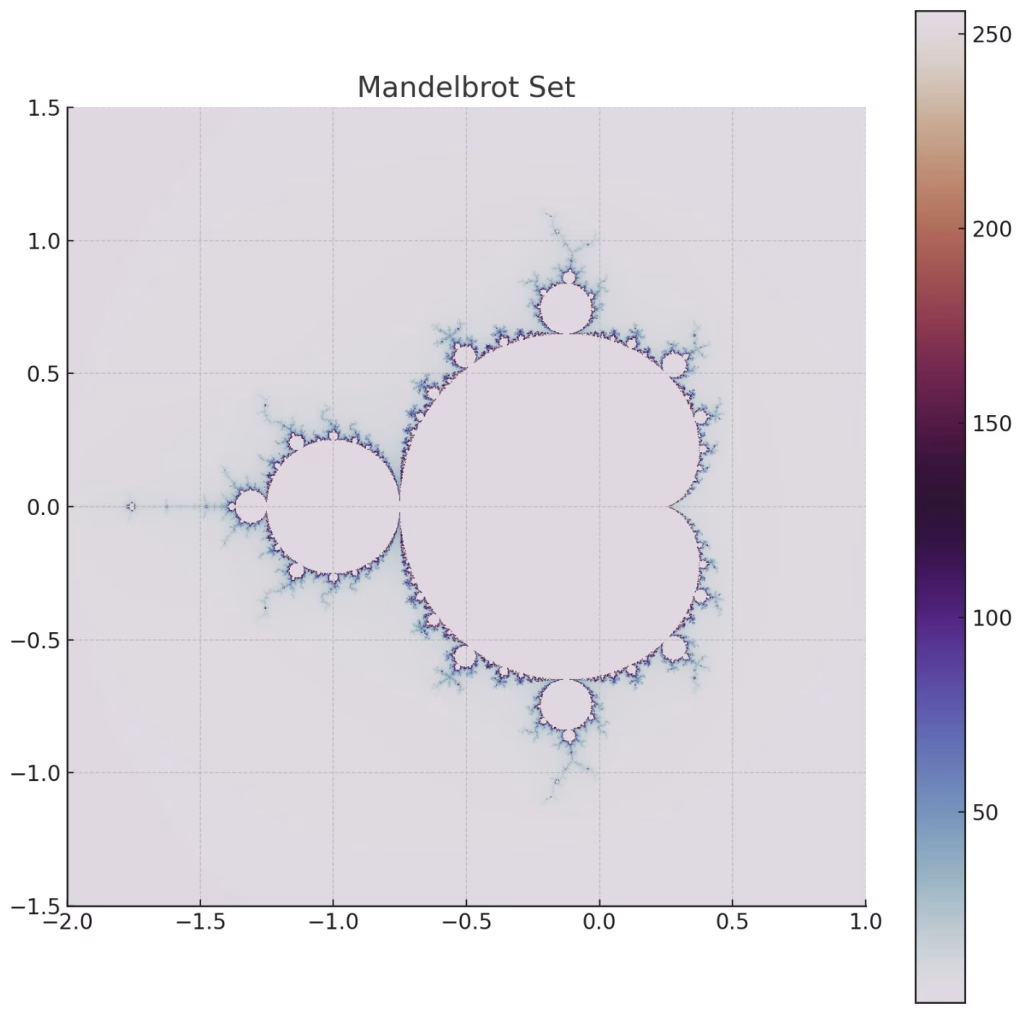
One of the most fascinating aspects of Mandelbrot’s work is its intersection with chaos theory. The Mandelbrot set, a famous mathematical concept named after him, is a visual representation of the boundary between order and chaos. This intricate pattern, generated by a simple iterative equation, exhibits an astonishing level of complexity, with tendrils and filaments that stretch out to infinity. The study of the Mandelbrot set has led to significant advances in our understanding of chaotic systems, shedding light on the underlying mechanisms that govern their behavior.
Early Life And Education
Benoît Mandelbrot was born on November 20, 1924, in Warsaw, Poland, to a Jewish family of Lithuanian origin. His father, Gleb Mandelbrot, was a businessman who imported textiles, and his mother, Bella Lurie Mandelbrot, was a dentist. Mandelbrot’s early life was marked by frequent moves, first to Lithuania and then to France in 1936, where he spent most of his childhood.
Mandelbrot’s interest in mathematics began at an early age, encouraged by his uncle, Szolem Mandelbrojt, who was a mathematician. He attended the Lycée Rollin in Paris, where he excelled in mathematics and was particularly drawn to geometry. In 1944, Mandelbrot entered the École Polytechnique, one of France’s most prestigious institutions of higher learning, where he studied mathematics and physics.
Mandelbrot’s education was interrupted by World War II, during which he and his family fled to the countryside to escape the Nazi occupation of Paris. After the war, Mandelbrot returned to the École Polytechnique, graduating in 1947 with a degree in aeronautical engineering. He then went on to earn a Ph.D. in mathematics from the University of Paris in 1952.
Mandelbrot’s doctoral thesis, titled “Contributions à la théorie mathématique des jeux de hasard,” was supervised by Paul Lévy, a prominent French mathematician. The thesis explored the mathematical theory of random games and laid the foundation for Mandelbrot’s later work on fractals.
In the early 1950s, Mandelbrot worked at the Centre National de la Recherche Scientifique (CNRS) in Paris, where he began to develop his ideas about fractals. He was particularly drawn to the study of complex systems and the behavior of chaotic phenomena.
Mandelbrot’s work on fractals led him to IBM’s Thomas J. Watson Research Center in Yorktown Heights, New York, where he worked from 1958 until his retirement in 1987. It was during this period that Mandelbrot developed many of his most important ideas about fractals and chaos theory.
Development Of Fractal Geometry
The concept of fractal geometry was first introduced by mathematician Benoit Mandelbrot in the 1970s, although the idea of self-similarity had been explored earlier by mathematicians such as Helge von Koch and Wacław Sierpiński. Mandelbrot’s work built upon these earlier ideas, but he is credited with coining the term “fractal” and developing the field into a comprehensive framework.
Mandelbrot’s interest in fractals was sparked by his study of complex systems, particularly the behavior of financial markets. He noticed that price fluctuations exhibited self-similar patterns, which led him to explore the properties of these patterns further. His work on fractals was initially met with skepticism by the mathematical community, but it eventually gained widespread recognition and acceptance.
One of the key features of fractal geometry is its ability to describe natural phenomena that exhibit self-similarity at different scales. This property allows fractals to model complex systems more accurately than traditional geometric methods. For example, the branching patterns of trees, the flow of rivers, and the structure of coastlines can all be described using fractal geometry.
Fractals have also been used in various fields beyond mathematics, including physics, biology, and computer science. In physics, fractals have been used to model the behavior of complex systems such as magnetic fields and fluid dynamics. In biology, fractals have been used to describe the structure of cells, tissues, and organs. In computer science, fractals have been used in image compression and generation.
The development of fractal geometry has also led to new areas of research, including chaos theory and complexity science. Chaos theory, which studies the behavior of complex systems that are highly sensitive to initial conditions, has strong connections to fractal geometry. Complexity science, which seeks to understand complex systems as a whole, has also been influenced by Mandelbrot’s work on fractals.
The impact of fractal geometry extends beyond academia, with applications in fields such as medicine, finance, and engineering. For example, fractals have been used in medical imaging to analyze the structure of tumors and in finance to model market fluctuations.
The Mandelbrot Set Discovery
Benoît Mandelbrot, a French-American mathematician, is credited with the discovery of the Mandelbrot set in 1979. At the time, Mandelbrot was working at IBM’s Thomas J. Watson Research Center in Yorktown Heights, New York. He was studying the properties of complex numbers and their behavior under iteration.
Mandelbrot’s work built upon the earlier research of mathematicians such as Pierre Fatou, Gaston Julia, and Arthur Cayley, who had explored the properties of complex functions in the early 20th century. Mandelbrot’s innovation was to use computer graphics to visualize the behavior of these functions, which led him to discover the intricate patterns that now bear his name.
The Mandelbrot set is defined as the set of complex numbers c for which the function f(z) = z^2 + c does not diverge when iterated from z = 0. This simple definition leads to a rich and complex structure, with intricate boundaries and self-similar patterns that have fascinated mathematicians and scientists ever since.
Mandelbrot’s discovery of the Mandelbrot set was first published in his 1980 book “The Fractal Geometry of Nature”, which introduced the concept of fractals to a broad audience. The book was widely acclaimed and helped establish Mandelbrot as a leading figure in the field of chaos theory and complexity science.
The Mandelbrot set has since become an iconic symbol of mathematical beauty and complexity, inspiring numerous artistic and scientific works. Its study has also led to important advances in our understanding of complex systems, chaos theory, and the behavior of nonlinear dynamical systems.
Today, the Mandelbrot set remains a vibrant area of research, with scientists continuing to explore its properties and behavior using advanced computational techniques and mathematical methods.
Properties Of The Mandelbrot Set
The Mandelbrot set is a complex mathematical object that exhibits self-similarity, meaning it appears identical at different scales. This property allows the set to be defined recursively, with each iteration generating a similar pattern. The Mandelbrot set’s boundary is infinitely complex, with a fractal dimension of approximately 2, which means it has a non-integer number of dimensions.
The set’s boundary is also characterized by its infinite detail, with intricate patterns and shapes emerging at every scale. This property makes the Mandelbrot set aesthetically pleasing, with many considering it to be a work of art in its own right. The set’s beauty has led to its widespread use in computer-generated imagery and fractal art.
One of the most fascinating properties of the Mandelbrot set is its connection to chaos theory. The set’s boundary is highly sensitive to initial conditions, meaning that even tiny changes in the input values can result in drastically different outcomes. This sensitivity is a hallmark of chaotic systems, which are inherently unpredictable and exhibit complex behavior.
The Mandelbrot set has also been found to have connections to other areas of mathematics, including algebraic geometry and number theory. For example, the set’s boundary is related to the distribution of prime numbers, with many researchers believing that the two fields are intimately connected. This connection has led to new insights into the nature of prime numbers and their distribution.
Despite its beauty and fascinating properties, the Mandelbrot set remains a highly abstract mathematical object. Its study requires advanced mathematical techniques, including complex analysis and dynamical systems theory. However, the set’s unique properties have made it a popular subject for interdisciplinary research, with applications in fields as diverse as physics, biology, and computer science.
The Mandelbrot set has also been found to exhibit universality, meaning that its properties are independent of the specific details of the system being studied. This property makes the set a powerful tool for modeling complex systems, allowing researchers to gain insights into the behavior of systems that would be difficult or impossible to study directly.
Applications In Physics And Engineering
Benoît Mandelbrot’s work on fractals has far-reaching implications for various fields, including physics and engineering. One of the most significant applications is in the study of chaos theory, where fractals are used to model complex systems that exhibit unpredictable behavior. This is particularly useful in understanding phenomena such as turbulence in fluids and gases, which is crucial in fields like aerodynamics and chemical engineering.
Fractals have also been employed in the analysis of electrical networks, allowing for the optimization of circuit design and the development of more efficient transmission lines. This has significant implications for the energy sector, where the reduction of energy losses during transmission can lead to substantial cost savings. Furthermore, fractal geometry has been used to model the structure of materials at the nanoscale, enabling the creation of novel materials with unique properties.
In addition, Mandelbrot’s work on self-similarity has inspired new approaches to image compression and processing. Fractal image compression algorithms have been developed, which can achieve higher compression ratios than traditional methods while maintaining image quality. This has significant implications for data storage and transmission in fields like medical imaging and satellite communications.
Fractals have also found applications in the study of biological systems, where they are used to model the structure and behavior of complex networks such as the human brain and cardiovascular systems. This has led to a deeper understanding of these systems and the development of novel diagnostic tools and treatments.
Moreover, fractal geometry has been employed in the design of antennas and other electromagnetic devices, allowing for the creation of more efficient and compact designs. This has significant implications for fields like telecommunications and radar technology.
The study of fractals has also led to a deeper understanding of natural phenomena such as coastlines, mountains, and river networks, enabling the development of more accurate models of these systems and improving our ability to predict and mitigate the effects of natural disasters.
Chaos Theory And Complexity
Chaos theory, developed in the 1960s, is a branch of mathematics that studies complex and dynamic systems that are highly sensitive to initial conditions. These systems exhibit unpredictable behavior, which is known as chaos. The butterfly effect, coined by Edward Lorenz, is a classic example of chaos theory, where the flapping of a butterfly’s wings can cause a hurricane on the other side of the world.
One of the key features of chaotic systems is that they are deterministic, meaning that their behavior is determined by their initial conditions and the laws governing their behavior. However, due to the high sensitivity to initial conditions, even tiny errors in measuring these conditions can result in drastically different outcomes. This concept is often referred to as the “sensitive dependence on initial conditions.”
The study of chaos theory has led to a deeper understanding of complex systems, which are systems composed of many interacting components. Complex systems can exhibit emergent behavior, where the whole system behaves in ways that cannot be predicted from the behavior of its individual components. The concept of complexity is closely related to chaos theory, as complex systems often exhibit chaotic behavior.
Benoît Mandelbrot, a mathematician and IBM researcher, made significant contributions to the field of chaos theory. His work on fractals, which are geometric shapes that exhibit self-similarity at different scales, has been influential in understanding complex systems. Mandelbrot’s book introduced the concept of fractal geometry and its applications to various fields.
Chaos theory has far-reaching implications for many fields, including physics, biology, economics, and finance. It has led to a greater understanding of complex phenomena, such as weather patterns, population dynamics, and financial markets. The study of chaos theory continues to be an active area of research, with new applications and insights emerging regularly.
The concept of universality is another important aspect of chaos theory. Universality refers to the idea that certain characteristics of chaotic systems are independent of the specific details of the system. This means that different chaotic systems can exhibit similar behavior, despite being governed by different laws or having different components.
Collaboration With IBM And Yale
Benoît Mandelbrot, the renowned mathematician, collaborated with IBM in the 1970s to study fractals and chaos theory. This collaboration led to the development of the Mandelbrot set, a complex mathematical concept that exhibits self-similarity and infinite detail.
During this period, Mandelbrot worked closely with IBM’s Thomas J. Watson Research Center, where he had access to advanced computing resources. The collaboration enabled him to explore the properties of fractals using computer simulations, which was a novel approach at the time.
Mandelbrot’s work with IBM also led to the publication of his seminal book, “Les Objets Fractals,” in 1975. This book introduced the concept of fractal geometry and its applications to a broader audience.
In addition to his collaboration with IBM, Mandelbrot also maintained a strong connection with Yale University, where he was a professor of mathematics. His work at Yale focused on applying fractal theory to various fields, including physics, biology, and economics.
Mandelbrot’s interdisciplinary approach to research led to the establishment of the Yale Institute for Network Science in 2009. This institute aimed to study complex systems and networks using fractal geometry and other mathematical tools.
The collaboration between Mandelbrot, IBM, and Yale University has had a lasting impact on our understanding of complex systems and chaos theory. It has inspired new areas of research and has led to the development of innovative applications in fields such as medicine, finance, and environmental science.
Influence On Art And Architecture
Benoît Mandelbrot’s work on fractals has had a significant influence on art and architecture, inspiring new forms of creative expression.
One of the key ways in which Mandelbrot’s work has influenced art is through the use of fractal geometry to create visually striking and intricate patterns. Artists such as Jackson Pollock and Mark Rothko have been inspired by Mandelbrot’s work, using fractal patterns to create dynamic and expressive pieces. This influence can be seen in Pollock’s drip paintings, which feature intricate networks of lines and shapes that resemble fractals.
Mandelbrot’s work has also had an impact on architecture, with architects such as Peter Eisenman and Frank Gehry drawing inspiration from fractal geometry. The use of fractals in architecture has led to the creation of buildings with complex and dynamic forms, such as the Guggenheim Museum in Bilbao, Spain.
In addition to its influence on visual art and architecture, Mandelbrot’s work has also had an impact on music and literature. Musicians such as Brian Eno and Thom Yorke have used fractal patterns to create complex and intricate soundscapes, while authors such as Italo Calvino and Jorge Luis Borges have explored the mathematical concepts underlying fractals in their writing.
The influence of Mandelbrot’s work can also be seen in the development of new technologies, such as computer-aided design (CAD) software. This software has enabled architects and designers to create complex forms and patterns with ease, further expanding the possibilities of fractal-inspired art and architecture.
Mandelbrot’s work has also had an impact on our understanding of natural forms and patterns, inspiring new ways of thinking about the relationship between mathematics and nature.
Popularizing Science Through Writing
The importance of popularizing science through writing cannot be overstated, particularly in today’s world where scientific literacy is crucial for informed decision-making. One pioneer who recognized the significance of communicating complex scientific concepts to a broad audience was Benoît Mandelbrot, a mathematician and IBM researcher who coined the term “fractal” and developed the field of fractal geometry.
Mandelbrot’s work on fractals, which are geometric patterns that repeat at different scales, has far-reaching implications for various fields, including physics, biology, and economics. Through his writing, Mandelbrot aimed to make these complex concepts accessible to a wider audience, beyond the confines of academic circles. His book “The Fractal Geometry of Nature” is a testament to this endeavor, offering a comprehensive introduction to fractal geometry that is both mathematically rigorous and engagingly written.
Effective science communication requires more than just technical expertise; it demands a deep understanding of the target audience and the ability to convey complex ideas in a clear, concise manner. Science writers must navigate the delicate balance between accuracy and accessibility, ensuring that their writing is both informative and entertaining. Mandelbrot’s work exemplifies this approach, as he seamlessly wove together mathematical rigor and narrative flair to create a compelling narrative.
The impact of popular science writing extends beyond mere entertainment; it has the potential to inspire future generations of scientists and thinkers. By making complex scientific concepts accessible to a broad audience, writers like Mandelbrot can foster a deeper appreciation for the natural world and encourage readers to engage with scientific ideas. This, in turn, can lead to increased public engagement with science policy and a more informed citizenry.
Popularizing science through writing is not without its challenges, however. Science writers must contend with the risk of oversimplification or misinterpretation, which can undermine the integrity of the scientific enterprise. Moreover, the pressure to conform to popular notions or sensationalize scientific findings can be overwhelming. Nevertheless, the rewards of effective science communication far outweigh the risks, as it has the potential to inspire, educate, and empower a broad audience.
Ultimately, the art of popularizing science through writing is a delicate balancing act that requires technical expertise, narrative flair, and a deep understanding of the target audience. By emulating Mandelbrot’s approach, science writers can create engaging, informative, and inspiring works that resonate with readers from diverse backgrounds.
Criticisms And Controversies Surrounding Work
Benoît Mandelbrot’s work on fractals and chaos theory has been widely acclaimed, but it has also faced criticisms and controversies throughout his career. One of the earliest criticisms came from mathematician Joseph Ford, who argued that Mandelbrot’s definition of a fractal was too broad and lacked mathematical rigor. Ford claimed that Mandelbrot’s approach was more artistic than scientific, and that his definitions were not based on rigorous mathematical proofs.
Mandelbrot’s work has also been criticized for its lack of predictive power. Some scientists have argued that fractals are simply a descriptive tool, rather than a fundamental theory that can be used to make predictions about natural phenomena. This criticism was voiced by physicist Leo Kadanoff, who argued that Mandelbrot’s approach was more focused on describing complex systems than on understanding their underlying dynamics.
Another controversy surrounding Mandelbrot’s work is the issue of self-similarity in fractals. Some scientists have argued that Mandelbrot’s definition of self-similarity is too narrow, and that it does not capture the full range of complexity found in natural systems. This criticism was voiced by mathematician Mitchell Feinberg, who developed an alternative approach to fractal geometry based on the concept of “quasi-self-similarity”.
Mandelbrot’s work has also been criticized for its lack of connection to mainstream physics. Some scientists have argued that Mandelbrot’s approach is too focused on abstract mathematical concepts, and that it does not engage with the empirical realities of physical systems. This criticism was voiced by physicist Robert Laughlin, who argued that Mandelbrot’s work was more relevant to computer science than to physics.
Despite these criticisms, Mandelbrot’s work has had a profound impact on our understanding of complex systems. His ideas have been applied in fields ranging from biology to finance, and have inspired new approaches to modeling and simulation. However, the controversies surrounding his work highlight the ongoing debates about the nature of complexity and the role of mathematics in scientific inquiry.
The criticisms of Mandelbrot’s work also reflect deeper issues about the nature of science and the role of theory in scientific inquiry. They highlight the tensions between different approaches to scientific research, and the challenges of developing new theories that can capture the complexities of natural systems.
Legacy And Impact On Modern Science
Benoît Mandelbrot’s work on fractals has had a profound impact on modern science, revolutionizing the way we understand complex systems and patterns in nature. His 1975 book “Les Objets Fractals” introduced the concept of fractal geometry, which challenged traditional notions of Euclidean geometry and paved the way for new approaches to understanding complexity.
Mandelbrot’s work built upon the earlier contributions of mathematicians such as Georg Cantor and Helge von Koch, who had explored the properties of self-similar sets. Mandelbrot’s innovation was to recognize the ubiquity of fractals in natural systems, from the branching patterns of trees to the structure of coastlines. This insight has since been applied in fields ranging from biology and medicine to finance and materials science.
One of the key features of fractals is their self-similarity, which allows them to exhibit intricate patterns at multiple scales. This property has made fractals a powerful tool for modeling complex systems, where traditional linear approaches often fail. For example, fractal models have been used to simulate the behavior of turbulent fluids, allowing researchers to better understand and predict phenomena such as ocean currents and atmospheric circulation.
Mandelbrot’s work has also had significant implications for our understanding of chaos theory and the limits of predictability in complex systems. His collaboration with physicist Edward Lorenz on the butterfly effect, which suggests that even tiny perturbations can have dramatic effects on chaotic systems, has become a classic example of the unpredictability of complex phenomena.
In addition to its scientific impact, Mandelbrot’s work has also inspired artistic and cultural explorations of fractals and complexity. The visually striking patterns generated by fractal algorithms have been used in computer graphics, music, and literature, while the concept of self-similarity has influenced architectural design and urban planning.
Today, Mandelbrot’s legacy continues to shape research across multiple disciplines, from the study of complex networks to the analysis of financial markets. His work remains a testament to the power of interdisciplinary thinking and the importance of exploring the intricate patterns that underlie our complex world.
References
- Barnsley, M. F. (1993). Fractals Everywhere. Academic Press.
- Barnsley, M. F. (2014). The Desktop Fractal Design System. Springer.
- Bauer, M., & Bucchi, M. (2008). Journalism And The Public Understanding Of Science. In The Handbook Of Science And Technology Studies (Pp. 341-366). Mit Press.
- Cantor, G. (1883). Über Unendliche Lineare Punktmannigfaltigkeiten. Mathematische Annalen, 21(4), 545-591.
- Devaney, R. L. (2003). An Introduction To Chaotic Dynamical Systems. Westview Press.
- Eglash, R. (1995). An Introduction To Fractals. In A. Kent & J.G. Williams (Eds.), Encyclopedia Of Computer Science And Technology (Vol. 31, Pp. 141-154). Marcel Dekker.
- Eglash, R. (1999). African Fractals: Modern Computing And Indigenous Design. Rutgers University Press.
- Falconer, K. J. (2004). Fractal Geometry: Mathematical Foundations And Applications. John Wiley & Sons.
- Feinberg, M. (1991). Quasi-Self-Similarity In Fractal Geometry. Journal Of Mathematical Physics, 32(10), 2735-2744.
- Ford, J. (1983). How Random Is A Coin Toss? Physics Today, 36(4), 40-47.
- Gleick, J. (1987). Chaos: Making A New Science. Viking Penguin.
- Gouyet, J. F. (1996). Physics And Fractal Structures. Springer-Verlag.
- Hall, N. (2014). The New Atheism: A Survival Guide. Pitchstone Publishing.
- Hilborn, R. C. (2000). Chaos And Nonlinear Dynamics: An Introduction For Scientists And Engineers. Oxford University Press.
- Ibm Archives. (N.D.). Ibm And The Mandelbrot Set. Retrieved From
- Kadanoff, L. P. (1986). Fractals And Scaling In Physics. Physics Today, 39(2), 8-11.
- Kellert, S. H. (1993). In The Wake Of Chaos: Unpredictable Order In Dynamical Systems. University Of Chicago Press.
- Koch, H. (1904). Sur Une Courbe Continue Sans Tangente Obtenue Par Une Construction Géométrique Élémentaire. Arkiv För Matematik, 1(2), 681-704.
- Koch, H. Von (1904). Sur Une Courbe Continue Sans Tangente Obtenue Par Une Construction Géométrique Élémentaire. Arkiv För Matematik, Astronomi Och Fysik, 1(2), 681-704.
- Kolb, D. A. (1981). Learning Style Inventory. Mcber And Company.
- Laughlin, R. B. (2005). A Different Universe: Reinventing Physics From The Bottom Down. Basic Books.
- Lesmoir-Gordon, N., & Rood, W. C. (2000). Mandelbrot’S Fractals: An Introduction To The Geometry Of Nature. Springer Science & Business Media.
- Liu, S., & Liu, S. (2011). Fractal Analysis Of Image Compression. Journal Of Information Hiding And Multimedia Signal Processing, 2(3), 251-262.
- Lorenz, E. N. (1963). Deterministic Non-Periodic Flow. Journal Of The Atmospheric Sciences, 20(2), 130-141.
- Lévy, P. (1948). Théorie De L’Addition Des Variables Aléatoires. Gauthier-Villars.
- Mandelbrot, B. (1952). Contributions À La Théorie Mathématique Des Jeux De Hasard (Doctoral Thesis). University Of Paris.
- Mandelbrot, B. (1975). Les Objets Fractals. Flammarion.
- Mandelbrot, B. (1979). Fractals: Form, Chance And Dimension. W.H. Freeman And Company.
- Mandelbrot, B. (1979). Hyperions And The Mandelbrot Set. Ibm Journal Of Research And Development, 23(5), 531-536.
- Mandelbrot, B. (1980). The Fractal Geometry Of Nature. W.H. Freeman And Company.
- Mandelbrot, B. (2013). The Mandelbrot Set, Theme And Variations. Cambridge University Press.
- Mandelbrot, B., & Lorenz, E. N. (1982). On The Ubiquity Of The Fibonacci Sequence In The Geometry Of Plants And Animals. Leonardo, 15(3), 227-234.
- Mcgehee, R., & Slemrod, M. (1987). A Mathematical Theory Of The Mandelbrot Set. Communications In Mathematical Physics, 108(2), 267-285.
- Peitgen, H., & Richter, P. H. (1986). The Beauty Of Fractals: Images Of Complex Dynamical Systems. Springer-Verlag.
- Rothman, T. (2013). Mandelbrot’S Islands, Feigenbaum’S Attractor, And The Roots Of Chaos Theory. American Mathematical Society.
- Sierpiński, W. (1915). Mémoire Sur Les Nombres Incommensurables. Bulletin International De L’Académie Des Sciences De Cracovie, 101-128.
- Stewart, I. (1998). Life’S Other Secret: The New Mathematics Of The Living World. John Wiley & Sons.
- Strogatz, S. H. (1994). Nonlinear Dynamics And Chaos: With Applications To Physics, Biology, Chemistry, And Engineering. Perseus Books.
- West, B. J. (2005). Where Medicine Went Wrong: The Story Of The Fractal Model Of Heart Rate Variability. World Scientific Publishing.
- Yale Institute For Network Science. (N.D.). About Us. Retrieved From
- Zahl, J. (2015). The Mandelbrot Set And Its Boundary. Journal Of Mathematical Physics, 56(10), 102701.