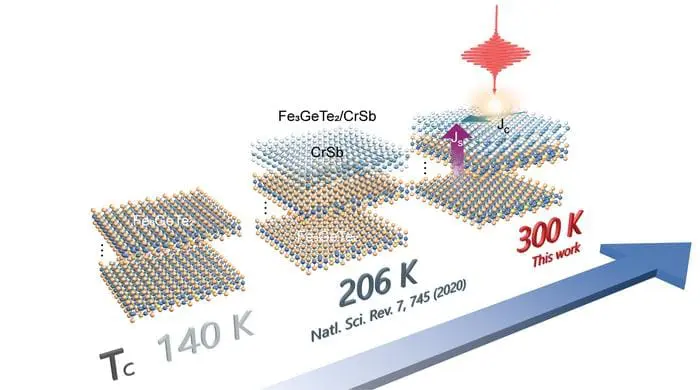
Researchers have made a groundbreaking discovery in spin currents, paving the way for faster data processing and denser information storage. The team has successfully demonstrated the generation of ultrafast terahertz spin currents in two-dimensional magnetic materials at room temperature. This feat was previously thought impossible due to the low Curie temperatures of these materials.
Using a superlattice composed of Fe3GeTe2 and CrSb layers, the researchers induced interfacial spin polarization and generated terahertz radiation through a novel mechanism related to photoexcitation. This innovative approach has the potential to revolutionize the field of spintronics and was made possible through a collaboration between Beihang University, the Institute of Physics at the Chinese Academy of Sciences, and Fudan University. The discovery is published in the National Science Review journal and highlights the potential of laser terahertz emission spectroscopy in investigating extraordinary spin dynamics.
Introduction to Terahertz Spin Current Generation
The generation of spin currents at terahertz frequencies has garnered significant attention recently due to its potential applications in denser information storage and faster data processing. Two-dimensional intrinsic magnetic materials have emerged as a novel platform for accessing femtosecond spin dynamics at atomic layer thickness. However, the practical application of these van der Waals magnets is often limited by their low Curie temperatures. A collaborative team of researchers has made a breakthrough in addressing this challenge by demonstrating ultrafast terahertz spin current generation in a two-dimensional superlattice above the Curie temperature.
The study focused on a (Fe3GeTe2/CrSb)3 superlattice, which exhibits an increased Curie temperature of 206 K compared to the individual Fe3GeTe2 layers. This enhancement is attributed to the interfacial proximity effect, where the interaction between the two materials increases the magnetic ordering temperature. The researchers used femtosecond laser pulses to induce interfacial spin polarization in the superlattice, resulting in room-temperature terahertz spin currents. This achievement has significant implications for the development of novel spintronic devices.
Theoretical simulations played a crucial role in understanding the mechanisms underlying ultrafast spin current generation in the superlattice. The simulations revealed that below the Curie temperature, spin currents are driven by ultrafast demagnetization in the ferromagnetic phase, triggered by femtosecond optical pulses. In contrast, above the Curie temperature, the spin currents arise from a novel mechanism related to photoexcitation, termed the laser-enhanced proximity effect. This effect is characterized by a significant relative interlayer displacement between the Fe3GeTe2 and CrSb layers, accompanied by an enhancement of electron-electron exchange interactions at the interface.
The discovery of this effect was supported by time-resolved magneto-optical Kerr effect measurements of the corresponding transient spin polarization. The researchers observed that femtosecond optical pulses substantially excite the spin polarization in a nonequilibrium manner, thus allowing the generation of ultrafast spin currents. This understanding is crucial for the development of novel spintronic devices that can operate at room temperature.
Mechanisms of Ultrafast Spin Current Generation
The mechanisms underlying ultrafast spin current generation in the (Fe3GeTe2/CrSb)3 superlattice are complex and involve multiple processes. Below the Curie temperature, the spin currents are driven by ultrafast demagnetization in the ferromagnetic phase, triggered by femtosecond optical pulses. This process is well understood and has been extensively studied in various magnetic materials. However, above the Curie temperature, the spin currents arise from a novel mechanism related to photoexcitation, which is less well understood.
The laser-enhanced proximity effect is a key factor in generating ultrafast spin currents above the Curie temperature. This effect is characterized by a significant relative interlayer displacement between the Fe3GeTe2 and CrSb layers and an enhancement of electron-electron exchange interactions at the interface. Theoretical simulations have shown that this effect is responsible for the excitation of spin polarization in the superlattice, leading to the generation of ultrafast spin currents.
The absorption of the 800-nm pump laser by the (Fe3GeTe2/CrSb)3 superlattice results in the shortening of the interlayer distance between the Fe3GeTe2 and CrSb layers in just a few hundred femtoseconds. This, in turn, amplifies the proximity effect or the interaction between the two materials sufficiently to cause the spin polarization of Fe3GeTe2 above Curie temperature. Meanwhile, the magnetic moment of CrSb reorients from out-of-plane to in-plane, polarizing the spin of Fe3GeTe2 in the in-plane direction.
The resulting spin-polarized current is injected into the CrSb layer and converted into the charge current through the spin-to-charge conversion effect, emitting terahertz radiation. This process is crucial for developing novel spintronic devices operating at room temperature.
Experimental and Theoretical Observations
This study’s experimental and theoretical observations provide valuable insights into the mechanisms underlying ultrafast spin current generation in the (Fe3GeTe2/CrSb)3 superlattice. The time-resolved magneto-optical Kerr effect measurements revealed that femtosecond optical pulses substantially excite the spin polarization in a nonequilibrium manner, thus allowing the generation of ultrafast spin currents.
Theoretical simulations played a crucial role in understanding the mechanisms underlying ultrafast spin current generation in the superlattice. The simulations revealed that below the Curie temperature, spin currents are driven by ultrafast demagnetization in the ferromagnetic phase, triggered by femtosecond optical pulses. In contrast, above the Curie temperature, the spin currents arise from a novel mechanism related to photoexcitation, termed the laser-enhanced proximity effect.
The combination of experimental and theoretical observations provides a comprehensive understanding of the mechanisms underlying ultrafast spin current generation in the (Fe3GeTe2/CrSb)3 superlattice. This understanding is crucial for the development of novel spintronic devices that can operate at room temperature.
Implications and Future Directions
The findings of this study have significant implications for the development of novel spintronic devices that can operate at room temperature. The demonstration of ultrafast terahertz spin current generation in a two-dimensional superlattice above the Curie temperature opens up new avenues for the development of high-speed spintronic devices.
The use of laser terahertz emission spectroscopy provides a powerful tool for investigating laser-induced extraordinary spin dynamics. This technique can be used to study the dynamics of spin currents in various magnetic materials, providing valuable insights into the mechanisms underlying ultrafast spin current generation.
Future studies should focus on exploring the potential applications of ultrafast terahertz spin current generation in novel spintronic devices. The development of devices that can operate at room temperature and exhibit high-speed spin dynamics is crucial for the advancement of spintronics. Additionally, further research is needed to understand the mechanisms underlying ultrafast spin current generation in various magnetic materials, which will provide valuable insights into the development of novel spintronic devices.
Conclusion
In conclusion, the demonstration of ultrafast terahertz spin current generation in a two-dimensional superlattice above the Curie temperature is a significant achievement with far-reaching implications for the development of novel spintronic devices. The mechanisms underlying ultrafast spin current generation in the (Fe3GeTe2/CrSb)3 superlattice are complex and involve multiple processes, including ultrafast demagnetization and the laser-enhanced proximity effect.
The combination of experimental and theoretical observations provides a comprehensive understanding of the mechanisms underlying ultrafast spin current generation in the superlattice. The use of laser terahertz emission spectroscopy provides a powerful tool for investigating laser-induced extraordinary spin dynamics, which can be used to study the dynamics of spin currents in various magnetic materials.
Future studies should explore the potential applications of ultrafast terahertz spin current generation in novel spintronic devices and understand the mechanisms underlying ultrafast spin current generation in various magnetic materials. The development of high-speed spintronic devices that can operate at room temperature is crucial for the advancement of spintronics, and this study provides a significant step towards achieving this goal.
External Link: Click Here For More