Quantum key distribution (QKD) is rapidly moving from laboratory experiments toward practical application in secure communication networks, but realising its full potential requires overcoming significant engineering challenges. Pooja Chandravanshi, Jayanth Ramakrishnan, Tanya Sharma, and colleagues at the Quantum Science and Technology Laboratory, Physical Research Laboratory, and Telecom Paris, address these hurdles by presenting a comprehensive framework for building and optimising QKD systems. Their work focuses on the widely used BB84 protocol, yet offers broadly applicable techniques for device calibration, synchronisation, and key processing, providing a systematic approach to improve performance. The team demonstrates the critical importance of carefully selecting timing windows to maximise key generation rates while minimising errors, and introduces a novel random sampling method for more accurate error estimation, ultimately paving the way for more robust and efficient secure communication systems.
Free-Space and Fiber QKD System Challenges
This research explores the landscape of Quantum Key Distribution (QKD) and related quantum technologies, encompassing free-space optical links, fiber optic cables, and satellite-based communication. Free-space systems face challenges from atmospheric conditions like dust and turbulence, requiring precise synchronisation and channel characterisation. Researchers are striving for higher key rates, exceeding 1. 25 Gbps, and developing resource-efficient systems to create practical, deployable QKD systems. The development of quantum light sources is central to this field, with efforts directed towards creating on-demand entangled photons and deterministic single-photon sources to improve QKD performance and security.
Alongside light sources, the research addresses fundamental QKD protocols like BB84 and BBM92, while tackling security vulnerabilities such as detection-efficiency mismatch attacks and side-channel attacks that exploit hardware imperfections. Techniques like privacy amplification and error correction, utilising codes like LDPC, are crucial for ensuring secure key exchange. Generating truly random numbers is another critical area, with researchers exploring quantum chaotic maps and linear feedback shift registers for random number generation, as the quality of these numbers directly impacts QKD security. Precise clock synchronisation is essential, particularly over long distances, often relying on optical classical communication channels. Understanding and mitigating the effects of atmospheric turbulence and dust on QKD signals is also paramount, alongside hardware acceleration utilising field-programmable gate arrays (FPGAs) for real-time post-processing and low-cost implementations.
Streamlined Key Sifting for Practical QKD
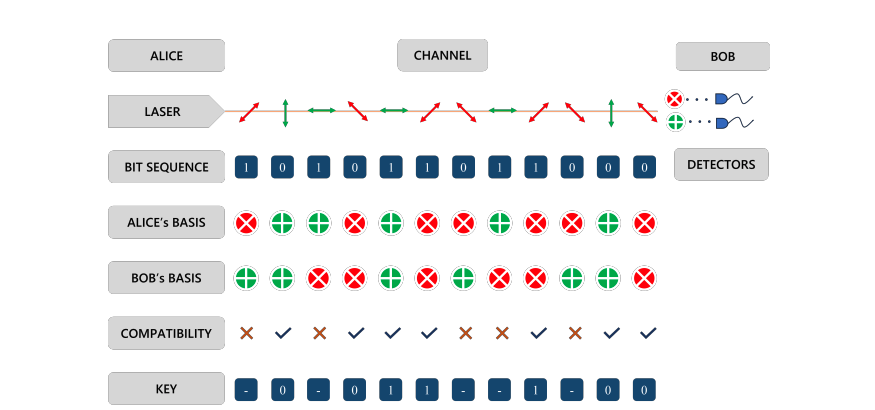
Researchers have developed a practical approach to implementing Quantum Key Distribution (QKD), focusing on the BB84 protocol but designing the methodology for broader applicability. Recognising that real-world QKD systems are susceptible to hardware imperfections, they prioritised a systematic framework encompassing device calibration, synchronisation, and optical alignment, alongside key post-processing techniques to bridge the gap between theoretical security and practical implementation. A key innovation lies in the method for key sifting, the process of establishing a shared secret key, with the team developing a streamlined algorithm designed for efficient hardware implementation. Furthermore, they refined the method for estimating error rates, moving beyond sequential sampling to a random sampling technique that yields more reliable results, crucial for assessing security.
To enhance key generation rates, the researchers integrated the Entrapped Pulse Coincidence Detection (EPCD) protocol, leveraging multiple photons to improve signal detection without compromising security. The team placed significant emphasis on meticulous source characterisation to mitigate potential side-channel attacks, opting for a four-laser diode system to encode polarisation qubits. Rigorous testing for inconsistencies in parameters like wavelength, pulse width, and arrival time allowed them to quantify potential information leakage and develop methods to minimise vulnerabilities. Careful characterisation of the mean photon number of weak coherent pulses used recognised that inaccurate estimation could create opportunities for undetected attacks. This precise control over timing, combined with advanced error estimation and multi-photon detection techniques, demonstrates a commitment to building a robust and practical QKD system capable of secure key generation in real-world conditions.
BB84 Protocol Framework for Practical QKD
Quantum Key Distribution (QKD) promises unhackable communication by leveraging quantum mechanics, offering a solution to vulnerabilities posed by increasingly powerful computers. Unlike traditional encryption, QKD allows two parties to securely share a secret key, guaranteed by the laws of physics, and detect any attempt at eavesdropping. Recent advancements have moved QKD from laboratory experiments to real-world deployments, including satellite-based systems and fiber optic networks, but practical implementation challenges remain. Researchers have developed a comprehensive framework for implementing QKD, focusing on the BB84 protocol but designed to be adaptable to other approaches.
This work addresses a gap in the field by providing detailed practical insights into building and operating QKD systems, covering everything from initial setup to real-time key generation. Crucially, the team emphasises meticulous characterisation of each component, the source of quantum signals, the transmission channel, and the detectors, to ensure system efficiency and security, paying particular attention to potential side-channel vulnerabilities. The framework integrates several key improvements to optimise performance. Careful selection of the timing window for detecting signals significantly enhances both the key generation rate and the accuracy of the key, minimising errors.
Furthermore, the team demonstrates that using a random sampling method for estimating errors provides more reliable results than traditional sequential sampling techniques. By incorporating the Entrapped Pulse Coincidence Detection (EPCD) protocol, they have successfully boosted key generation rates, further improving the system’s overall efficiency. This research demonstrates a significant step towards practical, robust QKD systems, with the detailed approach to characterisation, combined with improvements to key generation and error estimation, providing a valuable guide for both researchers and those deploying secure quantum communication networks.
Practical BB84 Implementation and Key Sifting
This work presents a practical framework for implementing Quantum Key Distribution (QKD), specifically the BB84 protocol, with the aim of bridging the gap between theoretical security and real-world deployment. The research details key concepts and techniques for establishing a functional QKD system, including device calibration, synchronisation, and optical alignment. A streamlined algorithm for key sifting is presented, designed for ease of implementation in hardware, and the importance of optimising the temporal window for both key rate and error rate is highlighted. The findings demonstrate that random sampling of sifted key bits provides more reliable error estimation than sequential sampling, improving the accuracy of security assessments.
Integration of the Entrapped Pulse Coincidence Detection (EPCD) protocol further enhances key generation rates, boosting overall system performance. While the focus is on BB84, the authors emphasise that the techniques and practices outlined are broadly applicable to a range of QKD protocols, offering a valuable resource for both research and practical applications. The authors acknowledge that the performance of QKD systems is inherently limited by imperfections in physical devices and channel noise. Future work could focus on mitigating these limitations through improved hardware components and advanced signal processing techniques. The presented framework provides a solid foundation for further development and refinement of QKD systems, paving the way for more secure communication networks.
🗞 System design and realisation towards optimising secure key bits in free space QKD
🧠 ArXiv: https://arxiv.org/abs/2508.10458