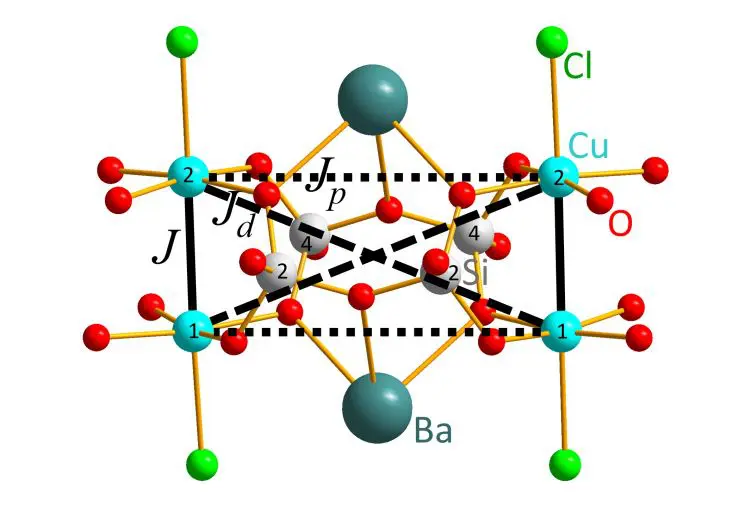
The behaviour of magnetic materials near critical points reveals fundamental physics, and recent research focuses on the quasi-two-dimensional compound barium copper silicon oxide chloride. K. M. Ranjith, Maxime Dupont, and Steffen Krämer, alongside Sylvain Capponi, Edmond Orignac, and Nicolas Laflorencie, investigate the magnetic fluctuations within this material, which exhibits a unique state where magnetism arises from linked pairs of electron spins. Their work demonstrates strong two-dimensional behaviour, specifically a Berezinskii-Kosterlitz-Thouless (BKT) transition, extending to surprisingly high temperatures, and establishes barium copper silicon oxide chloride as an ideal system for understanding this important type of magnetic transition. By combining experimental measurements with large-scale computer simulations, the team accurately maps the boundaries of this magnetic state and confirms the underlying physics governing its behaviour, offering new insights into the behaviour of quantum magnets.
This work investigates the spin dynamics within the quasi-2D compound Ba₂CuSi₂O₆Cl₂, a material exhibiting a magnetic field-induced Bose-Einstein condensate of triplons. The research employs nuclear magnetic resonance to measure how quickly excited spins return to equilibrium, revealing details about the system’s dynamic properties and the behaviour of the triplon condensate under varying magnetic fields. This approach characterises the mechanisms governing spin relaxation, contributing to a deeper understanding of quantum phenomena within this material. Scientists meticulously measured nuclear spin-lattice relaxation rates to investigate spin dynamics within Ba₂CuSi₂O₆Cl₂, revealing critical fluctuations across its phase diagram. Experiments utilizing both ⁶³Cu and ²⁹Si nuclei, coupled with large-scale Monte Carlo simulations, demonstrate a pronounced peak in the relaxation rate extending well above the Néel temperature, indicating strong two-dimensional Berezinskii-Kosterlitz-Thouless (BKT)-type fluctuations. The team established a quantitative match between experimental data and theoretical predictions for the BEC phase boundaries, validating an effective model describing the material’s behaviour.
Correlation Length and Quantum Antiferromagnet Transitions
This research investigates the behaviour of a quantum antiferromagnet, focusing on how the system transitions into a disordered phase as temperature increases or a magnetic field is applied. A key focus is the correlation length, a measure of how far apart spins remain correlated, indicating proximity to a phase transition. Scientists used Quantum Monte Carlo simulations to study both static and dynamic correlation lengths, considering spatial and temporal correlations of the spins. They developed a theoretical framework to relate these measurements and predict the system’s behaviour near the phase transition.
The results demonstrate a consistent relationship between dynamic and static correlation lengths, suggesting comparable timescales and spatial scales of spin correlations. The data confirms theoretical predictions for the critical behaviour of the system, aligning with the Kosterlitz-Thouless-Halperin-Nelson theory. The research provides a detailed understanding of the critical behaviour of a quasi-two-dimensional quantum antiferromagnet, important for developing new materials with exotic magnetic properties and understanding the fundamental physics of phase transitions. The combination of advanced computational techniques and theoretical modelling provides a powerful approach for studying complex quantum systems.
BKT Fluctuations Confirm Triplon Condensate Boundaries
Measurements of the intrinsic BKT transition temperature, determined through Monte Carlo simulations, reveal a nearly field-independent value, remaining consistent across much of the BEC dome, decreasing only slightly at the edges. The study precisely measured relaxation rates using a saturation-recovery method, fitting the recovery of nuclear magnetization with exponential functions, and confirmed sample homogeneity through the quality of the fits. Data from ⁶³Cu nuclei show a relaxation rate 135times faster than that from ²⁹Si nuclei, a consistent ratio observed throughout the experiments. Analysis of temperature dependence reveals strong peaks in relaxation rates at the phase transition into the low-temperature BEC phase, reflecting critical spin fluctuations, and nearly constant rates at critical fields. Measurements at 1. 6 K demonstrate that the ⁶³Cu and ²⁹Si relaxation rates exhibit a pronounced peak, confirming the presence of strong two-dimensional BKT-type fluctuations, establishing Ba₂CuSi₂O₆Cl₂ as a model system for exploring BKT dynamics in magnets.
BKT Criticality in Barium Copper Silicate Chloride
This study establishes barium copper silicate chloride, Ba₂CuSi₂O₆Cl₂, as a valuable model compound for investigating Berezinskii-Kosterlitz-Thouless (BKT) criticality in quasi-two-dimensional quantum magnets. Combining nuclear magnetic resonance experiments with large-scale Monte Carlo simulations, researchers mapped the magnetic field-temperature phase diagram and identified a region dominated by two-dimensional BKT fluctuations. The observed, pronounced peak in the spin-lattice relaxation rate confirms the dominance of these critical dynamics across a significant temperature range, demonstrating behaviour consistent with established theoretical predictions for two-dimensional systems. The research successfully matches experimental data with theoretical calculations based on an effective model, validating the approach and providing insight into triplon condensation. The team acknowledges limitations in fully capturing the system’s dynamics, noting discrepancies between simulation results and the sharpness of the observed NMR relaxation peak, potentially stemming from complexities in extracting real-frequency information or finite-size effects within the computational model. Future work could focus on characterizing the dimensional crossover from two to three dimensions and exploring NMR dynamics within the magnetically ordered phase, potentially with more refined theoretical approaches.
🗞 Critical BKT dynamics in the archetypal 2D spin system Ba CuSi O Cl
🧠 ArXiv: https://arxiv.org/abs/2511.17381