
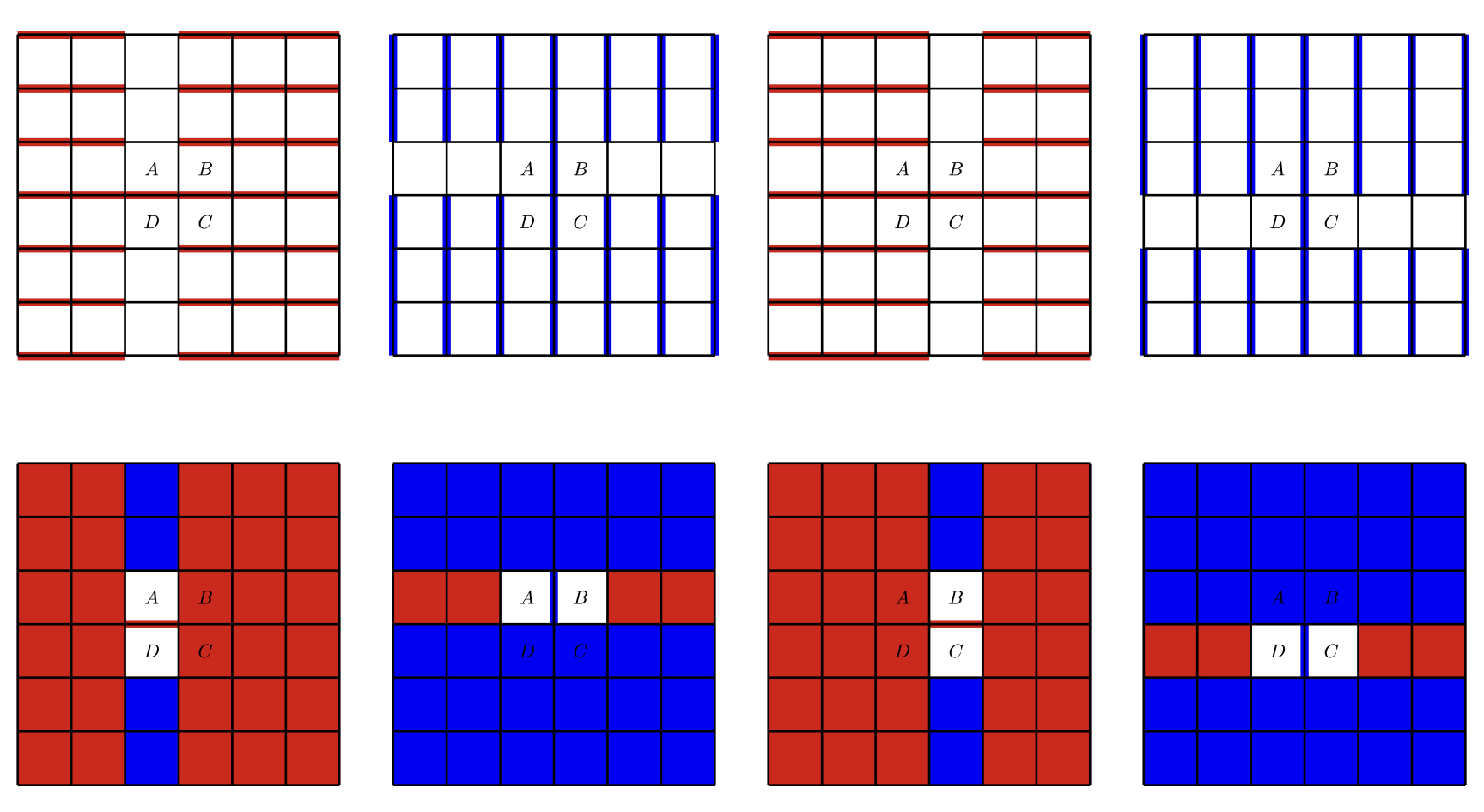
The BaconShor code is a quantum error correcting subsystem code that plays a crucial role in quantum computing, particularly in quantum error correction (QEC). Unlike other quantum error correction codes, such as the surface code, the BaconShor code can host several dynamical logical qubits, preserving more logical information and making it more efficient in error correction. The code is naturally defined on a square lattice, which could be beneficial from an experimental perspective. The BaconShor code’s unique features and potential for constructing more examples of Floquet codes make it a promising tool for future advancements in quantum computing.
What is the BaconShor Code and its Role in Quantum Computing?
The BaconShor code is a quantum error correcting subsystem code that is composed of weight 2 check operators. It allows for a single logical qubit and has distance on a square lattice. The code is significant in the field of quantum computing, particularly in the area of quantum error correction (QEC). QEC is a broad framework that encodes logical information on part of the full physical Hilbert space and protects against errors through measurements of appropriate syndrome observables followed by post-measurement correction operations.
The BaconShor code, when viewed as a Floquet code by choosing an appropriate measurement schedule of the check operators, can host several dynamical logical qubits. This means that it can preserve logical information between the instantaneous stabilizer groups. The code measures not only the usual stabilizers of the BaconShor code but also additional stabilizers that protect the dynamical logical qubits against errors.
The code distance of these Floquet-BaconShor codes scales on a square lattice with dynamical logical qubits along with the logical qubit of the parent subsystem code. Furthermore, several errors are shown to be self-corrected purely by the measurement schedule itself. This makes the BaconShor code a valuable tool in quantum computing.
How Does the BaconShor Code Compare to Other Quantum Error Correction Codes?
The BaconShor code is compared to other quantum error correction codes such as the surface code, which has been a popular choice due to its relatively high threshold and simple square lattice architecture. However, the BaconShor code offers unique advantages.
For instance, it can host several dynamical logical qubits, which is not possible with the surface code. This means that the BaconShor code can preserve more logical information, making it more efficient in error correction.
Moreover, the BaconShor code is naturally defined on a square lattice, which may be appealing from an experimental perspective. It is also an example of a CSS Floquet code since all the stabilizers are of either X or Z type.
What is the Future of the BaconShor Code in Quantum Computing?
The BaconShor code has a promising future in quantum computing. It offers a simpler example of a Floquet code and comes naturally equipped with a boundary without the complication of nontrivial automorphisms between electric and magnetic operators.
The code also demonstrates the construction of a Floquet code using essentially only the subsystem structure of the parent code through the addition of gauge defects. This approach may be widely applicable in constructing more examples of Floquet codes, which could further advance the field of quantum computing.
In conclusion, the BaconShor code is a significant development in quantum computing, particularly in the area of quantum error correction. Its ability to host several dynamical logical qubits and its simple square lattice structure make it a promising tool for future advancements in the field.
Publication Date: 2024-03-05
Authors: M. Sohaib Alam and Eleanor Rieffel
Source: arXiv (Cornell University)
DOI: https://doi.org/10.48550/arxiv.2403.03291