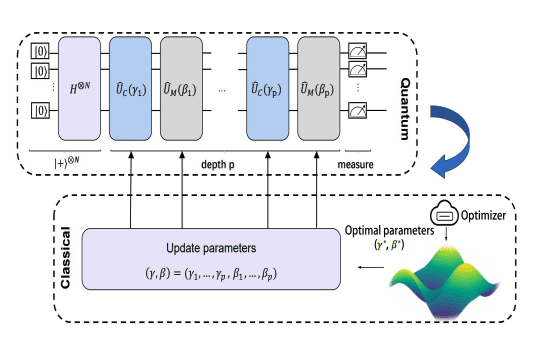
On April 13, 2025, researchers published Hierarchical Quantum Optimization via Backbone-Driven Problem Decomposition: Integrating Tabu-Search with QAOA, detailing a novel hybrid framework that combines classical adaptive Tabu search with quantum approximate optimization algorithms (QAOA) to address the scalability challenges of combinatorial optimization on noisy intermediate-scale quantum (NISQ) devices.
The study introduces Backbone-Driven QAOA, a hybrid framework addressing scalability challenges of Quantum Approximate Optimization Algorithm (QAOA) on Noisy Intermediate Scale Quantum (NISQ) devices. By leveraging adaptive Tabu search for classical preprocessing, large-scale quadratic unconstrained binary optimization (QUBO) problems are decomposed into smaller, NISQ-compatible subproblems. Backbone variables are dynamically identified and fixed to preserve critical optimization landscapes, enabling iterative refinement of solutions via QAOA in a closed-loop process. Experimental results demonstrate the framework’s competitiveness with classical algorithms and efficient resource allocation on current quantum hardware.
Combinatorial optimization problems are among the most challenging tasks in computer science, with applications spanning logistics, finance, and artificial intelligence. These problems require identifying the optimal solution from a finite yet often astronomically large set of possibilities. Classical computers face significant limitations when tackling such tasks due to their exponential growth in complexity. As a result, researchers have turned to quantum computing as a potential solution. Recent advancements in quantum algorithms, particularly those designed for optimization, have demonstrated promising results in addressing these challenges more efficiently than classical methods.
One notable example is the Max-Cut problem, a fundamental task in graph theory with practical applications in network design and machine learning. By leveraging the principles of quantum mechanics, researchers are developing innovative approaches that could fundamentally alter how we solve complex decision-making problems.
Quantum Algorithms for Optimization
Quantum computing introduces a novel paradigm for solving optimization problems by exploiting the principles of superposition and entanglement. Unlike classical bits, which can only exist in states of 0 or 1, quantum bits (qubits) can occupy multiple states simultaneously. This property enables quantum computers to explore many potential solutions concurrently, offering a significant advantage over classical systems.
A promising approach in this domain is the use of variational quantum algorithms, such as the Quantum Approximate Optimization Algorithm (QAOA). These hybrid methods combine classical and quantum computing to iteratively refine solutions, making them particularly well-suited for near-term quantum hardware. By encoding optimization problems into quantum circuits, researchers can leverage the unique properties of qubits to find approximate solutions more efficiently than classical algorithms in certain cases.
The application of quantum computing to combinatorial optimization has seen significant progress, driven by advancements in cloud-based quantum computers that allow researchers to test and refine their algorithms at scale. For instance, experiments on the Max-Cut problem have shown that quantum approaches can achieve better results than classical methods under specific conditions.
However, several challenges remain. Variational quantum algorithms are highly sensitive to noise and errors inherent in current quantum hardware, which can limit their performance. Additionally, translating real-world problems into formats compatible with quantum computing requires careful consideration and optimization. Despite these hurdles, the potential for quantum computing to transform optimization tasks is immense, offering hope for breakthroughs in fields that rely heavily on decision-making under complexity.
As quantum technology continues to evolve, its role in solving complex optimization problems is likely to expand significantly. This expansion could provide new tools for industries grappling with intricate decision-making processes. While current implementations remain experimental and face significant challenges, the progress made so far underscores the transformative potential of quantum computing. By addressing the limitations of existing hardware and algorithms, researchers can unlock a future where quantum methods become an indispensable part of our computational toolkit.
👉 More information
🗞 Hierarchical Quantum Optimization via Backbone-Driven Problem Decomposition: Integrating Tabu-Search with QAOA
🧠 DOI: https://doi.org/10.48550/arXiv.2504.09575