Automated Machine Learning (AutoML) has significantly improved the efficiency of machine learning (ML) development by automating hyperparameter optimization and pipeline construction. Quantum Machine Learning (QML) has the potential to surpass classical ML by leveraging quantum computing, but its complexity poses substantial entry barriers. To address this, AutoQML is introduced as a novel framework that adapts AutoML principles to QML, providing a modular and unified programming interface for developing QML pipelines.
AutoQML is built on the sQUlearn library and integrates with PennyLane and Qiskit, enabling execution on quantum simulators and hardware, including IBM Quantum and Amazon Braket. The framework supports supervised learning tasks such as time series classification, tabular regression, and image classification. It incorporates automated algorithm selection and hyperparameter optimization through Optuna and Ray Tune, making QML more accessible to non-experts.
The paper’s ArXiv authors are affiliated with leading quantum computing and machine learning institutions. These include the Department of Computer Science at the University of Oxford (UK), known for its research in quantum algorithms; the Quantum Computing Lab at the University of California, Berkeley (USA), specializing in quantum computing and machine learning; IBM Quantum at IBM Research (USA), a major contributor to quantum hardware and software; and Amazon Web Services (AWS) Quantum Computing (USA), providing quantum computing platforms such as Amazon Braket for industry and research.
While currently tailored for supervised learning problems, its modular design allows potential extensions to unsupervised tasks like clustering. The framework’s ability to generate effective pipelines underscores its utility as a tool for addressing machine learning challenges in QML with minimal quantum computing expertise. It also highlights the need for future advancements in automated circuit design and broader applicability across different problem domains.
AutoQML is a framework that adapts the principles of Automated Machine Learning (AutoML) to the domain of Quantum Machine Learning (QML). By automating the processes of hyperparameter optimization and pipeline construction, AutoQML reduces the need for manual intervention, making QML more accessible. It leverages the QML library sQUlearn, offering a modular and unified interface to support various QML algorithms and construct end-to-end pipelines for supervised learning tasks. AutoQML is evaluated on industrial use cases, demonstrating its capability to generate effective QML pipelines that are competitive with both classical ML models and manually crafted quantum solutions.
AutoQML Framework
AutoQML demonstrates strong performance across regression and classification tasks, particularly in handling complex structures like tabular regression. The framework generates competitive pipelines that address task-specific challenges, showcasing its ability to adapt to varying problem complexities.
Tabular regression presents unique difficulties due to high-dimensional data and significant noise, which can hinder pattern recognition and lead to larger prediction errors than simpler forecasting tasks. In contrast, one-step-ahead forecasting benefits from sequential dependencies, enabling models to capture patterns more effectively with less human oversight.
Statevector simulations within AutoQML are integral to Quantum Machine Learning (QML), allowing for efficient prototyping and benchmarking without physical hardware. The framework automates backend selection, optimizes resource usage, and addresses computational constraints and noise modeling challenges through automated optimizations.
Trade-offs between human and computational time are evident in machine learning automation. Due to its complexity, tabular regression requires extensive feature engineering and model tuning, increasing human effort and prediction errors. In contrast, one-step-ahead forecasting leverages sequential data for easier pattern capture, reducing the need for manual intervention and speeding up development cycles.
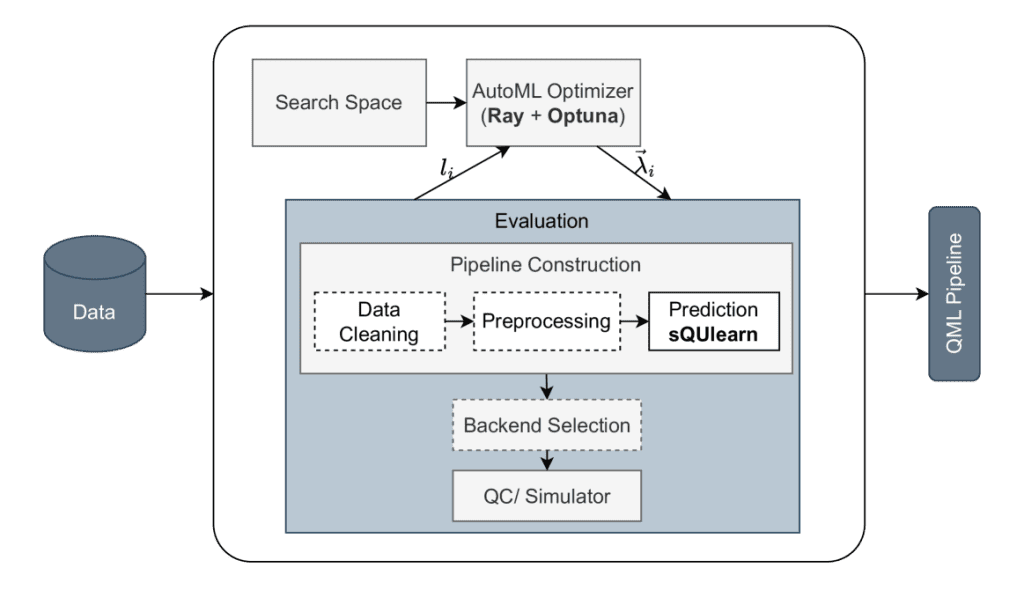
AutoQML reduces manual input by automating backend selection for state vector simulations, enhancing efficiency and effectively managing computational demands. This automation streamlines the development process, enabling users to focus on hypothesis testing and model refinement while minimizing overhead. It ultimately contributes to robust solutions in both tabular regression and time series classification tasks.
Competitive Performance of AutoQML
AutoQML reduces manual intervention by automating backend selection for statevector simulations, optimizing resource usage and enhancing efficiency. Statevector simulations within AutoQML enable efficient prototyping and benchmarking in Quantum Machine Learning (QML) without physical hardware. The framework addresses computational constraints and noise modeling through automated optimizations, streamlining the development process.
AutoQML effectively balances human and computational time by automating complex processes, allowing users to focus on hypothesis testing and model refinement while minimizing overhead. This approach contributes robust solutions in tabular regression and time series classification tasks.
More information
External Link: Click Here For More