

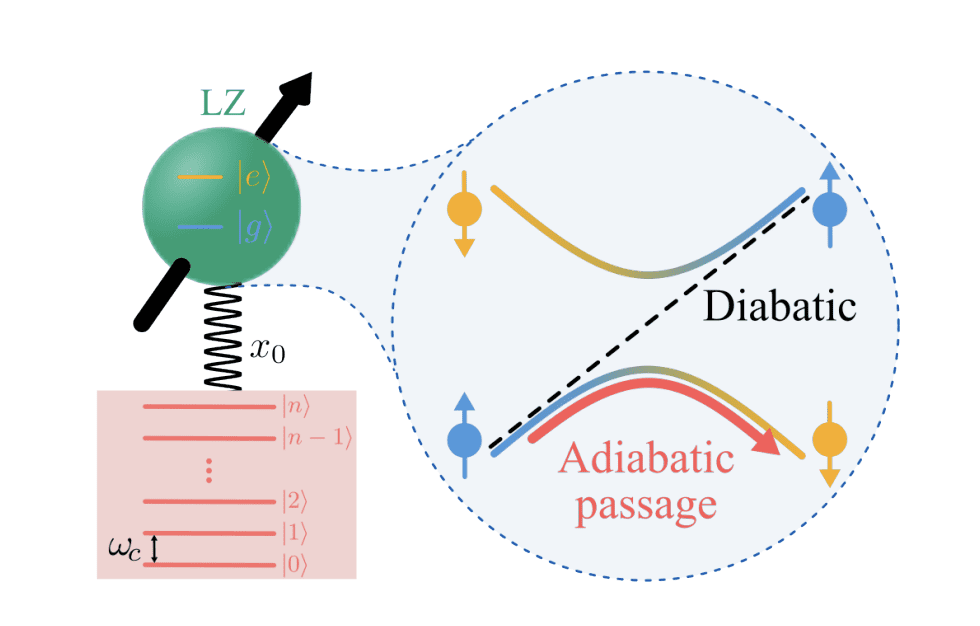
Adiabatic computing promises powerful solutions to complex problems, but its reliance on slow, gradual changes in a system often limits practical application. Emma C. King, Giovanna Morigi, and Raphaël Menu, from the Theoretische Physik at the Universität des Saarlandes and associated institutions, demonstrate a method to significantly accelerate these computations. Their research focuses on suppressing unwanted transitions that occur when systems change state, using carefully designed control fields to create ‘shortcuts to adiabaticity’. By coupling a simple quantum system, exemplified by the Landau-Zener model, to a secondary system, the team shows they can reduce the probability of these detrimental transitions by over two orders of magnitude, paving the way for faster and more efficient quantum algorithms.
The Landau-Zener model describes how quantum systems transition between states under the influence of changing fields. Researchers are now exploring how to improve quantum state transfer within this model, a key element of quantum adiabatic dynamics. They demonstrate that unwanted transitions can be suppressed by coupling the system to a second quantum system, effectively creating a more controlled environment. By carefully tuning the strength of this coupling, the team reduces the probability of errors, representing a significant step towards implementing shortcuts to adiabaticity, where quantum processes are accelerated without sacrificing accuracy.
Adiabatic Computation and Shortcut Techniques Explored
A comprehensive body of research exists on adiabatic quantum computation, open quantum systems, and ultrastrong coupling, all crucial for advancing quantum technologies. This work explores core concepts like adiabatic quantum computation, where problems are solved by slowly evolving a quantum system, and focuses on shortcuts to adiabaticity, techniques designed to speed up these processes using carefully engineered control pulses or environments. These methods aim to achieve the same results as traditional adiabatic computation, but much faster. Researchers are also investigating reservoir engineering, a process of manipulating the environment surrounding a quantum system to enhance control and implement these shortcuts.
A major challenge is overcoming dissipation and decoherence, which introduce errors and limit the lifespan of quantum information, with some studies focusing on mitigating these effects while others explore ways to exploit them for control, even demonstrating methods for cancelling decoherence through noise interference. Understanding open quantum systems is vital, as real-world systems inevitably interact with their environment, particularly through non-Markovian dynamics where the environment has memory effects. Engineering quantum reservoirs, carefully designed environments that interact with the system, is central to many control schemes. Furthermore, research into ultrastrong coupling, where the interaction between light and matter is exceptionally strong, is opening up new possibilities for quantum control, often explored within the framework of cavity quantum electrodynamics.
These advances are paving the way for advanced quantum devices, including qubits and quantum sensors, with current research focusing on specific implementations using superconducting qubits and trapped ions, as well as central spin systems for quantum information processing. Advanced techniques like quantum state preparation and quantum search algorithms are being developed, alongside applications in quantum sensing. Crucially, researchers are addressing the challenge of errors caused by decoherence and other noise sources, highlighting the importance of control and manipulation, overcoming decoherence, and adapting techniques to specific quantum platforms, bridging the gap between theoretical developments and experimental implementations.
Spectator Qubit Boosts Transfer Fidelity Significantly
Researchers have significantly improved the reliability of quantum state transfer by strategically coupling a qubit to an additional quantum system, termed a spectator. This approach tackles the inherent challenge of maintaining quantum information during transitions, where unwanted shifts between energy levels can introduce errors. By carefully controlling the interaction between the qubit and the spectator, the team has effectively suppressed these detrimental transitions, achieving a substantial increase in transfer fidelity. The core of this advancement lies in manipulating the energy landscape of the combined qubit-spectator system.
The researchers discovered that by tuning the strength of the interaction between the two systems, they could reshape the energy levels to minimize the probability of unwanted transitions, achieved through a process where the spectator’s dynamics are carefully designed to counteract factors that would normally cause the qubit to shift to an incorrect state. The team identified specific thresholds related to the interaction strength and the speed of the transfer process, defining distinct regimes where this control is most effective. Quantitative results demonstrate a dramatic reduction in the probability of errors. In scenarios where the qubit would typically have a greater than 50% chance of ending in an incorrect state, the introduction of the spectator field, tuned to operate within the identified optimal regime, significantly lowered this probability.
Furthermore, the researchers observed a corresponding increase in the purity of the qubit’s state, indicating a stronger preservation of quantum information throughout the transfer, assessed by tracking entanglement between the qubit and the spectator, with higher entanglement correlating to more robust information transfer. Notably, the team found that increasing the speed of the transfer process, while potentially introducing errors in a standard system, can actually enhance the effectiveness of this control method. This counterintuitive finding suggests that the carefully designed interaction with the spectator field can compensate for the increased risk of errors associated with faster transitions, expanding the range of parameters where highly reliable transfer is possible. This research provides a promising pathway towards building more robust and reliable quantum technologies by leveraging the principles of controlled interactions and strategic system coupling.
Interference-Assisted Superadiabacity Boosts Quantum Computation
Researchers have demonstrated a method for improving the efficiency of adiabatic quantum computation through the use of autonomous dynamics. By coupling a quantum system to a second ‘spectator’ system, they successfully suppressed unwanted non-adiabatic transitions, processes that limit the speed and accuracy of computation. This approach, termed interference-assisted superadiabacity, leverages quantum coherence and entanglement to achieve enhanced performance, even when operating in conditions where transitions would normally be highly probable. The team’s findings indicate that this protocol is robust against variations in experimental parameters and moderate dissipation within the spectator system, suggesting practical feasibility. While the current study focuses on a single qubit and spectator, the authors note that scalability to more complex systems, such as strings of qubits, is possible through the use of architectures found in circuit quantum electrodynamics platforms. Future work could focus on optimising the qubit sweep schedule and extending the approach to larger systems, potentially contributing to advancements in quantum supremacy and the development of more efficient quantum algorithms.
👉 More information
🗞 Shortcuts to adiabaticity with a quantum control field
🧠 ArXiv: https://arxiv.org/abs/2508.06304


