

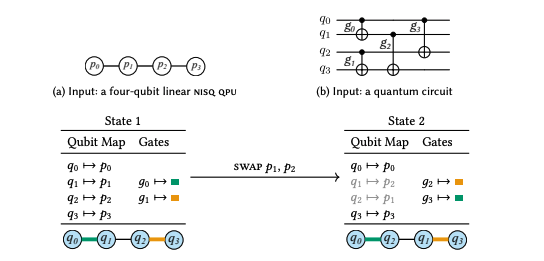
Quantum computers hold the promise of revolutionizing fields from materials science to medicine, but realising this potential depends on sophisticated software to manage their complex operations. Abtin Molavi, Amanda Xu, and Ethan Cecchetti, from the University of Wisconsin-Madison, along with Swamit Tannu and Aws Albargouthi, present a new method for automatically generating compilers that optimise the mapping and routing of quantum information, a critical step in running quantum programs. This research addresses a significant challenge, as the rapidly evolving landscape of quantum hardware demands constant adaptation of these compilers, a process traditionally requiring substantial manual effort. By identifying a core structure underlying all qubit mapping and routing problems, the team has created a system capable of generating efficient compilers for diverse and emerging quantum architectures, achieving performance comparable to compilers painstakingly designed by hand and paving the way for simpler development of future quantum software.
A critical step is qubit mapping and routing, which assigns logical qubits to physical qubits and plans the sequence of operations. The challenge lies in the diversity and rapid evolution of quantum computer architectures, demanding tailored compilation strategies. Researchers have developed MaxState, a compilation system designed to address these challenges and improve the performance of quantum circuits on real hardware.
MaxState combines several techniques to achieve high-quality qubit mappings and routing solutions. The system employs a search algorithm guided by a cost function considering factors such as the number of qubit swaps, expected gate fidelity, and hardware connectivity. A key innovation is an incremental isomorphism optimization, a ‘warm-start’ procedure that efficiently finds a good initial qubit mapping by constructing an interaction graph representing qubit dependencies and searching for a similar subgraph within the hardware’s connectivity graph. This warm-start speeds up the search process and improves solution quality, particularly for circuits with a linear interaction graph.
Extensive experimental results demonstrate that MaxState consistently outperforms other compilation systems on various quantum devices and benchmark circuits. Comparisons with established tools like Qiskit and Qsynth, as well as state-of-the-art techniques, reveal lower swap counts and higher expected gate fidelities. Ablation studies confirm the importance of both the incremental isomorphism warm-start and a maximal state search strategy in achieving high performance, demonstrating MaxState’s versatility and power.
Automated Quantum Compiler Generation for Diverse Architectures
Developing compilers for quantum computers is a significant bottleneck in realizing the potential of this emerging technology. Quantum computers promise to solve complex problems beyond the reach of classical computers, but maximizing their performance requires sophisticated compilers that efficiently manage resources and minimize errors. Researchers have developed a new system for automatically creating these compilers, addressing the challenge of diverse and rapidly evolving quantum hardware, focusing on qubit mapping and routing.
The team’s approach identifies a common underlying structure within all qubit mapping and routing problems, formulating an abstract problem adaptable to any architecture. At the heart of the system is a new domain-specific language, Marol, which allows researchers to concisely describe the unique characteristics of a quantum computer. This specification is then fed into a powerful solver that automatically generates a compiler tailored to that specific hardware, demonstrating versatility across near-term and fault-tolerant designs.
Importantly, the automatically generated compilers are competitive with those created by hand. Tests using a comprehensive suite of benchmark circuits demonstrate comparable runtime and solution quality, and even outperform existing compilers in certain areas, paving the way for faster innovation as new quantum architectures emerge.
Automatic Compiler Generation For Quantum Processors
Compiling quantum programs is a significant challenge, particularly given the diversity and rapid evolution of quantum hardware. Researchers have developed a new method for automatically generating qubit mapping and routing compilers, essential for translating quantum algorithms into instructions a specific processor can execute. By identifying a common underlying structure within these compilation problems, they created a domain-specific language, Marol, which allows for concise specification of mapping and routing requirements.
This language then feeds into a powerful solving algorithm capable of generating compilers tailored to a wide range of quantum processors. Evaluations demonstrate that the automatically generated compilers achieve performance competitive with those designed manually by experts, both in terms of runtime and solution quality, offering a viable path towards simplifying the development of compilers for future quantum architectures.
Future work will focus on improving the speed and accuracy of the search algorithm, potentially through the application of reinforcement learning, and combining mapping and routing with circuit optimization to create even more efficient compilers that co-optimize both the quantum circuit and its physical implementation.
🗞 Generating Compilers for Qubit Mapping and Routing
🧠 ArXiv: https://arxiv.org/abs/2508.10781


