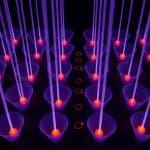
In a groundbreaking achievement, researchers at the University of Innsbruck and spin-off AQT have successfully integrated a quantum computer into a high-performance computing environment in Austria for the first time. This hybrid infrastructure combines the power of supercomputing with the potential of quantum computing to solve complex problems in fields like chemistry, materials science, and optimization.
Quantum physicist Thomas Monz, assistant professor at the University of Innsbruck and CEO of AQT, highlights this development’s significance, enabling the operation of heterogeneous infrastructures consisting of specialized nodes or accelerators. The project, funded by the Austrian Research Promotion Agency (FFG), has created a quantum computer compatible with a standardized 19-inch rack infrastructure, offering an eco-friendly solution with low power consumption. Henrietta Egerth, Managing Director of FFG, praises this pioneering development, demonstrating Austria’s and Europe’s innovative strength and technological lead in quantum technologies.
Harmonizing Supercomputers and Quantum Computers for Enhanced Problem-Solving Capabilities
The integration of a quantum computer into a high-performance computing (HPC) environment has been successfully achieved by the University of Innsbruck and its spin-off, AQT, marking a significant milestone in Austrian and European research and technology development. This hybrid infrastructure combines the strengths of both supercomputers and quantum computers to tackle complex problems in various fields such as chemistry, materials science, and optimization.
The demand for computing power is constantly increasing, driven by the need to solve complex problems in various scientific disciplines. However, the consumption of resources required to support these calculations is growing exponentially. Conventional computers have reached their limit regarding processor clock speeds, typically a few GHz. Researchers have focused on parallelizing tasks using multi-core systems operated in HPC centers as fast networked multi-node computing clusters to overcome this limitation. While this approach has led to some performance improvements, the increase in computing power is only approximately linear with the number of nodes.
To address this challenge, researchers have shifted their focus towards developing heterogeneous infrastructures consisting of various specialized nodes or accelerators such as graphics processing units (GPUs) or neural processing units (NPUs), each optimized for specific calculations. The advent of quantum computers has opened up new possibilities for solving certain problems much faster than is classically possible, making quantum accelerators for HPC computers an exciting and promising area of research.
Integrating Quantum Computers into High-Performance Computing Environments
Researchers at the University of Innsbruck and AQT have made significant progress in integrating a quantum computer into an HPC environment as part of the FFG-funded project HPQC. Building on standardized interfaces for quantum computers, the team successfully interfaced the UIBK-operated computing cluster “LEO5” with the “IBEX Q1” quantum computer at AQT. This achievement sets the stage for future research and development on quantum-enabled solutions within heterogeneous infrastructures.
Integrating a quantum computer into an HPC environment requires careful consideration of various technical challenges, including the development of standardized interfaces, efficient data transfer protocols, and robust error correction mechanisms. The successful demonstration of this hybrid infrastructure marks a significant step forward in developing practical applications for quantum computing.
Eco-Friendly Quantum Computing with Standardized Rack Infrastructure
AQT has developed the first quantum computer compatible with standardized 19-inch rack infrastructure, making it possible to install these systems at HPC or data centers readily. Operating at room temperature with a power consumption of less than 2 kW, this eco-friendly quantum computer offers the highest quantum volume within Europe.
Developing compact and energy-efficient quantum computers is critical for widespread adoption in various industries and research institutions. The standardized rack infrastructure enables easy integration into existing computing environments, allowing the strengths of both classical and quantum computing architectures to be leveraged.
Hybrid Supercomputing Infrastructure for Research, Teaching, and Industry
The hybrid supercomputer infrastructure developed by the University of Innsbruck and AQT is currently being operated and extended in the context of the HPQC project—the consortium partners, including Math.Tec GmbH in Vienna and the research group around Prof. Ivona Brandić at the TU Vienna can directly access and execute computations in this hybrid HPC-QC framework.
The infrastructure builds on standardized resource and user management, facilitating the possibility for many more users to benefit from the infrastructure in Innsbruck. In addition to research and development, the offered solutions will also find applications in new lectures by the departments of computer science, physics, or chemistry to train an upcoming generation of quantum-aware researchers and engineers.
The hybrid supercomputing infrastructure has far-reaching implications for various industries, including chemistry, materials science, and optimization. By leveraging the strengths of both classical and quantum computing architectures, researchers and developers can tackle complex problems that were previously intractable, driving innovation and technological advancements in these fields.
External Link: Click Here For More