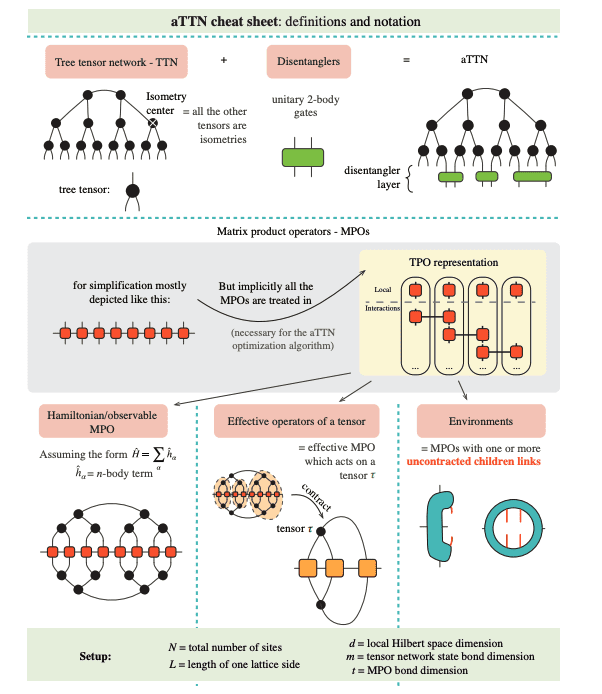
Simulating the behaviour of complex quantum systems presents a significant challenge for modern physics, particularly when dealing with many interacting particles, and researchers are constantly seeking more efficient methods to tackle this problem. Nora Reinić, Luka Pavešić, and colleagues at the Universities of Padua and Ulm have developed a detailed guide to implementing a powerful new technique called the augmented tree tensor network, or aTTN. This approach improves upon existing methods by effectively managing the entanglement that arises when simulating larger systems, allowing for more accurate calculations with reasonable computational resources. The team’s work, presented as a comprehensive ‘cookbook’, details how to use aTTNs to find the ground state of a system and measure its properties, and includes a freely available software implementation, demonstrating its potential to advance the field of quantum simulation.
This method builds upon existing tree tensor networks by incorporating a layer of “disentanglers” that absorb and manage entanglement, allowing aTTNs to accurately represent states with higher levels of entanglement, especially in higher dimensions.
Adaptive Tensor Trees for Quantum Simulation
This research details the development of Adaptive Tensor Tree Networks (aTTNs), a new approach to representing quantum many-body systems, and their implementation within the Quantum Red TEA framework. Accurately and efficiently simulating quantum systems is computationally demanding, especially in two and higher dimensions, and traditional methods like Matrix Product States struggle with highly entangled systems. The goal was to develop a tensor network ansatz that effectively captures entanglement, scales well with system size, and efficiently utilizes modern hardware. aTTNs build upon Tree Tensor Networks, which exploit the area law of entanglement, representing the wavefunction as a tree structure.
The key innovation is adaptivity; aTTNs dynamically adjust the tree structure during the simulation to focus computational resources on the most entangled regions. This is achieved through a process of splitting and merging tree nodes, improving accuracy and efficiency. aTTNs demonstrate improved accuracy, enhanced efficiency, and promising scalability compared to fixed-structure networks. The aTTN ansatz is implemented within the Quantum Red TEA framework, a software package optimized for parallel execution on CPUs, GPUs, and TPUs. Benchmarking against other tensor network methods and quantum Monte Carlo demonstrates superior performance for certain quantum systems with strong entanglement.
The researchers observed promising scaling behavior, enabling simulations of larger systems than previously possible. This combination of aTTNs and Quantum Red TEA offers a powerful tool for tackling challenging problems in quantum many-body physics. Future work includes optimizing the adaptivity algorithms, integrating aTTNs with variational optimization techniques, and applying them to real-world systems in materials science and quantum chemistry. The researchers also aim to develop user-friendly tools and libraries to broaden access to this promising new approach.
Disentangling Entanglement with Augmented Tensor Networks
Researchers have developed an augmented tree tensor network (aTTN), a new method for simulating quantum systems, particularly those exhibiting complex entanglement patterns. This approach builds upon existing tree tensor networks by incorporating a layer of “disentanglers”, special components that manage entanglement within the system. This enhancement allows aTTNs to accurately represent states with higher levels of entanglement than traditional methods, especially in higher-dimensional systems where entanglement typically increases with complexity. The key innovation lies in the disentanglers’ ability to effectively distribute entanglement, enabling the aTTN to model systems that adhere to the “area law” of entanglement, a principle governing how entanglement scales with the system’s boundaries, in any number of dimensions.
By strategically placing these disentanglers, researchers can encode complex entanglement patterns. In tests on two-dimensional quantum systems, including the Ising and Heisenberg models, the aTTN demonstrably outperformed standard tree tensor networks and matrix product states, achieving lower energy states for a 32×32 lattice with the same computational resources. This improvement suggests that aTTNs offer a significant advantage in simulating complex quantum phenomena, potentially unlocking new insights in areas like materials science and condensed matter physics. To facilitate wider adoption, the researchers have released an open-source implementation of the aTTN within a dedicated software library.
Augmented Tensor Networks Simulate Quantum Systems
The augmented tree tensor network (aTTN) represents a new approach to simulating quantum many-body systems, building upon existing tensor network methods like matrix product states, projected entangled-pair states, and tree tensor networks. This method enhances a standard TTN by incorporating a layer of disentanglers, which effectively manage the entanglement within the system and allow the aTTN to accurately represent states that obey the area law of entanglement in any dimension. The researchers have provided a detailed guide for implementing the aTTN, including methods for ground state searches and observable measurements, alongside an open-source implementation within the TEA library. Benchmarking the aTTN on the square lattice Ising model and the triangular lattice Heisenberg model demonstrates its potential advantages in balancing accuracy and computational cost compared to matrix product states and tree tensor networks. The results indicate that the aTTN can achieve comparable or improved accuracy with potentially lower computational demands in certain regimes. Future work could focus on optimizing the positioning of disentanglers and extending the method to more complex systems and larger lattice sizes.
👉 More information
🗞 The Augmented Tree Tensor Network Cookbook
🧠 ArXiv: https://arxiv.org/abs/2507.21236