The pursuit of attosecond-level precision, measuring the timescale of electrons in motion, demands exquisitely synchronised oscillators, a challenge particularly acute in large-scale facilities like free-electron X-ray lasers. Alexander E. Ulanov, Bastian Ruhnke, and Thibault Wildi, alongside Tobias Herr and colleagues at Deutsches Elektronen-Synchrotron DESY and University of Hamburg, now demonstrate a significant advance in achieving this synchronisation. They successfully synchronise two chip-integrated photonic oscillators, known as microcombs, across a 100-metre fibre optic link, achieving relative timing jitter below 400 attoseconds without active stabilisation. This breakthrough bypasses the complexity and cost of current methods, paving the way for precision timing across large facilities and enabling next-generation technologies like disaggregated computing and, ultimately, fully integrated attosecond photonics.
Electron X-ray lasers demand sub-atomic resolution, and achieving synchronisation across hundreds of metres is essential. Current synchronisation methods, based on mode-locked lasers, deliver this level of performance but their complexity, cost and size hinder deployment in facility-wide multi-node networks. This work demonstrates attosecond-level synchronisation of two chip-integrated photonic oscillators (microcombs) separated by 100 metres of fibre. A pair of continuous-wave lasers establishes a time reference delivered over fibre, and on-chip Kerr-nonlinear synchronisation results in an integrated relative timing jitter of the microcombs below 400 attoseconds.
Attosecond Synchronisation via Kerr-Nonlinear Microcombs
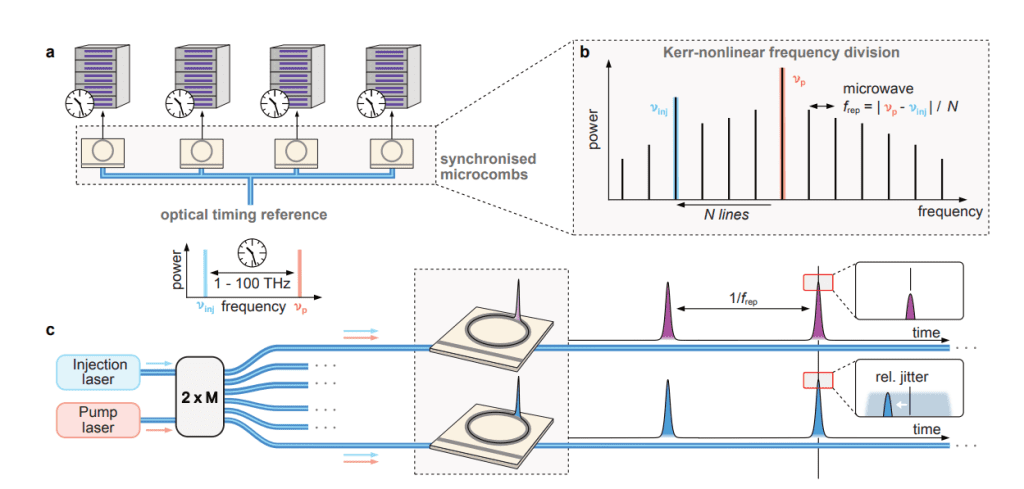
Scientists pioneered a method for synchronising two microcomb photonic chips separated by 100 metres of optical fibre, achieving attosecond-level precision. The study harnessed Kerr-nonlinear synchronisation, employing a pair of continuous-wave lasers to establish a shared time reference delivered via fibre optic cables to each microcomb. This approach bypasses the need for active stabilisation loops, enabling precise timing across a fibre network. The core of the technique involves injecting a second, weaker continuous-wave laser alongside the primary pump laser into each microcomb, locking the repetition rate to an integer fraction of the frequency difference between the two lasers.
Effectively, this implements optical frequency division, ensuring synchronisation of all comb frequencies. Both pump and injection lasers are combined and delivered via fibre, synchronising the repetition rates of both microcombs, despite inherent uncorrelated noise in each system. To characterise the synchronisation performance, the team developed a frequency domain technique, adapted from methods used to measure optical linewidth in microcombs. This technique reveals remarkably low relative timing jitter between the microcombs, operating well below the fundamental thermorefractive noise level of the microresonators, opening opportunities for precision timing in large networks and chip-integrated attosecond science.
Soliton Microcombs From Microresonator Designs
Research into microcomb frequency combs focuses on their creation, stabilisation, and manipulation. Scientists are investigating different materials, such as silicon nitride, and geometries, like whispering gallery mode and photonic crystal designs, to optimise microcomb performance. A significant focus lies on generating and controlling soliton microcombs, a particularly stable and coherent type of comb, by understanding the physics of soliton formation and developing methods for initiating and sustaining them. Stabilisation techniques include self-injection locking, external locking to atomic clocks or lasers, and sideband injection locking, alongside dispersion engineering and noise reduction strategies.
The unique properties of microcombs, broad bandwidth, high coherence, and precise frequency control, drive a wide range of potential applications. In optical communications, microcombs enable high-capacity data transmission through dense wavelength division multiplexing and facilitate fast, efficient optical switching. In precision metrology and sensing, they serve as optical toothbrushes for atomic clocks, enable high-resolution distance measurements, and support broadband spectroscopy for chemical analysis. Emerging applications include quantum key distribution, quantum computing, and RF/microwave photonics.
Several studies address the practical challenges of integrating microcombs into real-world systems. Researchers are fabricating microcombs on integrated photonic chips for miniaturisation, cost reduction, and improved performance, and developing complete systems incorporating lasers, amplifiers, detectors, and control electronics. Specific attention is given to applications in data centres, such as high-bandwidth interconnects and low-power switching. Current trends include miniaturisation and integration, leveraging microcombs for quantum technologies, meeting the bandwidth demands of data centres, and maintaining coherence and stability.
Attosecond Synchronisation of Chip-Based Microcombs
Scientists have demonstrated attosecond-level synchronisation between two chip-integrated photonic oscillators, also known as microcombs, separated by 100 metres of optical fibre. This achievement relies on transmitting continuous-wave lasers to establish a time reference, and then utilising a process called Kerr-nonlinear synchronisation to minimise timing discrepancies between the microcombs. The resulting system exhibits remarkably low integrated relative timing jitter, measuring less than 400 attoseconds, which represents a significant advance in precision timing technology. This breakthrough unlocks possibilities for a range of applications requiring precise synchronisation across extended distances.
Researchers anticipate benefits for large-scale scientific facilities, including those used for attosecond experiments and radio-telescopes, as well as emerging technologies such as data centres, large-scale computing, and secure communication networks. While the current demonstration used free-running lasers, the team notes that stabilising the lasers with external references could further enhance performance and compatibility with existing technologies. Future work may also extend this approach to systems with lower repetition rates and different comb designs, ultimately paving the way for fully chip-integrated attosecond photonics.
🗞 Attosecond-level synchronisation of chip-integrated oscillators
🧠 ArXiv: https://arxiv.org/abs/2510.11630