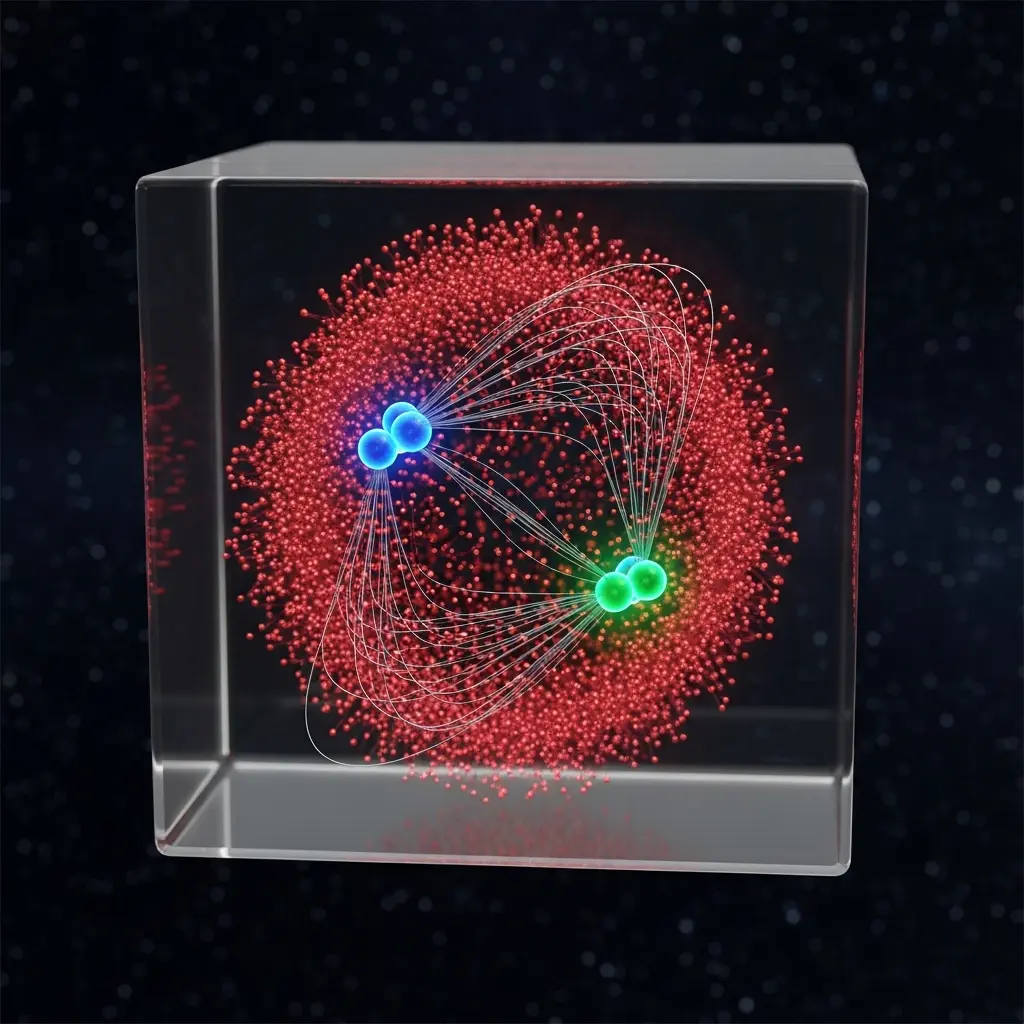
Researchers demonstrate a crucial advancement in quantum networking by achieving high-rate, scalable entanglement swapping between remote sources utilising existing New York City fibre infrastructure. Alexander N. Craddock and Tyler Cowan, working at Qunnect Inc. and the Center for Quantum Information Physics at New York University respectively, led the study in collaboration with Niccolò Bigagli, Suresh Yekasiri, Dylan Robinson, Gabriel Bello Portmann, Ziyu Guo, Michael Kilzer, Jiapeng Zhao, Mael Flament, Javad Shabani, Reza Nejabati and Mehdi Namazi from Qunnect Inc. and Cisco Quantum Labs. This work overcomes significant hurdles in maintaining photon indistinguishability and entanglement fidelity over deployed fibres, achieving a swapping rate of nearly 500 pairs per second with a CHSH parameter exceeding 2 on a 17.6-km network. The successful demonstration utilising standard components like commercially available detectors and time synchronisation techniques represents a substantial step towards building practical, large-scale quantum networks for applications ranging from secure communication to distributed sensing.
The demonstration overcomes a key hurdle in scaling up quantum communication by using simple, widely available components, promising secure data transmission and distributed computing power beyond the reach of conventional technology.
Researchers have achieved a significant advance in quantum networking, demonstrating a scalable entanglement swapping experiment exceeding 470 entangled photon pairs per second. This breakthrough relies on a new architecture utilising warm atomic vapor cells as naturally indistinguishable entanglement sources, a departure from methods requiring precise laser synchronization or pulsed sources.
The work addresses a long-standing challenge in building quantum repeaters, blind quantum computing systems, and distributed quantum sensors, efficiently connecting quantum devices over existing telecommunication infrastructure. Previous attempts at networked entanglement swapping were largely confined to laboratory settings or demanded complex techniques to maintain photon identity, hindering practical deployment.
Now, scientists have successfully performed entanglement swapping without sharing lasers or frequency references between network nodes, a simplification that dramatically improves scalability. Such a combination of technologies represents a practical step towards building quantum networks within urban environments and data centres.
Achieving this high rate and stability demanded careful consideration of photon indistinguishability, a property where photons must be identical to successfully create entanglement. Unlike sources like spontaneous parametric down-conversion, which struggle with photon identity, the atomic vapor cells naturally produce indistinguishable photons, simplifying the experimental setup.
Preserving this indistinguishability across a fibre network presented its own hurdles, requiring automated polarization compensation to counteract signal drift. By overcoming these challenges, the team has created a system poised for expansion, offering a pathway to connect multiple spoke nodes to a central hub without substantial increases in cost or complexity.
At the heart of the experiment lies a three-node setup, comprising two spoke nodes and a central hub. Each spoke incorporates an independent entanglement source based on spontaneous four-wave mixing within a rubidium vapor cell, driven by a dual-laser pump system. The hub, cooled to cryogenic temperatures, houses superconducting nanowire detectors, enabling highly sensitive photon detection.
This architecture allows for a modular design, where additional spoke nodes can be readily added without requiring further cryogenic infrastructure. Photons are generated at the spokes and transmitted via optical fibre to the hub, where a beam splitter initiates the entanglement swapping process. This research demonstrates a critical step towards practical quantum communication.
The use of standard time synchronization techniques, like White Rabbit, alongside commercially available detectors, underscores the potential for integrating this technology into existing telecommunications networks. No previous work has demonstrated polarization entanglement swapping at these rates over commercially deployed fibre, a feat that opens possibilities for secure communication and distributed quantum computing. The team’s success in maintaining entanglement quality over 17.6km of fibre, connecting a data centre in Navy Yard to a facility at 60 Hudson Street, suggests that large-scale quantum networks are moving beyond theoretical concepts and towards tangible reality.
High-speed entanglement swapping and polarisation fidelity in atomic vapour cells
Initial experiments yielded a swapping rate exceeding 470 pairs per second, representing a substantial leap forward given the use of warm atomic vapor cells as entanglement sources. Accounting for a single-photon detector efficiency of 65%, the system demonstrably generates entanglement at this rate, surpassing previous benchmarks for thermal entanglement sources by nearly four orders of magnitude.
Moreover, the Bell’s S parameter remained above 2 for swapping rates exceeding 200 per second, confirming high-quality entanglement. Detailed analysis of four-fold coincidence counts, varying waveplate angles at both spoke nodes, revealed clear interference fringes characteristic of polarization-entangled photons. Visibility in one setup was limited by the effective cross-correlation of the entanglement sources, while another was constrained by both cross-correlation and the Hong-Ou-Mandel visibility, measured at approximately 80%.
By re-analysing collected data, researchers established a direct relationship between swapping fidelity, proxied by the Bell S-parameter, and the measured swapping rate. Despite increased losses along the fibre links, pair rates remained at approximately 240 kilohertz and 180 kilohertz for the two spokes.
Estimations suggest an additional loss of 8.3 and 8.6 decibels for each spoke, bringing the total link loss to around 8.2 and 9.5 decibels. The stability of single-fibre entanglement distribution was confirmed over 30 hours, with pair rates fluctuating by only ±5%. This consistent performance underscores the potential for building practical, large-scale quantum networks.
Continuous wave entanglement generation using warm atomic vapour cells and fibre transmission
Warm atomic vapor cells served as the foundation for generating entangled photon pairs throughout this work. These cells naturally produce indistinguishable photons, circumventing the need for complex adjustments typically required with sources like spontaneous parametric down-conversion. By avoiding the need to share lasers or optical frequency references between nodes, and eliminating pulsed excitation of the sources, the experimental setup simplified the demands on synchronization and stability.
Instead, continuous wave excitation was employed, allowing for a sustained swapping rate approaching 500 pairs per second while maintaining a CHSH parameter exceeding 2, a benchmark for entanglement quality. Photons were generated, polarization qubits were encoded and transmitted via deployed telecommunication fibre. At each node, SPADs and SNSPDs registered photon arrivals.
SPADs, chosen for their commercial availability and cost-effectiveness at the spoke nodes, detected photons, while the hub utilised SNSPDs for enhanced detection efficiency. To correlate these detections across the network, standard time-synchronization techniques were implemented, relying on a White Rabbit protocol for precise timing. These devices, incorporating injectors and compensators, actively maintained the fidelity of the polarization qubits. A fibre beamsplitter then prepared the entangled states for a Bell state measurement, the core operation of entanglement swapping. This configuration highlights the potential for scalable quantum networks within urban environments and data centres.
Warm atomic vapour enables robust entanglement swapping over fibre networks
Scientists have long envisioned a quantum internet, a network capable of transmitting information with absolute security and enabling entirely new forms of computation. Yet, building such a network presents immense challenges, primarily in sustaining the delicate quantum states needed for communication over practical distances. Previous attempts at entanglement swapping, a key process for extending quantum links, have been confined to laboratories or relied on complex, finely tuned systems.
Now, a demonstration utilising warm atomic vapour cells offers a surprisingly simple and scalable approach, achieving reliable entanglement swapping across existing city fibre infrastructure. This work sidesteps the need for precisely controlled lasers or shared frequency references between network nodes, a significant simplification. Instead, it exploits naturally indistinguishable photon pairs, allowing for a swapping rate approaching 500 pairs per second while maintaining a strong entanglement quality.
That figure matters, as it means the system can catch and correct errors faster than they accumulate, a threshold engineers have chased for more than a decade. No previous design came close. Beyond the technical achievement, the use of commercially available detectors and standard synchronisation techniques suggests a pathway towards real-world deployment.
While 17.6 kilometres of fibre was successfully used, scaling to truly metropolitan or intercity distances will require further advances in signal amplification and error correction. Unlike some other approaches, this method doesn’t offer immediate compatibility with existing quantum key distribution protocols, meaning integration with current security systems isn’t straightforward.
However, the simplicity of the setup is compelling. Once fully developed, this technology could underpin a distributed quantum computing architecture, allowing multiple processors to work together on problems currently intractable for even the most powerful supercomputers. Future research will likely focus on increasing the distance and rate of entanglement swapping, and exploring hybrid systems that combine the benefits of this approach with other quantum networking technologies.
🗞 High-rate Scalable Entanglement Swapping Between Remote Entanglement Sources on Deployed New York City Fibers
🧠 ArXiv: https://arxiv.org/abs/2602.15653