

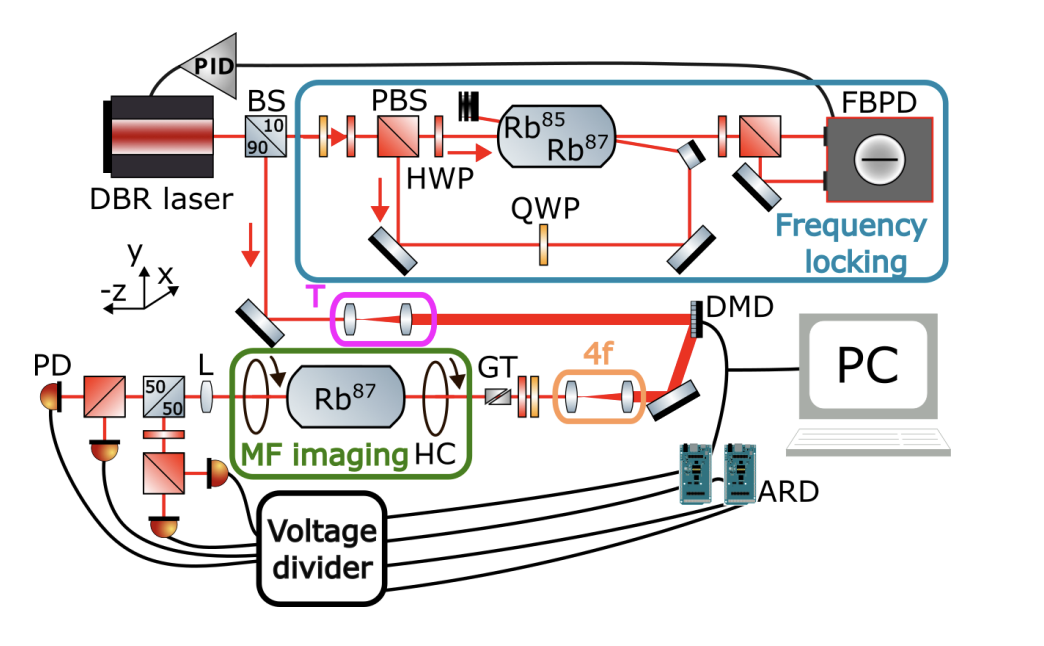
Recent advances allow scientists to measure magnetic fields with remarkable sensitivity using hot atomic vapours, opening doors to applications such as biological imaging. However, creating detailed, high-resolution images of these fields has remained a significant challenge, often limited by the physical size of the sensing system. Now, Cyril Torre, Jordan Brass, Sebastien Bisdee, and colleagues at the University of Bristol have overcome this hurdle by combining this atomic vapour technology with a technique called single-pixel imaging. This innovative approach achieves microscopic magnetic field imaging with a resolution currently limited only by the imaging system itself, promising a new level of detail for studying everything from materials science to biological processes.
In recent years, sensors based on hot atomic vapor cells have emerged as a compact and highly sensitive means of measuring magnetic fields, finding applications in diverse fields including biological measurements and representing a promising practical application of quantum technologies. This research addresses the challenge of achieving high-resolution magnetic field measurements by exploring novel methods to decouple sensitivity from bandwidth, enabling sensors capable of both detecting faint magnetic signals and tracking rapidly changing fields.
Squeezed Light and Single-Pixel Magnetometry
This research details the development of a novel magnetometer leveraging the principles of quantum enhancement, specifically squeezed light, combined with the efficiency of single-pixel imaging. The team aimed to improve magnetometer sensitivity by reducing noise below the standard quantum limit using squeezed light, then coupled this with single-pixel imaging to create a cost-effective and potentially high-resolution magnetic field mapping system. The system utilizes squeezed light, a non-classical state of light with reduced noise, to enhance sensitivity, focusing on polarization squeezing in Rubidium vapor. Instead of a traditional camera array, it employs single-pixel imaging, significantly reducing cost and complexity; an image is reconstructed by sequentially measuring light intensity at each point using a single detector.
The magnetometer relies on the Faraday effect, the rotation of light polarization in a magnetic field, with changes in polarization detected to measure field strength. Sophisticated algorithms reconstruct the image from sequential measurements, opening the possibility of real-time magnetic field mapping. A multipass configuration improves squeezed vacuum generation, and artificial intelligence controls the source for ultra-stable, high-performance operation. This combination of squeezed light and single-pixel imaging offers a promising pathway for advancing magnetic field sensing technology and enabling new applications, including mapping magnetic fields generated by the brain or heart, detecting flaws in materials, and performing precision measurements.
Atomic Vapor and Microscopic Magnetic Imaging
Researchers have developed a new technique for imaging magnetic fields at a microscopic scale, combining the sensitivity of hot atomic vapor cells with the versatility of single-pixel imaging. This approach overcomes a key limitation of traditional atomic magnetometers, their difficulty in creating high-resolution images, and opens possibilities for applications ranging from biological imaging to materials science. The core of the method lies in using a digital micromirror device to scan a laser beam across a sample containing an atomic vapor. As light passes through the vapor, magnetic fields within the sample rotate its polarization, an effect known as the Faraday effect.
By carefully measuring these polarization changes at each point in the scan, a detailed map of the magnetic field distribution can be reconstructed, achieving a spatial resolution limited only by the resolution of the digital micromirror device and the experimental setup. A significant advantage of this system is its compactness and potential for integration with existing atomic vapor magnetometer technologies. The use of well-established photodetector technology ensures high sensitivity and low noise, paving the way for future systems that could operate with even greater precision. Importantly, the researchers demonstrated imaging capabilities without the need for magnetic shielding, simplifying the experimental setup and broadening potential applications. By projecting specifically designed light patterns onto the sample and measuring the resulting changes in polarization, they can accurately reconstruct the magnetic field distribution without physically scanning a small sensor, offering a significant advantage in terms of speed and efficiency. This technique represents a substantial step forward in microscopic magnetic field imaging, offering a powerful new tool for exploring a wide range of scientific and technological challenges.
Microscopic Imaging with Warm Atomic Vapor Cells
This research successfully demonstrates microscopic magnetic field imaging with a spatial resolution of approximately 62. 5 μm, achieved by combining a hot atomic vapor cell magnetometer with single-pixel imaging techniques. This represents the first demonstration of this approach using a compact, warm atomic vapor setup, opening possibilities for more accessible and potentially portable magnetic field imaging systems. The method relies on sensing magnetic fields via the Faraday effect within the vapor cell and reconstructing images using polarimetric single-pixel methods. The authors acknowledge limitations related to data acquisition speed, stemming from communication between Arduino boards and the computer, and the resolution being limited by the digital micromirror device projection system.
They suggest several avenues for improvement, including integrating data storage directly onto the Arduino boards, utilizing faster hardware, and employing compressive imaging methods to reduce the number of patterns required for image reconstruction. Further enhancements could involve implementing magnetic shielding to improve sensitivity and decreasing the imaging area to mitigate nonlinear effects. The team believes the system is far from fundamental resolution limits and anticipates that improvements to the digital micromirror device and laser power will further enhance performance.
🗞 Microscopic magnetic field imaging with hot atoms via single-pixel imaging
🧠 ArXiv: https://arxiv.org/abs/2508.13869


