Van der Waals heterostructures represent a powerful approach to materials design, and the inclusion of ferroelectric monolayers further expands this potential. Mohammad Amini, Linghao Yan, and Orlando J. Silveira, alongside colleagues from Aalto University and Soochow University, investigate the possibility of engineering magneto-electric coupling within these heterostructures. The team focuses on the interface between bilayer SnTe and iron phthalocyanine molecules, utilising these molecules as nanoscale spins to probe the coupling with exceptional precision through scanning tunneling microscopy. This research reveals an intrinsic and structural mechanism for coupling electric and magnetic properties at the nanoscale, independent of specific material choices, and thus represents a significant step towards designing materials with precisely controlled, coupled functionalities.
The research focuses on van der Waals heterostructures, specifically the interface between bilayer SnTe and iron phthalocyanine (FePc) molecules, to engineer magneto-electric coupling. Through scanning tunneling microscopy, the team measured the lowest spin excitation energies and the location of the LUMO maxima within the FePc molecules, revealing a direct correlation between the spin excitation energy and the domain structure of the SnTe. Experiments revealed that the spin excitation energies within the FePc molecules change in response to the ferroelectric properties of the SnTe, even in individual molecules.
The team traced this effect to small lattice distortions, directly observable through atomically resolved images, arising from subtle differences in stacking with the underlying substrate. By manipulating a single FePc molecule across a domain boundary in the SnTe, scientists tracked changes in both the LUMO maxima and the lowest spin excitation energies, reproducing patterns observed across the entire FePc island. These measurements confirm that the observed variations in spin excitation energy are intrinsically linked to the interplay between FePc and the ferroelectric properties of SnTe. The breakthrough delivers a proof of concept for designer multiferroics that leverage changes in the magneto-crystalline anisotropy, potentially leading to a new class of engineered two-dimensional heterogeneous multiferroics.,.
Interface Controls Molecular Spin State
This research demonstrates a fundamental mechanism for coupling electric and magnetic properties at the nanoscale, achieved through the study of van der Waals heterostructures combining bilayer SnTe with iron phthalocyanine molecules. By employing scanning tunneling microscopy, scientists observed and characterized the interaction between these materials, revealing that the magnetic state of the molecules can be influenced by the material’s structure. Specifically, the team found that increasing a parameter within computational modeling, known as U, alters the spin configuration of iron atoms within the molecules, shifting them from a triplet to a quintuplet state. This change is intrinsic to the material interface and independent of specific chemical bonding, suggesting a robust pathway for controlling magneto-electric coupling. The findings establish a new understanding of how to engineer materials with tailored electric and magnetic responses, potentially enabling the development of novel nanoscale devices.,.
SnTe Lattice Distortion Measured by STM
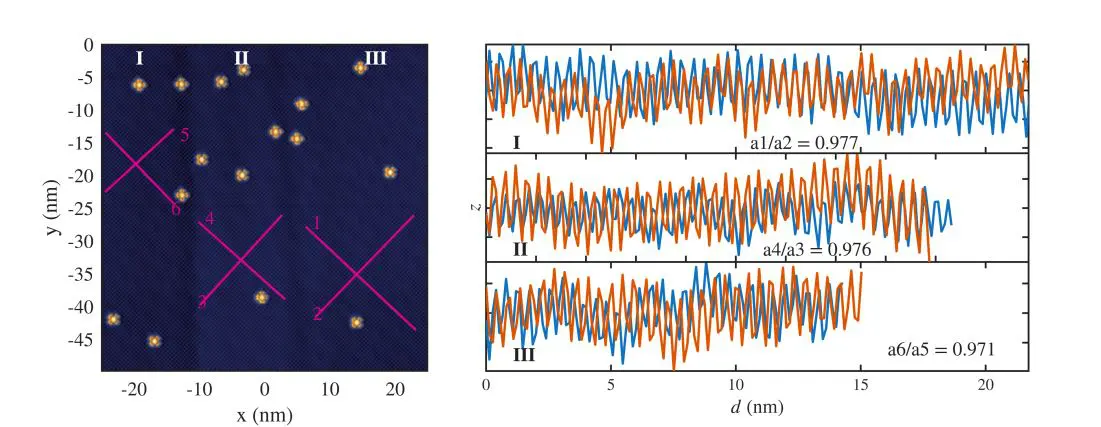
To understand the origin of the observed coupling, scientists performed detailed measurements of the SnTe lattice structure. Atomically resolved scanning tunneling microscopy images revealed variations in the lattice parameters between adjacent SnTe domains. Line profiles extracted from these images quantified the lattice parameters, demonstrating that the SnTe lattice is not uniform. The ratio of shorter to longer lattice parameters served as a measure of distortion, confirming the presence of these structural variations. These findings support the idea that lattice distortion plays a crucial role in influencing the magnetic properties of the adsorbed FePc molecules.,.
FePc Molecule Manipulation
Researchers developed a precise method for positioning individual FePc molecules on the SnTe surface. This control is essential for conducting controlled experiments and studying the interaction between the molecules and the substrate. The manipulation procedure involved positioning the STM tip above the molecule, reducing bias and increasing setpoint current, repositioning the tip with feedback engaged, and restoring the original bias and current to release the molecule. This technique allowed for the reliable detachment and repositioning of individual FePc molecules, even across grain boundaries in the SnTe. This ability to control the molecular environment enables detailed studies of the effects of the SnTe substrate on the magnetic properties of the molecules.,.
DFT Calculations
To complement the experimental observations, scientists performed spin-polarized Density Functional Theory calculations. These calculations investigated the electronic and magnetic properties of FePc adsorbed on SnTe, and explored the role of electron correlation in determining the spin state of the iron atom. The calculations employed the DFT+U approach, using the Hubbard U parameter to account for strong electron correlation effects in the Fe 3d orbitals. The results show that the spin state of the Fe atom in FePc changes from a triplet (S=1) to a quintuplet (S=2) as the value of the Hubbard U parameter increases.
For U values greater than 4 eV, the quintuplet state becomes energetically favorable. This highlights the importance of electron correlation effects in determining the magnetic properties of FePc. Orbital-projected density of states analysis further revealed the contributions of the Fe 3d orbitals to the electronic structure, providing insights into the bonding and magnetic interactions.
👉 More information
🗞 Atomic-scale probe of molecular magneto-electric coupling
🧠 ArXiv: https://arxiv.org/abs/2512.07489