Understanding how molecules interact is fundamental to pharmacology, yet current techniques often struggle to observe these interactions at the single-molecule level. Sean D. Huver from NVIDIA and colleagues propose a novel approach, the Ligand-Binding Interrogator, or QLI, to directly detect the electric field created when a single ligand binds to its receptor. This innovative device functions as a gradiometer, employing a pair of co-trapped atomic ions to measure these subtle electric fields without the need for invasive labeling. The QLI promises to overcome limitations of existing methods by offering a sensitive and label-free way to observe molecular binding events, potentially revolutionising the validation of computational models used in drug discovery and offering unprecedented insight into receptor behaviour.
This gradiometric approach effectively cancels out background electric field noise, enhancing sensitivity and accuracy. To connect the sensor, which requires a cryogenic, ultra-high-vacuum environment, to a biological sample, researchers propose an architecture where the sample is mounted on a scanning probe. This innovative design enables the detection of the electrostatic signature of a single molecule in a specific conformational state, distinguishing between bound and unbound states. This work details the development and implementation of this novel approach to biomolecular sensing.
Two-Ion Ramsey Gradiometry for Electrostatic Sensing
This research proposes a novel technique, utilizing two trapped ions as a highly sensitive gradiometer to measure the electric field near a biomolecule. The goal is to detect electrostatic potential changes associated with conformational changes in single biomolecules without the need for labels, a significant challenge in biophysics. The Ramsey method, a type of atomic clock technique, is employed to enhance sensitivity. This label-free approach offers high sensitivity and directly measures electrostatic properties. The system involves holding ions near a surface where biomolecules can be immobilized, utilizing Ramsey interferometry to improve signal-to-noise ratio, and employing a differential measurement to cancel out common noise.
Calculations demonstrate how signal strength scales with parameters like ion height and baseline separation. The research includes detailed calculations of expected signal strength and sensitivity analysis, alongside consideration of potential noise sources. The system requires ultra-high vacuum and cryogenic temperatures to minimize noise and maintain ion trapping. Several challenges need to be addressed, including reliable sample immobilization without disrupting function and minimizing noise. The biggest unknown is the electric field noise inherent in vitrified samples, which could limit measurement feasibility.
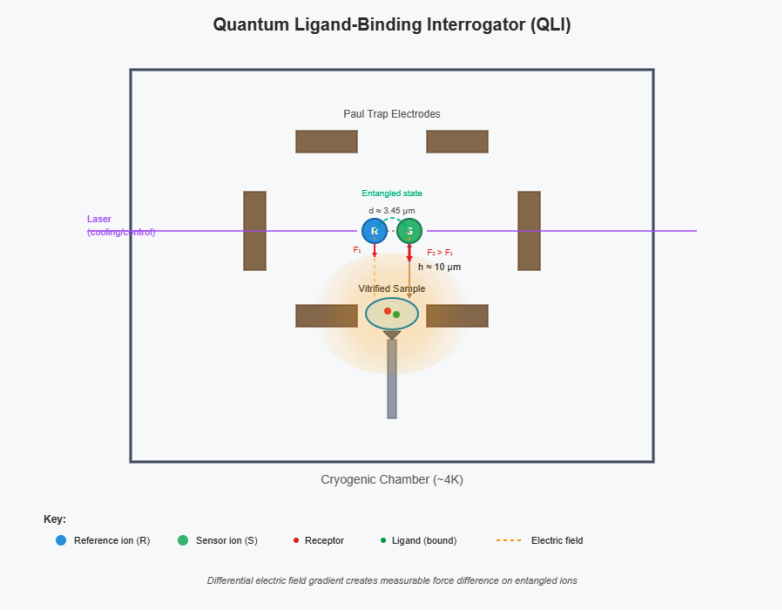
Despite these challenges, the proposal is novel, rigorously analyzed, and sets clear, measurable goals, focusing on a fundamental property to provide unique insights into biomolecular function. This is a highly ambitious but potentially groundbreaking proposal. If researchers successfully address the challenges related to sample noise and system stability, this technique could revolutionize our understanding of biomolecular electrostatics and function. Key areas for further investigation include characterizing the expected noise from vitrified samples, strategies for minimizing environmental noise, methods for biomolecule immobilization, expected ion trap lifetime, and the estimated cost of building and operating the system. Current methods often average signals from many molecules or require invasive labeling, but the QLI aims to detect the electric field of a single binding event without altering the sample. This is achieved by utilizing two co-trapped atomic ions as an extremely sensitive detector, acting as a nanoscale gradiometer to measure subtle electric field gradients. The QLI overcomes background noise by rejecting unwanted signals and focusing on the electric field change caused by the molecular binding.
To connect the ultra-cold, high-vacuum environment needed for ion detection to a biological sample, the technique proposes mounting the sample on a scanning probe and rapidly freezing it to preserve its natural state. This vitrified sample is then positioned close to the ions, allowing them to detect the electrostatic signature of the molecule in its bound or unbound state. The system is designed to detect changes in electric field with remarkable sensitivity, potentially achieving a signal-to-noise ratio sufficient to measure a single binding event within tens of seconds. This method differs from existing techniques like surface plasmon resonance by focusing on static conformational states rather than dynamic binding kinetics, making it a complementary tool for understanding drug-receptor interactions.
The QLI’s sensitivity stems from the use of precisely controlled quantum states within the ions, and repeated measurements are used to build up a clear signal. Researchers anticipate achieving a stand-off distance of around 10 micrometers between the ions and the sample, a key engineering goal. The technique relies on established technologies, including sympathetic cooling to minimize noise and dynamical decoupling to maintain the quantum coherence of the ions. This method utilizes two co-trapped atomic ions as a differential sensor, enabling label-free detection in vitrified samples and overcoming limitations of current techniques that rely on ensemble measurements or invasive labeling. Projections, based on established sensitivities of single ions, suggest the QLI could achieve a signal-to-noise ratio of one within tens of seconds, offering a pathway to directly observe binding-induced electric field changes. A key uncertainty is the electric field noise inherent in vitrified samples, which will ultimately determine the feasibility and optimal operating parameters of the QLI.
Future work will focus on characterizing this noise, alongside systematic variation of ion-sample separation and height, to establish a quantitative baseline for performance. While acknowledging the low throughput of this method, the researchers emphasize its potential to provide unique electrostatic contrast between different molecular states, offering a valuable tool for validating computational models of drug-receptor interactions and advancing understanding at the molecular level. Alternative quantum sensors, such as nitrogen-vacancy centers in diamond, are also noted as potential avenues for future exploration.
👉 More information
🗞 A Ramsey Ion Gradiometer for Single-Molecule State Detection
🧠 ArXiv: https://arxiv.org/abs/2508.12499