

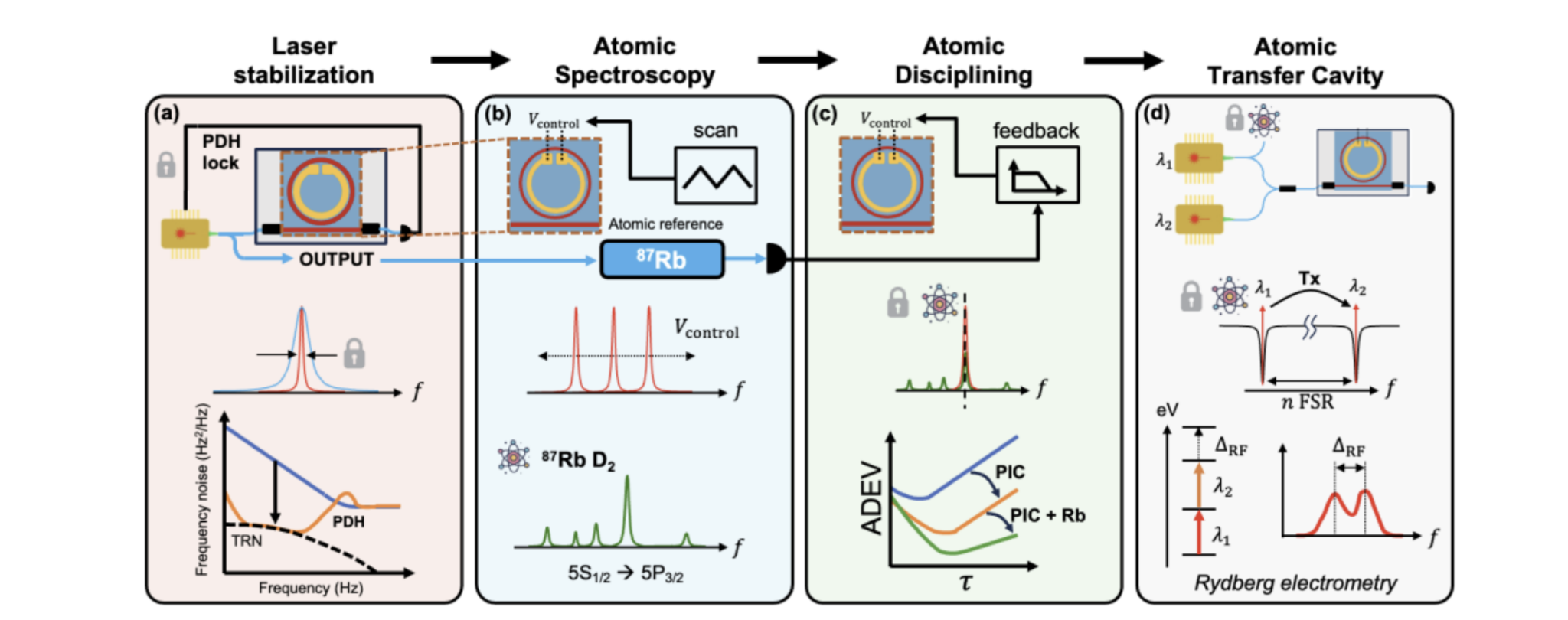
The pursuit of increasingly precise atomic and quantum experiments demands ultra-stable lasers, and a team led by Andrei Isichenko, Andrew S. Hunter, and Nitesh Chauhan from the University of California, Santa Barbara, alongside colleagues from the University of Texas at Austin and General Technical Services, has developed a new approach to achieving this stability. They present a compact, integrated device that significantly improves laser precision and allows for the simultaneous stabilization of multiple lasers at different wavelengths. This innovation overcomes limitations of traditional, bulky optical setups by utilising a silicon nitride photonic chip to narrow laser linewidths, perform high-resolution atomic spectroscopy, and transfer stability between lasers, ultimately enabling a new generation of portable, low-power quantum technologies. The demonstrated ability to stabilise multiple lasers on a single chip promises to unlock advancements in fields ranging from quantum computing to advanced atomic sensors, paving the way for scalable and integrated quantum systems.
Stable Laser System Using Photonic Integration
Researchers have developed a highly stable laser system by integrating photonic circuits with advanced control techniques and atomic spectroscopy. This system aims to provide a compact and stable light source for applications such as Rydberg atom-based sensing, which demands exceptional laser stability. The core of the system utilizes a photonic integrated circuit containing a resonant cavity to refine the laser’s characteristics, coupled with sophisticated digital control algorithms. The system employs a two-stage locking process; first, the laser is locked to the integrated circuit resonator, narrowing its linewidth.
Subsequently, the laser is further stabilized by locking it to a rubidium vapor cell, providing a precise frequency reference and minimizing long-term drift. Real-time control is achieved using an FPGA-based platform and open-source software tools designed for digital feedback control. The team successfully locked multiple lasers simultaneously to the same reference, a challenging task requiring careful control loop design. Experiments demonstrate a significant reduction in laser linewidth and a substantial improvement in frequency stability compared to systems relying on single-stage locking. This work represents a significant step towards compact, stable laser sources for advanced sensing and quantum technologies. The open-source software tools developed during this research are valuable resources for other scientists developing and optimizing feedback control systems.
Integrated Cavity Stabilizes Laser Frequency and Noise
Scientists engineered a photonic-integrated silicon nitride cavity to achieve ultra-stable laser performance, crucial for precision atomic experiments and emerging quantum technologies. This cavity forms the heart of a dual-stage locking system, combining the short-term stability of the integrated resonator with the long-term absolute frequency stability provided by rubidium spectroscopy. Initially, a laser is locked to the tunable integrated resonator, effectively narrowing the laser linewidth and reducing noise. To further enhance stability, a second stage locks the cavity-stabilized laser to a rubidium signal, creating a robust frequency reference.
Performance is characterized using optical frequency domain analysis for short-term noise and a stabilized optical frequency comb for long-term drift measurements. The dual-stage lock achieves a fractional frequency stability of 8. 5x 10 -12 at a 1-second averaging time, a two-order-of-magnitude improvement over locking to the integrated circuit alone. Continuous operation demonstrates frequency drift confined to within 50kHz over six hours. The team extended this stability to multi-wavelength Rydberg electrometry, successfully transferring rubidium stability to lasers operating at multiple wavelengths, demonstrating the potential for advanced sensing applications. This innovative approach paves the way for compact, scalable solutions for quantum computing, atomic clocks, and other precision measurements.
Integrated Photonics Stabilises Laser and Rubidium Spectroscopy
This research demonstrates a photonic-integrated silicon nitride resonator cavity capable of simultaneously achieving laser linewidth reduction, high-resolution rubidium spectroscopy, dual-stage laser locking, and stability transfer to other lasers. The cavity, fabricated on a silicon nitride platform, exhibits a high quality factor and finesse, with a thermal actuator enabling continuous tuning. Initial experiments focused on stabilizing a laser via Pound-Drever-Hall locking to the integrated cavity, resulting in a reduction of laser frequency noise. Precision spectroscopy was then performed by sweeping the tuned laser across the rubidium hyperfine transition range, demonstrating a spectral resolution capable of resolving atomic features.
Subsequent dual-stage locking to the rubidium line achieved a significant reduction in laser linewidth and yielded an Allan deviation of 8. 5x 10 -12 at a 1-second averaging time. Further demonstrating the cavity’s capabilities, the team transferred this atomic stability to a second laser, enabling multi-wavelength Rydberg RF electrometry, a sensitive quantum sensing technique. These results confirm the potential of this integrated, tunable reference cavity to enable compact, scalable, and precise atomic and quantum systems for applications ranging from sensing to computing. The demonstrated frequency noise reduction highlights the cavity’s ability to significantly improve the performance of precision laser-based experiments.
Silicon Nitride Stabilizes Atomic Spectroscopy and Lasers
This work demonstrates a photonic-integrated approach to key steps in preparing and measuring atomic states for quantum experiments, including atomic spectroscopy, laser stabilization, and stability transfer to multiple laser frequencies. By utilizing a tunable silicon nitride resonator, the researchers achieved significant frequency noise reduction and precise control over laser frequency, enabling high-resolution rubidium spectroscopy and a dual-stage locking mechanism that combines short-term resonator stability with the long-term stability of the rubidium atomic transition. This resulted in a fractional frequency stability of 8. 5x 10 -12 at one second, with frequency drift maintained within 100kHz over six hours of continuous operation.
Furthermore, the team successfully transferred this rubidium-referenced stability to a second laser, facilitating quantum atomic state preparation and enabling electromagnetic field measurement in a Rydberg RF sensing experiment. This integrated cavity offers a compact alternative to traditional, bulky optical setups, addressing limitations related to agility, free spectral range, and integration potential. This technology has potential applications in neutral atom and trapped-ion experiments requiring broader wavelength coverage, narrower linewidths, and precision frequency metrology, including optical atomic clocks and polyatomic molecule experiments.
🗞 Multi-laser stabilization with an atomic-disciplined photonic integrated resonator
🧠 ArXiv: https://arxiv.org/abs/2509.09124


