Atom interferometry sensitivity improves with a novel phase-modulation readout scheme, experimentally demonstrating enhancement over conventional methods. Multi-harmonic demodulation, coupled with atomic velocity dispersion compensation, eliminates nonlinearity and boosts performance in gyroscopes and inertial navigation systems without altering existing apparatus.
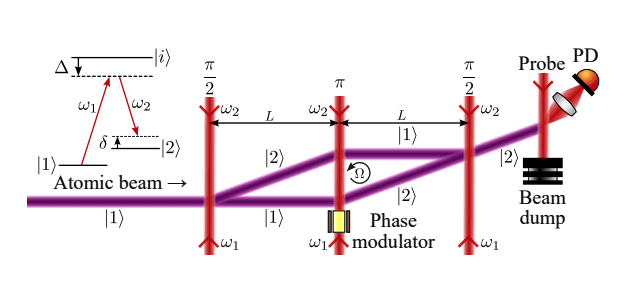
Atom interferometry represents a rapidly developing field with applications ranging from precision measurements of fundamental constants to advanced inertial navigation. Achieving enhanced sensitivity remains central to progress in this area, particularly for applications demanding compact designs or large experimental baselines. Researchers at the Institute of Science Tokyo and the University of Tokyo, including Sotatsu Otabe, Naoki Kaku, Tomoya Sato, Martin Miranda, Takuya Kawasaki, and Mikio Kozuma, detail a novel approach to sensitivity enhancement in their article, “Sensitivity Enhancement in Atom-Interferometer Gyroscopes via Phase-Modulation Signal Readout Scheme”. Their work demonstrates an improved sensitivity in atom-interferometer gyroscopes through the implementation of a phase-modulation signal readout, a technique which transfers phase modulation from the laser light to the atomic phase and is read out using multi-harmonic demodulation, effectively improving performance without requiring alterations to existing optical or vacuum systems.
Atom interferometry represents a sophisticated technique for precision measurement of inertial effects, encompassing rotation and acceleration, with applications ranging from fundamental physics to advanced navigation. These devices leverage the wave-particle duality inherent in atomic behaviour, generating interference patterns acutely sensitive to changes in motion. Recent advancements demonstrate a notable enhancement in the sensitivity of these instruments, specifically gyroscopes, achieved through a refined signal readout scheme that actively modulates the phase of the light interacting with the atoms. The core innovation centres on transferring phase modulation from the laser source to the atoms themselves, effectively creating a more coherent and well-defined interference signal.
By implementing phase-dispersion compensation control, scientists mitigate the blurring of the interference pattern, leading to sharper and more accurate measurements. Atomic velocity dispersion, a key limiting factor in interferometer performance, causes a broadening of the interference fringes. This control scheme effectively reduces this dispersion, improving the signal-to-noise ratio and enhancing precision. This technique significantly improves the performance of atom interferometers, particularly in applications demanding high precision and stability. The team validated these findings through rigorous experiments and simulations, demonstrating the robustness and reliability of their approach.
High-precision atom interferometers are increasingly deployed in geodesy, enabling accurate measurements of the Earth’s gravitational field and monitoring of changes in sea level. They also play a crucial role in the development of advanced navigation systems, providing highly accurate positioning and orientation information independent of external signals such as GPS. Furthermore, this technology has the potential to revolutionise metrology, facilitating the development of more accurate and precise measurement standards. Beyond these applications, atom interferometry is finding utility in resource exploration, allowing for accurate mapping of underground structures and detection of valuable minerals. It also contributes to environmental monitoring, providing highly sensitive measurements of atmospheric pollutants and greenhouse gases. The potential extends to medical imaging, where it could enable the development of more accurate and non-invasive diagnostic tools.
Looking ahead, researchers plan to explore new materials and fabrication techniques to further miniaturise and improve the performance of atom interferometers. They are also investigating the use of quantum entanglement and other advanced techniques to enhance the sensitivity and resolution of these instruments. This ongoing research promises to unlock even greater potential for atom interferometry, paving the way for significant discoveries and technological advancements. The team remains committed to disseminating their findings within the scientific community and fostering collaboration to accelerate the development of this promising technology.
👉 More information
🗞 Sensitivity Enhancement in Atom-Interferometer Gyroscopes via Phase-Modulation Signal Readout Scheme
🧠 DOI: https://doi.org/10.48550/arXiv.2506.23250