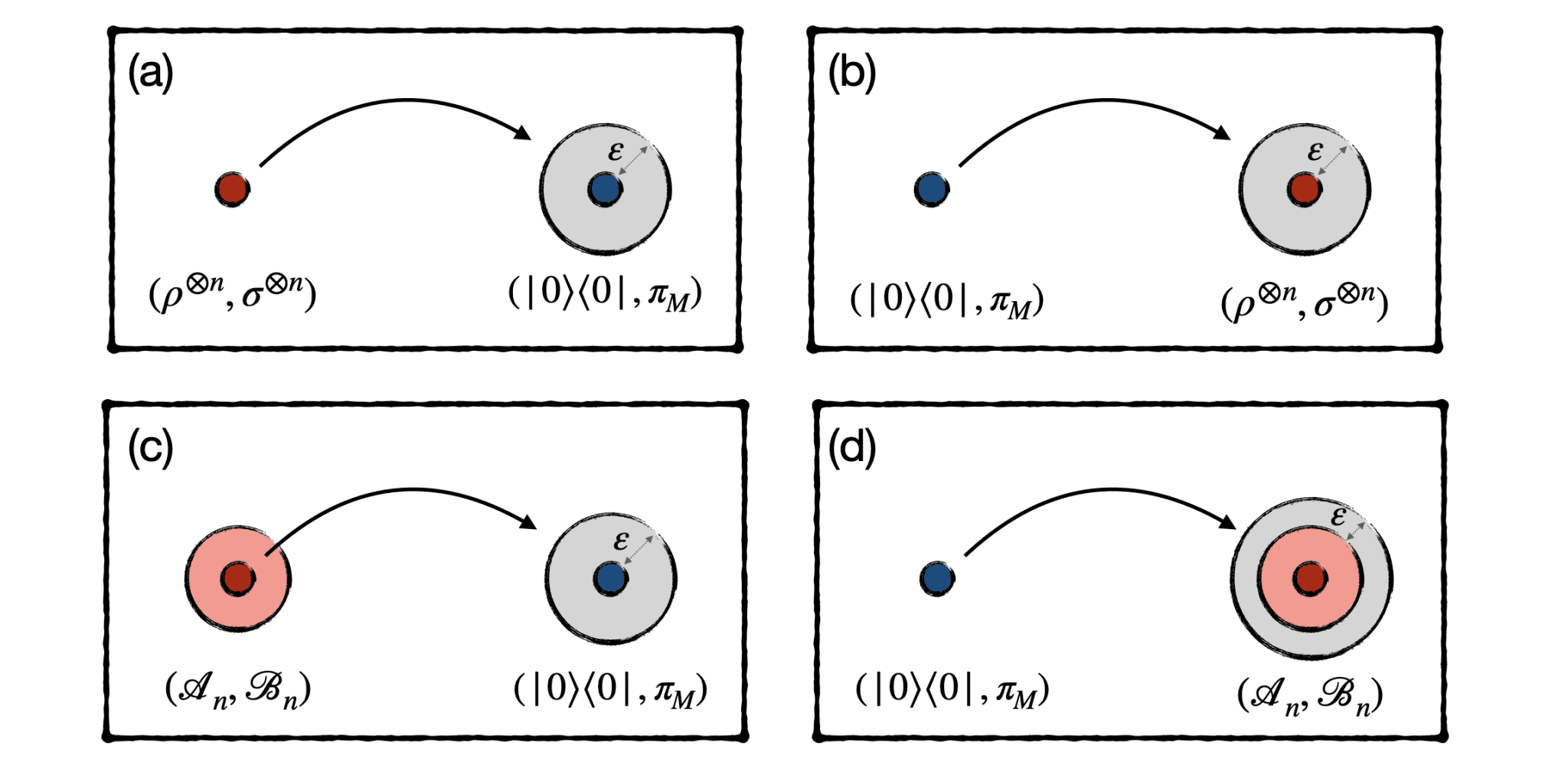
The challenge of telling apart quantum states becomes significantly harder when information is incomplete, yet distinguishing between sets of states remains crucial for many quantum technologies. Siqi Yao and Kun Fang, both from The Chinese University of Hong Kong, Shenzhen, now provide a new theoretical framework for understanding this problem, building upon the concept of ‘asymmetric distinguishability’ as a valuable resource. Their work characterises how efficiently this resource can be refined or diluted, revealing fundamental limits to how well we can distinguish between groups of quantum states when only partial information is available. This achievement not only offers a deeper operational understanding of how different quantum states relate to each other, but also extends existing resource theories to encompass more realistic, incomplete scenarios, paving the way for improved quantum communication and computation.
In this work, researchers utilise a pair of quantum states as a fundamental resource, extending existing frameworks to scenarios where complete information is unavailable. They investigate how efficiently this resource can be transformed between different states when only partial knowledge is accessible, focusing on distinguishing between sets of quantum states rather than individual ones. The team characterises optimal rates for both concentrating and diluting this resource, employing mathematical tools called smoothed and regularized divergences to quantify the efficiency of these processes. These divergences measure the difference between sets of quantum states, providing a way to assess the cost of resource conversion.
Resource Theory of Quantum Asymmetry
This research develops a resource theory, a framework used to understand what makes certain quantum states or operations valuable. The core idea is to identify operations considered easy or costless and then characterise the resources, states or operations, that cannot be created using only those free operations. This work focuses on a resource theory where the resource is the ability to create entanglement or correlations, and the free operations are standard quantum operations that preserve probability and avoid non-physical effects. The team explores how to quantify this resource and how to efficiently transform it between different states.
Key to this analysis are mathematical measures called divergences, which quantify how different two quantum states are. These divergences play a crucial role in characterizing the resource, with the team using divergences like Dmax, Dmin, and D0c to assess the cost of converting between different states. Dmax measures how distinguishable two sets of states are, while Dmin,ε accounts for small perturbations and provides a more robust measure of distance. The smoothed min-relative entropy is a particularly important measure, quantifying the distance between sets of quantum states. The research demonstrates that as systems become larger, the cost of converting between two sets of states is determined by their fundamental difference, as measured by the smoothed min-relative entropy.
This result is crucial for understanding how resource conversion scales with system size, and the team connects the smoothed min-relative entropy to the ability to distinguish between two sets of states, demonstrating that it represents the best possible rate at which this distinction can be made. Furthermore, the team establishes properties of divergences under combined systems, showing how resource conversion costs scale with system size, and identifies a fundamental building block for this resource theory, demonstrating that any valuable resource can be converted into a less valuable one using standard quantum operations. This work contributes to the development of a rigorous framework for understanding quantum resources, with implications for quantum communication, quantum computation, and other areas of quantum information processing. Understanding the cost of converting between different resources is crucial for designing efficient quantum protocols, and the theorems and lemmas provide insights into how resources scale with system size, essential for building large-scale quantum systems. The connection between the smoothed min-relative entropy and quantum hypothesis testing provides an operational interpretation of the resource theory, making it more concrete and applicable to real-world problems.
Asymmetric Distinguishability with Partial State Information
Recent advances in quantum resource theory have focused on quantifying and manipulating quantum features under operational constraints, providing a rigorous foundation for tasks like entanglement manipulation and coherence distillation. Building upon this framework, researchers have developed the resource theory of asymmetric distinguishability, utilizing the ability to differentiate between states as a fundamental resource. This work extends this theory to scenarios involving partial information, moving beyond distinguishing individual quantum states to instead focusing on sets of states, addressing situations where complete knowledge of individual states is unavailable and modelling tasks where only membership within a set is known. The research characterises optimal rates for resource distillation and dilution within this extended framework, employing both smoothed one-shot divergences and regularized divergences to quantify the efficiency of these processes.
Specifically, the team demonstrated that resource interconversions can be achieved without loss, with rates determined entirely by regularized divergences, representing a significant advancement ensuring that no resource is lost during manipulation. Furthermore, the study establishes a connection between quantum hypothesis testing between sets of states and a resource-theoretic perspective, assigning an operational meaning to the quantum divergence between these sets. This allows for a deeper understanding of how to quantify resource conversion between diverse ensembles, particularly in scenarios involving uncertainty or incomplete knowledge, and draws parallels with existing information-theoretic treatments, formulating pairwise convertibility between state pairs in terms of quantum relative majorization. This research provides a powerful new tool for analyzing complex quantum tasks and developing robust quantum technologies.
Distinguishability, Divergences, and Resource Reversibility
This work establishes a strong connection between resource theory and the distinguishability of quantum states, extending the framework to scenarios involving incomplete information. Researchers demonstrate that divergences, which measure the difference between sets of quantum states, have a clear operational interpretation through the concept of asymmetric distinguishability. They characterise optimal rates for both concentrating and diluting resources, utilizing smoothed and regularized divergences to quantify these processes, and importantly, prove a reversibility property, showing that resource conversions can occur without loss, governed entirely by regularized divergences. The research further defines and analyzes exact and asymptotic distillable distinguishability between sets of states, linking these quantities to the min-relative entropy. Through rigorous mathematical proofs, the team establishes that the one-shot exact distillable distinguishability is equal to the min-relative entropy, providing the latter with a concrete operational meaning, and extends this result to the asymptotic case, demonstrating that the limit of distillable distinguishability, as the number of states increases, is also determined by the min-relative entropy. While the results rely on certain assumptions regarding the state sets, and further investigation is needed to explore the implications of these findings in more complex scenarios, this work provides a significant advancement in understanding the fundamental limits of quantum information processing with incomplete information and establishes a powerful tool for analyzing resource transformations.
👉 More information
🗞 Resource theory of asymmetric distinguishability with partial information
🧠 ArXiv: https://arxiv.org/abs/2510.02071