Neutral atom arrays represent a promising frontier in quantum computing and simulation, and researchers continually seek ways to improve their speed and scalability. Yue-Hui Lu, Nathan Song, and Tai Xiang, all from the University of California, Berkeley, alongside colleagues Jacquelyn Ho, Tsai-Chen Lee, and Zhenjie Yan, have now achieved a significant advance in controlling these arrays. The team overcomes limitations imposed by traditional atom reconfiguration methods, which rely on sweeping acoustic signals that distort the movement of individual atoms. By employing a novel three-dimensional acousto-optic deflector lens and innovative waveform design, they demonstrate astigmatism-free control of optical tweezers, enabling unrestricted three-dimensional motion at velocities exceeding 4. 2 micrometers per second. This breakthrough promises to accelerate clock rates and enhance atom sorting capabilities in emerging atom-array computers, paving the way for scalable quantum systems with millions of qubits.
Reconfigurable arrays of neutral atoms represent a leading platform for quantum computing, quantum simulation, and quantum metrology. Current methods for atom reconfiguration typically utilise optical tweezers and rely on frequency chirping of acousto-optic deflectors (AODs). However, acoustic lensing, a distortion caused by sound waves, limits the speed of atom transport by deforming the tweezer profile and warping its trajectory. This research employs a three-dimensional acousto-optic deflector lens (3D-AODL) to mitigate these effects, a design predicted to halve current long-range transport times.
Acousto-Optic Deflection for Scalable Atom Control
This work details the development and application of acousto-optic deflectors (AODs) for building scalable neutral atom quantum computers. Scalability presents a major hurdle, as creating and controlling large numbers of qubits is challenging. Traditional atom manipulation methods struggle with scalability, often proving slow and difficult to parallelize. AODs offer a promising solution, using sound waves to diffract light and allowing for precise and rapid control of atom positions in three dimensions. Key advantages include their speed, precision, parallelism, and potential for scalability.
The research describes significant advancements in AOD technology specifically tailored for neutral atom quantum computing, including the development of three-dimensional AODs capable of deflecting light in all three dimensions. The team also integrated AODs with optical lattices to create versatile platforms for atom manipulation and qubit control, and explored new AOD architectures to enhance performance and scalability. This technology has potential applications in creating large-scale qubit arrays, enabling dynamic qubit connectivity, achieving high-fidelity qubit control, performing quantum simulations, and processing quantum information.
Fast, Precise 3D Atom Manipulation Demonstrated
Researchers have achieved a breakthrough in neutral atom manipulation, developing a three-dimensional acousto-optic deflector lens (3D-AODL) that significantly improves the speed and precision of atom transport. Conventional methods suffer from acoustic lensing, which distorts the optical tweezers and limits transport speed. This work mitigates these effects, halving long-range transport times. The team demonstrated unrestricted three-dimensional motion within a volume of at least 200µm x 200µm x 136µm, achieving tweezer velocities exceeding 4. 2m/s.
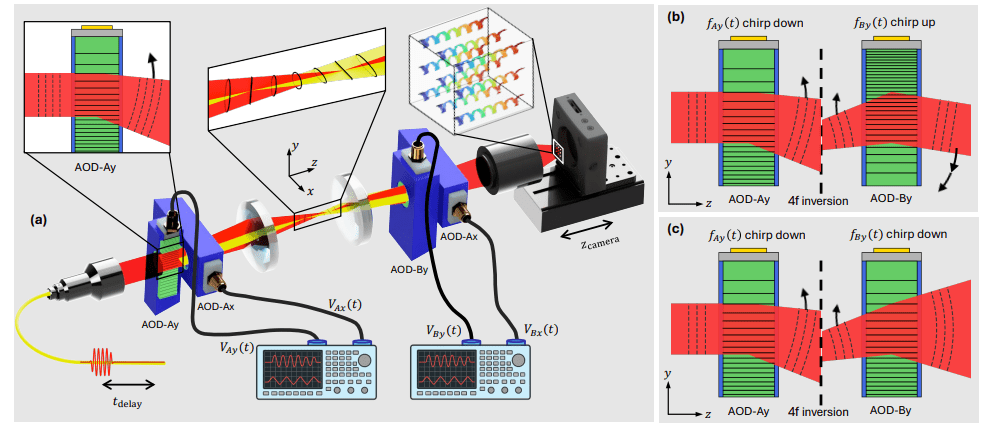
Simulations and observations show that uncompensated AOD lensing drastically reduces atom survival probability, necessitating longer transport times to prevent atom loss. In contrast, the 3D-AODL cancels astigmatism, maintaining the tweezer focus in-plane and enabling high-survival-probability translation for shorter durations. Monte Carlo simulations demonstrate that the 3D-AODL achieves substantially reduced motional heating with increasing transport times compared to conventional methods. Furthermore, the team introduced fading-Shepard waveforms that overcome limitations in AOD bandwidth, allowing for sustained axial displacement. By precisely controlling chirp rates across four AODs, the researchers achieved omnidirectional motion while maintaining a constraint that ensures the cancellation of induced cylindrical lenses. This technology promises to advance atom-array computers by boosting clock rates and enabling rapid sorting in geometries scalable to millions of qubits, paving the way for more powerful quantum computing architectures.
Fast, Stable 3D Atom Reconfiguration Achieved
This research demonstrates a significant advancement in the control of neutral atoms for applications such as quantum computing and simulation. Scientists have developed a three-dimensional acousto-optic deflector lens (3D-AODL) which overcomes limitations present in conventional atom reconfiguration techniques. By carefully manipulating sound waves, the team successfully cancelled acoustic lensing effects that previously distorted tweezer profiles and slowed atom transport. This innovative approach enables unrestricted three-dimensional motion within a substantial volume, achieving tweezer velocities exceeding 4.
2 meters per second. The 3D-AODL utilises counter-chirping of paired acousto-optic deflectors to maintain a stable focal plane and eliminate astigmatism, a common issue in previous methods. Simulations and experiments confirm that this technique significantly improves both atom survival rates and reduces motional heating during transport, allowing for faster and more reliable atom rearrangement. The technology promises to advance atom-array computers by boosting clock rates and enabling rapid sorting of qubits in scalable architectures.
👉 More information
🗞 Astigmatism-free 3D Optical Tweezer Control for Rapid Atom Rearrangement
🧠 ArXiv: https://arxiv.org/abs/2510.11451