

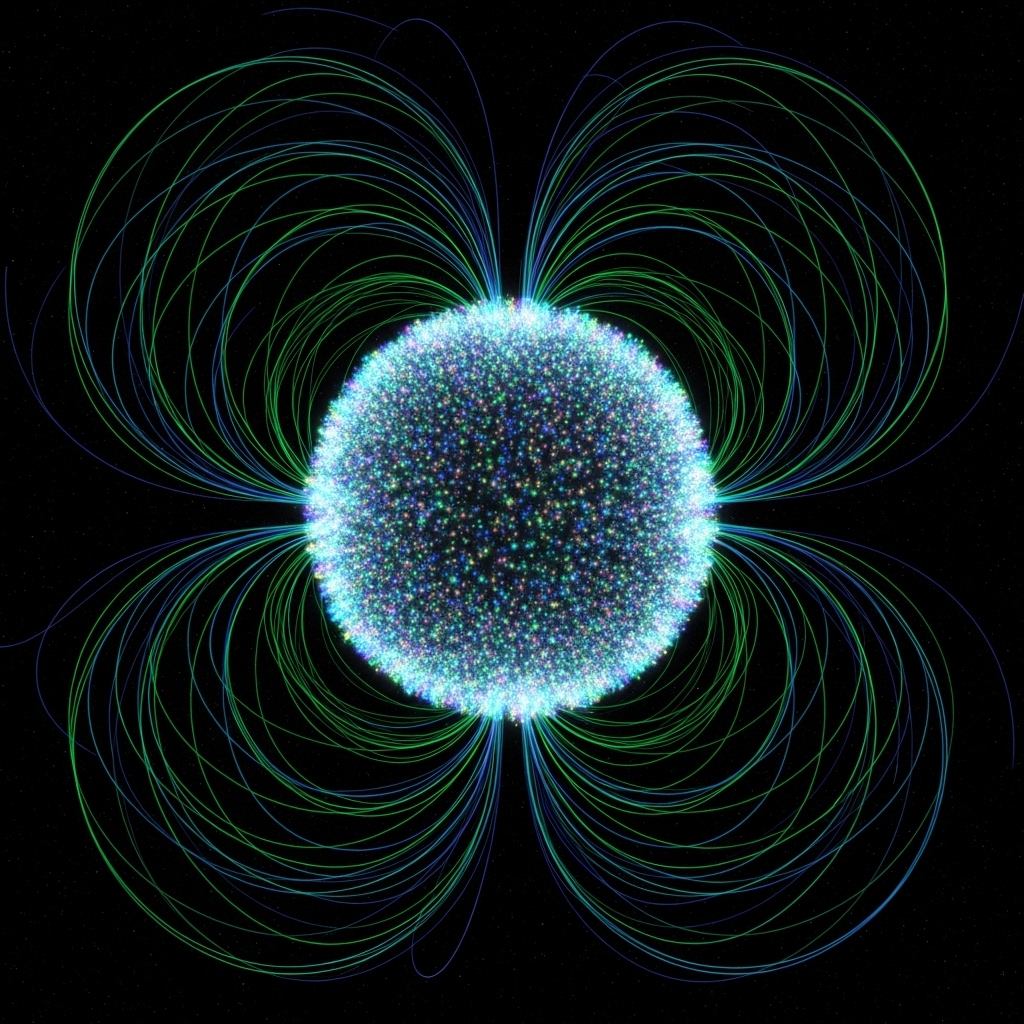
Researchers have, for the first time, experimentally demonstrated a synthetic Hall torus using a spinor Bose-Einstein condensate trapped in a ring-shaped configuration and observed using in situ imaging. Led by T. -H. Chien, S. -C. Wu, and Y. -H. Su from the Institute of Atomic and Molecular Sciences, Academia Sinica, and working with colleagues including L. -R. Liu, N. -C. Chiu, M. Sarkar, Q. Zhou, and Y. -J. Lin from both the Institute of Atomic and Molecular Sciences, Academia Sinica and National Tsing Hua University, this collaborative effort imposed a periodic boundary condition in a synthetic dimension by cyclically coupling hyperfine spin states. This innovative approach realises a toroidal geometry with synthetic magnetic flux, inducing unique azimuthal density modulations within the condensate and effectively emulating a Thouless charge pump. The ability to control and investigate these modulations as the system transitions between cylindrical and toroidal topologies establishes a novel and versatile platform for exploring Hall physics and topological phenomena in uniquely designed, synthetic curved spaces.
Scientists have created a novel system mimicking exotic states of matter found in two-dimensional materials. This breakthrough utilises a super-cooled gas to simulate complex magnetic fields and curved spaces, opening new avenues for exploring fundamental physics and potentially informing future materials science. Researchers have experimentally created a synthetic Hall torus using a spinor Bose-Einstein condensate, a state of matter formed when bosons are cooled to near absolute zero and trapped in a ring-shaped configuration.
This achievement circumvents the limitations of creating such a geometry with conventional materials, which requires threading magnetic flux through a torus, an impossible feat given the absence of magnetic monopoles. Instead, scientists imposed a periodic boundary condition using internal atomic states, effectively constructing a toroidal geometry within a synthetic dimension alongside the physical ring trap.
This innovative approach induces distinctive azimuthal density modulations within the condensate, a key signature of the Hall torus geometry, and allows for precise control over the system’s topological properties. The work establishes a new platform for investigating fundamental quantum phenomena in curved and topologically complex spaces. By cyclically coupling three hyperfine spin states via Raman and microwave fields, the team engineered a synthetic magnetic flux that directly manifests as density variations in the condensate.
The periodicity of these modulations is uniquely determined by the quantized flux, confirming the toroidal shape. Manipulating the relative phase between the coupling fields allows emulation of the Thouless charge pump, a topological effect where charge is transported without dissipation, within the synthetic torus. Further investigation revealed how these modulations emerge as the system transitions from a cylindrical to a toroidal topology, offering insights into the formation of topological order.
The ability to dynamically control the boundary conditions in the synthetic dimension opens avenues for exploring non-equilibrium phenomena and the emergence of complex quantum states. This synthetic Hall torus represents a significant step towards understanding quantum Hall physics and topological phenomena in highly controllable, artificial environments, potentially paving the way for novel quantum technologies and simulations.
Spinor condensate manipulation creates synthetic magnetic flux in a toroidal geometry
In situ imaging of a spinor Bose-Einstein condensate underpins the realisation of a synthetic Hall torus. A ring-shaped optical trap confines the condensate, establishing the real-space geometry of the torus with a radius of approximately 14 micrometres. A synthetic dimension is created by exploiting the three hyperfine spin states of the condensate atoms.
These states are coupled cyclically using a combination of Raman and microwave fields, effectively imposing a periodic boundary condition along this synthetic dimension and generating a synthetic magnetic flux threading the toroidal geometry. The Raman coupling simultaneously alters both the spin state of the atoms and their centre-of-mass orbital angular momentum, inducing coherent interference between different angular momentum wavefunctions.
By manipulating the relative phase between these couplings, the location of density extrema within the condensate is precisely controlled, mimicking the behaviour of a Thouless charge pump in a toroidal configuration. The onset of azimuthal density modulations, a key signature of the Hall torus, is investigated as the system transitions from a cylindrical to a toroidal topology.
This approach circumvents the limitations of creating a true toroidal geometry with a real magnetic field, as magnetic monopoles do not exist in nature. The use of in situ imaging allows direct observation of these density modulations, uniquely determined by the quantized toroidal magnetic flux and confirming the formation of the synthetic Hall torus.
Observation and control of density modulations confirm a synthetic Hall torus
Azimuthal density modulations, a key signature of the Hall torus geometry, were directly observed in the condensate with a periodicity uniquely determined by the quantized toroidal magnetic flux. In situ imaging revealed the presence of two distinct density minima along the azimuthal direction of the ring-shaped trap, a feature absent when the synthetic dimension possessed open boundary conditions.
This observation confirms the successful creation of a synthetic Hall torus within the Bose-Einstein condensate. By varying the relative phase between microwave and Raman fields, the azimuthal position of these density modulations was precisely controlled, emulating the behaviour of a Thouless charge pump on a toroidal geometry and demonstrating the ability to manipulate the system’s topological properties.
The experimental setup employed a ring-shaped trap with a radius of approximately 14μm, constructed using a non-uniform spatial profile of the Raman coupling. A microwave field, resonantly coupling specific spin states at a strength of 3.15kHz, further refined the control over the synthetic dimension. The Raman coupling strength exhibited an approximately cylindrical symmetry with a maximum at a radial position of 17μm and a frequency of 3.8kHz.
This combination of techniques enabled the dynamic switching of boundary conditions in the synthetic dimension, allowing investigation of the emergence of density modulations as the system transitioned to a toroidal topology. The observed density modulations provide compelling evidence for the successful realization of a synthetic Hall torus and a versatile platform for exploring quantum Hall physics.
Engineered quantum states simulate topological effects within an atomic condensate
Scientists have, for the first time, created a synthetic Hall torus within a Bose-Einstein condensate, subtly advancing the quest to understand topological phenomena. For years, manipulating quantum systems into non-trivial geometries has remained largely a theoretical exercise, hampered by the difficulty of precisely controlling matter at the atomic scale.
This experiment bypasses many of those limitations by creating a torus not in physical space, but through the internal states of the atoms themselves, a clever use of spin and laser manipulation. This work offers a uniquely controllable platform for exploring fundamental concepts in condensed matter physics, such as the Thouless charge pump, which describes the movement of electrons in materials with strong magnetic fields.
Being able to emulate these effects in a synthetic system allows researchers to isolate and study specific behaviours without the complexities of real materials. The ability to tune the ‘magnetic flux’ within this artificial torus is particularly noteworthy, opening doors to investigations of how topology influences quantum transport. Simulations reveal discrepancies between predicted and observed behaviour at longer timescales, suggesting that factors like atomic interactions and subtle asymmetries in the trap are playing a role.
Fully understanding these effects will be crucial for scaling up the system and achieving more complex topological states. Looking ahead, this approach could be extended to create even more exotic synthetic geometries, potentially mimicking the behaviour of materials with entirely new and unforeseen properties. The convergence of quantum simulation and synthetic matter design promises a new era of materials discovery, where the laboratory is no longer constrained by the limitations of the natural world.
👉 More information
🗞 Realization of a Synthetic Hall Torus with a Spinor Bose-Einstein Condensate
🧠 ArXiv: https://arxiv.org/abs/2602.14549