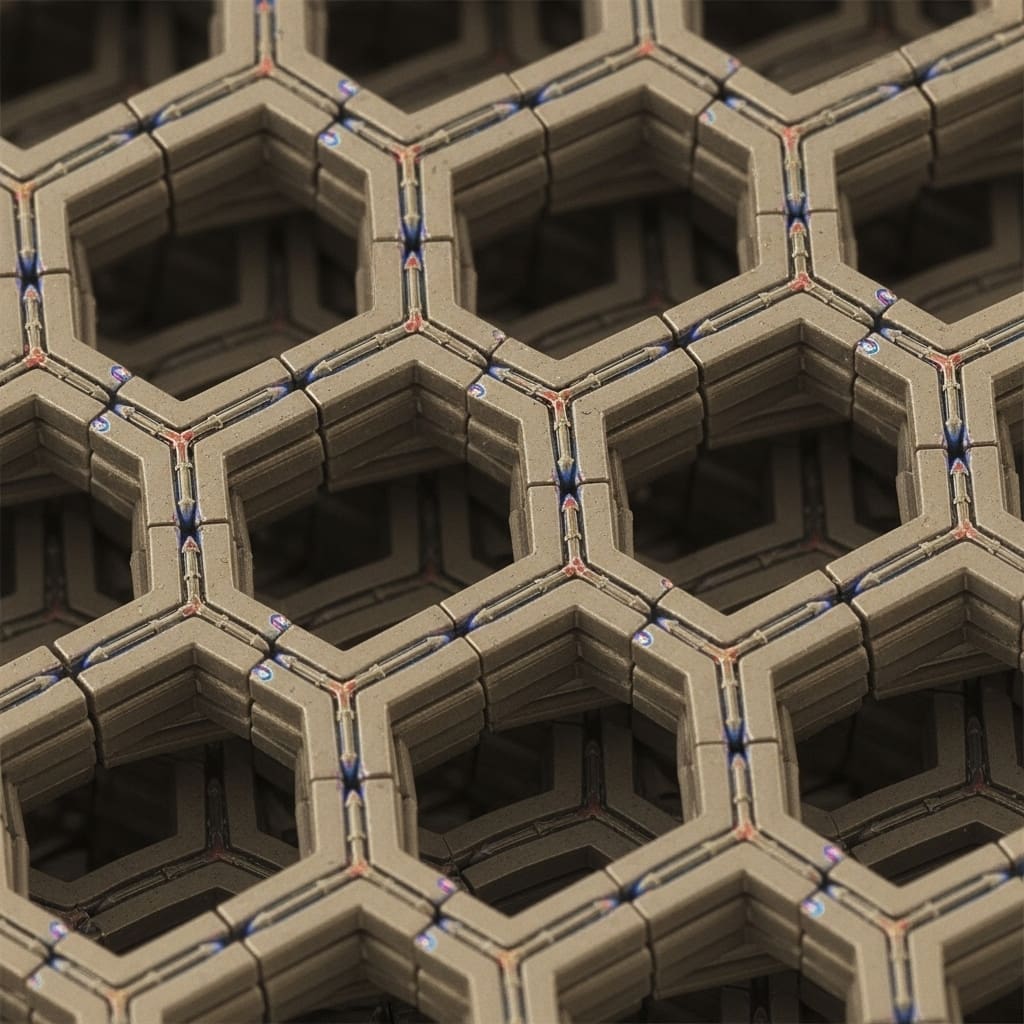
Artificial spin ices offer researchers a powerful means to investigate magnetic frustration and the resulting emergent phenomena, yet achieving the ground state in kagome artificial spin ice has proven remarkably difficult due to the system’s tendency to become locked in a disordered state. Now, D. Pecchio, S. Sahoo, V. Scagnoli, and L. J. Heyderman demonstrate a deterministic and remarkably swift method for rewriting the magnetic state and attaining the ground state using precisely targeted laser pulses. The team engineered the system to absorb laser energy differently across its sublattices, allowing them to selectively demagnetize one portion of the material under a weak magnetic field and drive the entire system into its lowest energy configuration in a single step. This achievement, confirmed by magnetic force microscopy and heat-transfer simulations, establishes a new, ultrafast approach to control kagome artificial spin ice without altering its fundamental design, and opens exciting possibilities for reconfigurable magnonic devices and advanced nanomagnetic logic.
Thermal Control of Artificial Spin Ice Structures
Research focuses on Artificial Spin Ice (ASI), nanostructured magnetic materials that mimic natural spin ice and exhibit geometric frustration. Scientists are exploring ASI for potential applications in neuromorphic computing, data storage, and fundamental studies of emergent magnetic phenomena. Current investigations explore how temperature and laser annealing affect ASI structures, including thermal relaxation, defect creation and annihilation, and phase transitions. Researchers also utilise ultrafast lasers to demagnetize, remagnetize, and control magnetic relaxation within ASI structures. Efforts are underway to optimize the geometry of ASI structures, control interactions between magnetic elements, and create structures with specific properties. ASI structures exhibit complex magnetic behaviour, including fragmentation and phase transitions, and show promise as building blocks for artificial neurons and synapses in neuromorphic computing. Techniques employed include ultrafast laser spectroscopy to study magnetization dynamics, microscopy to visualize structure and magnetic properties, and simulations to model behaviour and predict properties.
Selective Laser Annealing Reaches Ground State
Researchers have developed a new method to achieve the ground state of kagome artificial spin ice (ASI) using ultrafast, site-selective laser annealing. This technique overcomes the challenge of dynamical freezing by precisely controlling the excitation of individual nanomagnets. Scientists engineered differences in optical absorption between sublattices by selectively capping nanomagnets with chromium or varying their thicknesses, enabling targeted demagnetization of one sublattice under a weak magnetic field. This approach drives the system into the ground state in a single step, avoiding the need to modify the ASI geometry or materials.
The experimental setup carefully controls laser pulses to selectively heat specific nanomagnets within the kagome lattice. By manipulating the absorption properties of individual nanomagnets, researchers partially demagnetize one sublattice while leaving the other relatively unaffected, overcoming energetic barriers that typically prevent the system from reaching its lowest energy configuration. Heat-transfer simulations confirm the sublattice-selective excitation mechanism, demonstrating that the laser annealing process effectively targets the desired nanomagnets. Magnetic force microscopy then characterizes the resulting magnetic ordering, revealing nearly perfect long-range order throughout the ASI, confirming successful ground state attainment. This establishes a powerful new technique for controlling magnetic states in ASIs, opening avenues for reconfigurable magnonic crystals, neuromorphic computing, and programmable nanomagnetic logic.
Kagome Artificial Spin Ice Ground State Control
Scientists have demonstrated a deterministic and rewritable method to achieve the ground state of kagome artificial spin ice (ASI) using ultrafast, site-selective laser annealing. This work establishes a technique for controlling the magnetic states of these complex systems without altering their fundamental geometry or materials. The team achieved selective partial demagnetization of one sublattice under a weak magnetic field, driving the system into its ground state in a single switching step. Magnetic force microscopy revealed nearly perfect long-range ordering across the scanned regions, confirming successful ground state attainment.
Researchers engineered sublattice-dependent absorption through two distinct approaches: selective capping with chromium and modification of nanomagnet thickness. The chromium-capping method utilizes higher optical absorption in chromium compared to aluminum, enabling targeted laser activation of specific sublattices while preserving magnetic equivalence. Heat-transfer simulations confirmed this sublattice-selective excitation mechanism, supporting the deterministic writing of kagome ASI ground states over large areas. Simulations indicated that the temperature of permalloy remained below 770 K, retaining sufficient residual magnetization to prevent reversal under the applied field.
An alternative approach fabricated one sublattice with 8nm thick permalloy nanomagnets and the other with 14nm thick nanomagnets. Simulations of temperature profiles under laser irradiation revealed that the thicker permalloy layer retained substantial residual magnetization, while the thinner nanomagnets approached the Curie temperature and underwent almost complete demagnetization. This difference in thermal response enabled laser-assisted reversal of the thinner nanomagnets, again resulting in a magnetic configuration closely resembling the spin-crystal ground state. Both methods delivered almost perfect long-range ordered magnetic states, comparable to those achieved by modifying the ASI geometry itself. This ultrafast laser annealing technique offers new opportunities for constructing input-selective nanomagnetic logic circuits and neuromorphic computing architectures, where individual nanomagnets can be addressed at specific laser fluences. Furthermore, this approach provides a route to design reprogrammable magnonic crystals capable of encoding specific magnetic states and tuning spin-wave spectra at ultrafast timescales.
Kagome Ice Ground State Achieved by Laser Annealing
This work demonstrates a deterministic and rewritable method for achieving the ground state of kagome artificial spin ice, utilising ultrafast, site-selective laser annealing. Researchers successfully drove the system into its ground state by engineering differences in optical absorption between sublattices, enabling targeted magnetization reversal under relatively weak magnetic fields. This control was achieved through either selective capping with chromium or by varying the thickness of the nanomagnets, both implemented using standard nanofabrication techniques. Magnetic force microscopy confirmed the creation of nearly perfect long-range magnetic order, and heat transfer simulations validated the mechanism of sublattice-selective excitation.
While the chromium capping method preserves the inherent magnetic equivalence and frustration within the system, the thickness-based approach, though lifting the degeneracy of low-energy states, offers a simpler route to deterministic switching without additional materials. Both methods yielded magnetic states comparable to those achieved by modifications to the kagome lattice geometry itself. This establishes ultrafast laser annealing as a versatile tool for controlling frustrated nanomagnetic systems over extended areas, opening possibilities for advanced applications including reconfigurable magnonic crystals, neuromorphic computing, and programmable nanomagnetic logic.
👉 More information
🗞 Attaining the Ground State of Kagome Artificial Spin Ice via Ultrafast Site-Specific Laser Annealing
🧠 ArXiv: https://arxiv.org/abs/2510.17416