Scientists at National Tsing Hua University, led by Ching-Yeh Chen, have demonstrated a time-delayed coherent feedback system utilising a superconducting qubit, revealing pronounced non-Markovian effects. The system challenges the conventional Markovian approximation routinely employed in quantum electrodynamics, which traditionally assumes systems are “memoryless”. Introducing a feedback loop with delays comparable to qubit relaxation times significantly modifies the resonance fluorescence spectrum, including the first experimental observation of Mollow triplets in a non-Markovian regime. These findings hold the potential to improve existing quantum technologies, such as large-scale quantum networks and quantum information processing, and unlock a deeper understanding of novel quantum phenomena.
Observation of Mollow triplets reveals non-Markovian effects in a superconducting qubit system
Mollow triplets, a characteristic signature of resonance fluorescence, have been observed for the first time within a non-Markovian regime. This was achieved through a feedback loop delay comparable to the qubit relaxation time. Traditionally, the observation of these triplets necessitated the Markovian approximation, which effectively treats a quantum system as “memoryless” and provides limited insight into scenarios where past states influence present behaviour. This approximation simplifies calculations but breaks down when the system’s history becomes relevant, particularly when retardation effects, delays in the interaction, are significant. When the delay exceeds approximately 0.1 times the qubit lifetime, pronounced non-Markovian effects emerge, substantially altering the standard resonance fluorescence spectrum. The standard Mollow triplet arises from the superposition of different excitation pathways within the qubit, creating three distinct peaks in the emitted light spectrum. Deviation from this pattern indicates a departure from Markovian behaviour.
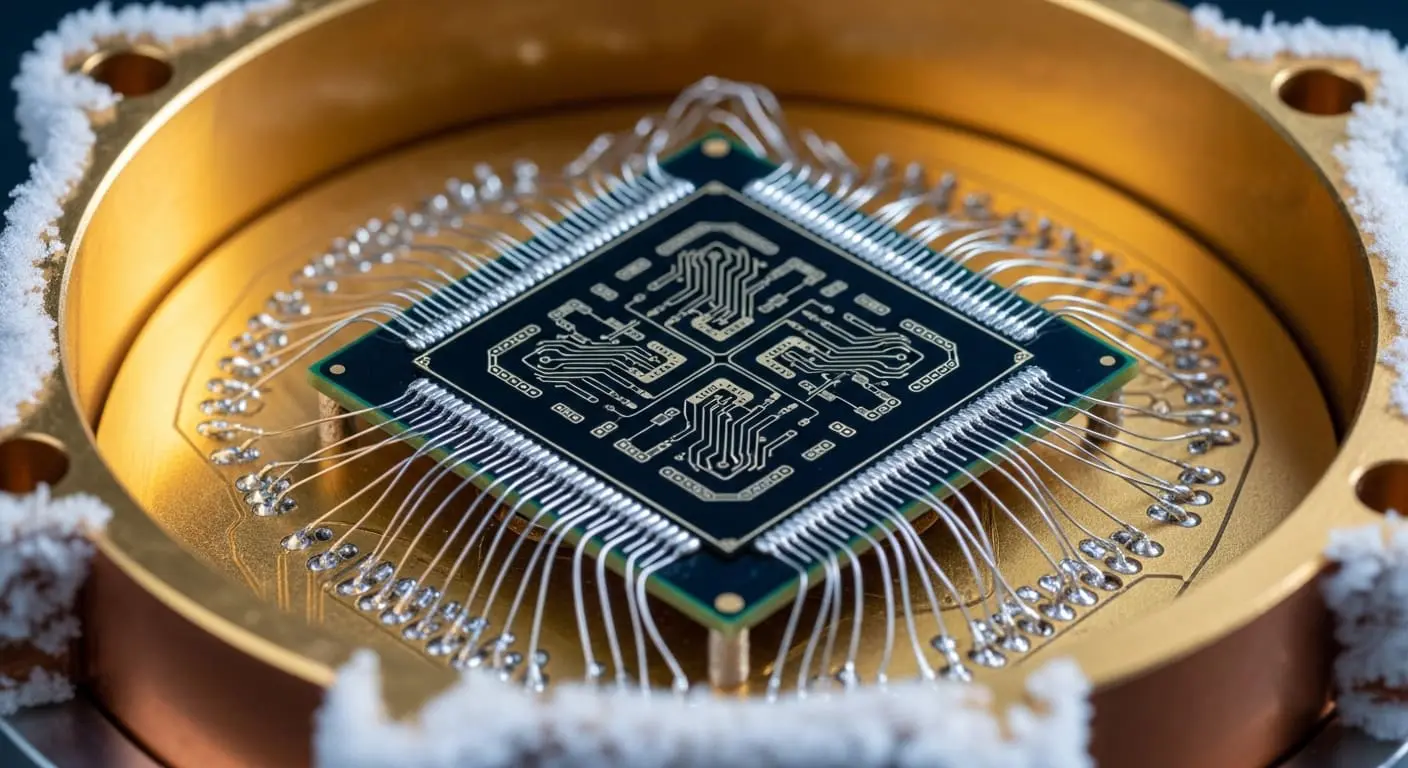
A team of researchers engineered a superconducting circuit incorporating a transmon qubit and a deliberately introduced delay, enabling the observation of these altered spectral features and opening avenues for manipulating quantum systems with precisely timed feedback. The transmon qubit, functioning as an artificial atom, allows for precise control and measurement of quantum states. Detailed analysis of the resonance fluorescence spectrum revealed modifications to the standard Mollow triplet, a pattern of light scattering indicative of qubit excitation. Specifically, simulations and experiments conducted with the transmon qubit demonstrated suppression of the Mollow triplet side-peaks and the emergence of new resonances attributable to the delayed feedback. This was achieved by designing a superconducting circuit with a carefully calibrated round trip length to create a delay comparable to the qubit’s relaxation rate of Γ, and a round trip phase change of φM equal to π. This precise control over the delay allowed for a detailed investigation of how the delay impacts spectral characteristics, providing crucial insights into the underlying physics of non-Markovian systems and the role of quantum memory. The suppression of side-peaks suggests that the delayed feedback interferes with the usual excitation pathways, while the new resonances indicate the creation of novel quantum states influenced by the system’s past.
Engineered Waveguide Delay Controls Qubit Relaxation in Superconducting Circuit
A deliberate time delay in a quantum system’s feedback loop proved central to this work. The team engineered a superconducting circuit containing a transmon, an “artificial atom” behaving as a fundamental unit of quantum information. This transmon was coupled to a waveguide, a microscopic channel designed to guide microwave signals, with a mirror strategically positioned to reflect signals back towards the qubit. This configuration created a closed loop for the microwave photons, allowing for controlled interaction with the qubit. The approach fundamentally differed from conventional modelling, which often assumes instantaneous coupling, thereby enabling the investigation of non-Markovian effects. Scientists meticulously controlled the length of the waveguide to introduce a specific delay, comparable to the qubit’s natural relaxation time, into the feedback loop. The relaxation time, denoted as T1, represents the average time it takes for a qubit to decay from an excited state to its ground state. By matching the delay to T1, the researchers ensured that the qubit’s “memory” of past interactions significantly influenced its present state. The team utilised a quantum trajectory method to simulate the system, a numerical technique that accounts for the stochastic nature of quantum measurements and the continuous evolution of the qubit’s state. They also accounted for pure dephasing and radiative loss within the qubit to refine comparisons between simulations and experimental data, substantially improving the accuracy of the model and validating the observed non-Markovian behaviour.
Qubit memory effects and their implications for advanced quantum systems
Scientists are increasingly acknowledging the delays inherent in light-matter interactions, potentially unlocking improvements in quantum technologies such as networks and processors. The ability to accurately model and control these interactions, moving beyond the Markovian approximation, is crucial for developing more sophisticated quantum devices. Achieving reliable control over these “memory” effects, where a qubit’s past interactions demonstrably influence its present behaviour, presents a considerable technological hurdle. The team acknowledges that scaling these time-delayed feedback systems to more complex quantum architectures is a significant challenge, particularly mitigating environmental noise and maintaining qubit coherence, the ability of a qubit to maintain its quantum state over time. Decoherence, the loss of quantum information, is a major obstacle in building practical quantum computers.
These experiments demonstrate a fundamental principle: qubits possess a “memory” of past interactions, influencing their current behaviour. This memory arises from the finite time it takes for photons to travel within the feedback loop, allowing the qubit to “remember” previous excitation events. Understanding these time-delayed effects allows for potential improvements in quantum networks, enabling more reliable data transmission through enhanced error correction and in quantum processors, boosting computational power by exploiting the qubit’s memory. Further research will focus on optimising these effects for practical applications, fundamentally altering how light and matter interact at the quantum level and potentially leading to the development of entirely new quantum technologies. The ability to engineer and control non-Markovian effects could pave the way for quantum devices with enhanced performance and functionality.
By engineering a superconducting circuit containing a transmon, a deliberate delay was induced in the feedback loop, revealing pronounced non-Markovian effects. These effects, where a qubit’s past influences its present, were confirmed by observing Mollow triplets within this non-Markovian regime for the first time. The ability to manipulate quantum systems with precisely timed feedback opens questions regarding the potential for improved quantum networks and processors, paving the way for future investigations into complex quantum phenomena and a deeper understanding of the fundamental nature of quantum interactions.
The researchers demonstrated non-Markovian effects in a transmon qubit embedded in a superconducting circuit, revealing that a qubit’s past interactions can influence its present behaviour. This finding is important because the standard model of light-matter interaction assumes systems are “memoryless”, an approximation that does not hold true when considering time delays. By introducing a feedback loop with a delay time comparable to the qubit’s relaxation time, they observed modified resonance fluorescence spectra and, crucially, the first experimental evidence of Mollow triplets in the non-Markovian regime. The authors intend to optimise these effects, potentially improving quantum networks and processors.
👉 More information
🗞 Resonance fluorescence of an artificial atom with a time-delayed coherent feedback
🧠 ArXiv: https://arxiv.org/abs/2603.28004